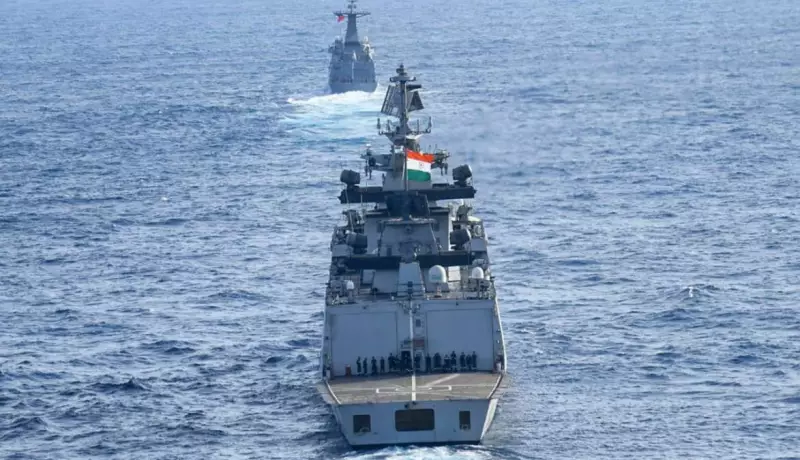
India's journey to becoming a formidable naval power is deeply intertwined with the story of its aircraft carriers. From the historic INS Vikrant to the ambitious future of INS Vishal, these floating airbases represent the nation's strategic vision and growing industrial capability. The evolution marks a shift from dependence on foreign acquisitions to the pride of indigenous design and construction.
The Legacy of INS Vikrant: India's First Step
The foundation of India's carrier aviation was laid with INS Vikrant (R11), the nation's first aircraft carrier. Originally the British HMS Hercules, it was purchased by India in 1957 and commissioned into the Indian Navy on March 4, 1961. This Majestic-class carrier played a pivotal role in the 1971 war with Pakistan, where its Sea Hawk aircraft enforced a naval blockade on East Pakistan, contributing significantly to India's victory.
After decades of service, the iconic vessel was decommissioned in 1997. It was later preserved as a museum ship in Mumbai until 2012, before finally being sold for scrap in 2014. The name 'Vikrant', meaning 'courageous' or 'victorious', was destined to live on, passing to a new indigenous champion.

The Indigenous Leap: INS Vikrant (IAC-1)
In a monumental leap for Indian defence manufacturing, the name Vikrant was reborn with Indigenous Aircraft Carrier 1 (IAC-1). This project signified India's entry into an elite club of nations capable of designing and building their own aircraft carriers. The keel was laid in 2009 at Cochin Shipyard Limited (CSL) in Kerala.
The carrier was launched in 2013 and commenced basin trials in 2020. After extensive sea trials, it was formally commissioned into the Indian Navy by Prime Minister Narendra Modi on September 2, 2022. The new INS Vikrant is a testament to Indian engineering, with over 76% of its materials and equipment sourced domestically.
Key specifications of INS Vikrant (IAC-1) include:
- A displacement of approximately 45,000 tonnes.
- Length of 262 meters, making it the largest warship ever built in India.
- Powered by four General Electric LM2500+ gas turbines.
- Capable of carrying up to 30 aircraft, including MiG-29K fighters, Kamov Ka-31 helicopters, and soon, the indigenously developed HAL TEDBF.
- It utilizes a Short Take-Off but Arrested Recovery (STOBAR) system with a ski-jump ramp.
Its induction created a two-carrier battle group for the Indian Navy, ensuring that at least one carrier is always operationally available while the other undergoes maintenance.
The Future: INS Vishal (IAC-2) and Technological Ambitions
Looking ahead, the Indian Navy has set its sights on an even more advanced and powerful vessel: INS Vishal (IAC-2). This proposed carrier represents the next generation of Indian naval ambition, aiming to bridge the technological gap with global superpowers.
While still in the planning and design phase, INS Vishal is envisioned to be a significantly larger carrier, with a proposed displacement of 65,000 tonnes or more. The most critical technological leap under consideration is the shift from the STOBAR system to the more advanced Electromagnetic Aircraft Launch System (EMALS), similar to that used on the latest US carriers.
An EMALS system would allow the carrier to launch a wider variety of heavier aircraft, including future Airborne Early Warning and Control (AEW&C) planes and unmanned combat aerial vehicles (UCAVs), with greater efficiency and less stress on the airframes. This would dramatically enhance the carrier's strike capability and operational flexibility. The project underscores India's long-term goal of developing a true blue-water navy capable of sustained power projection across the Indo-Pacific region.
Strategic Importance and the Road Ahead
The journey from Vikrant to Vishal is not merely about building bigger ships; it is a strategic imperative. Aircraft carriers are the ultimate symbols of maritime power and sovereignty. In the vast expanse of the Indian Ocean Region, they provide mobile airfields, extending India's defensive perimeter and enabling rapid response to threats far from its shores.

They serve as a potent deterrent, a command center for fleet operations, and a platform for humanitarian assistance and disaster relief (HADR) missions. The indigenous construction of these giants also fuels the national economy, creating thousands of skilled jobs and driving technological innovation across hundreds of ancillary industries.
The path forward for INS Vishal involves complex decisions regarding its final design, propulsion (with considerations for nuclear power), and aircraft complement. Funding and timely approvals will be crucial. However, the successful delivery of INS Vikrant (IAC-1) has proven India's fundamental capability. The journey of India's aircraft carriers, from a bought British hull to a future indigenous supercarrier, mirrors the nation's own trajectory: evolving from a regional maritime force into a confident, self-reliant naval power with global aspirations.