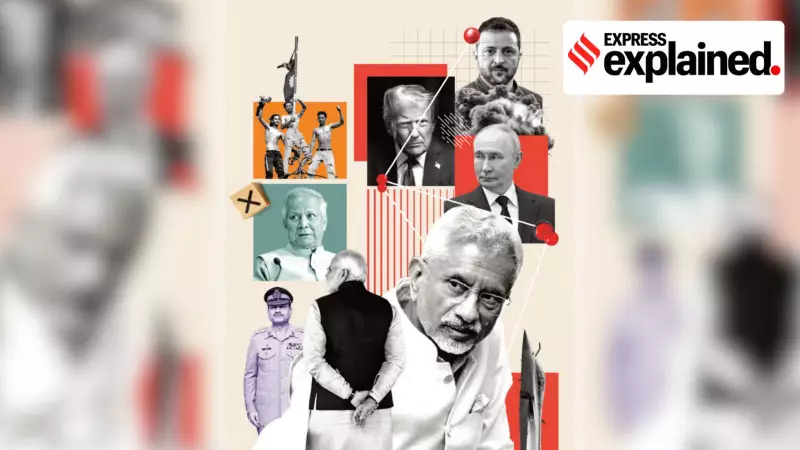
The year 2025 witnessed the dramatic unravelling of the global order that had held firm for eight decades. With the full force of US President Donald Trump's second-term policies reshaping alliances and conflicts raging from Ukraine to Gaza, India navigated a perilous geopolitical landscape. As the nation steps into 2026, it faces a defining moment, balancing strategic autonomy with global ambitions amidst high-stakes diplomacy, trade tensions, and regional instability.
A Year of Rupture and Recalibration: Key Events of 2025
The US-India relationship under Trump 2.0 took a sharp downturn. Initial optimism after Trump's re-election, marked by early engagement and the start of trade talks, faded rapidly. Relations soured after Trump claimed credit for halting the India-Pakistan conflict and imposed steep 50% tariffs on Indian goods. This forced India to reduce oil imports from Russia, and while trade negotiations continue, strategic trust has been significantly damaged.
Closer to home, a brief but lethal conflict with Pakistan following the April 22 terror attack in Pahalgam led to a four-day military action, Operation Sindoor. India established a firm redline, declaring that nuclear blackmail would not be tolerated and any future terror attack would be treated as an act of war. The year ended with another terror incident near Delhi's Red Fort, but India exercised restraint. Meanwhile, Pakistan's Army Chief, Asim Munir, consolidated power by anointing himself Field Marshal, gaining legal immunity.

India's neighbourhood witnessed significant churn. In Nepal, a Gen Z-led protest movement ousted the ruling establishment over corruption and nepotism, leading to an interim government under former Chief Justice Sushila Karki. In Bangladesh, unrest continued nearly 18 months after Sheikh Hasina's ouster, with an interim government facing legitimacy crises ahead of promised 2026 polls.
Strategic Autonomy in Action: Outreach to China, Russia, and Canada
As ties with Washington frayed, India actively asserted its strategic independence. Prime Minister Narendra Modi met Chinese President Xi Jinping and Russian President Vladimir Putin at the SCO summit in Tianjin and later hosted Putin for a bilateral visit, a move that unsettled European partners.
Re-engagement with China saw practical steps like the removal of visa curbs and restoration of direct flights post the October 2024 Kazan summit. However, a significant military standoff persists, with roughly 50,000 troops remaining deployed on each side of the Line of Actual Control.
A reset began with Canada under new Prime Minister Mark Carney, after two tense years stemming from allegations over the killing of Khalistan separatist Hardeep Singh Nijjar. Both sides agreed to firewall political and economic ties from the investigation, restoring visas and diplomatic staffing.
The 2026 Agenda: High-Stakes Diplomacy and Critical Choices
The trajectory of India-US relations hinges on concluding a trade deal and navigating Trump's unpredictability, including his potential mediation ambitions between India and Pakistan. The role of new US Ambassador Sergio Gor will be crucial.
Europe moves into sharp focus for Indian diplomacy. India is set to host EU leaders Ursula von der Leyen and Antonio Costa as chief guests for the Republic Day parade—a first. Visits by German Chancellor Friedrich Merz in January and French President Emmanuel Macron in February will solidify this engagement. New Delhi is also negotiating a significant trade deal with the European Union.
India's BRICS presidency this year, with expected participation from Putin and Xi, will be a major event. Concurrently, Delhi aims to host a Quad leaders' summit, potentially with Trump visiting. These parallel summits will test India's ability to balance competing alliances and showcase its convening power.
Other key events include hosting an Artificial Intelligence Impact Summit in February to showcase technological prowess, and potentially holding the next India-Africa Forum Summit to build on goodwill from the AU's G20 inclusion.

Neighbourhood on Edge and Global Flashpoints
The uneasy pause with Pakistan means Delhi remains on high alert, with any future terror attack linked to Pakistan demanding a major military and diplomatic response. Elections in Nepal and Bangladesh will be critical for regional stability, with risks of elite recapture or undermined credibility.
Globally, India will closely watch the US-China détente, especially their battle for dominance in AI and semiconductors—a sector where India is a new entrant. Delhi is also deeply invested in Ukraine peace talks, discussing a potential visit by President Zelenskyy, and holds a stake in reviving the India-Middle East-Europe Economic Corridor (IMEC), contingent on lasting West Asia peace.
In a fractured global order, India enters 2026 walking a tightrope. Its choices on trade, neighbourhood management, and great-power engagement will profoundly shape not only its global standing but also the stability of the region. The room for error is minimal.