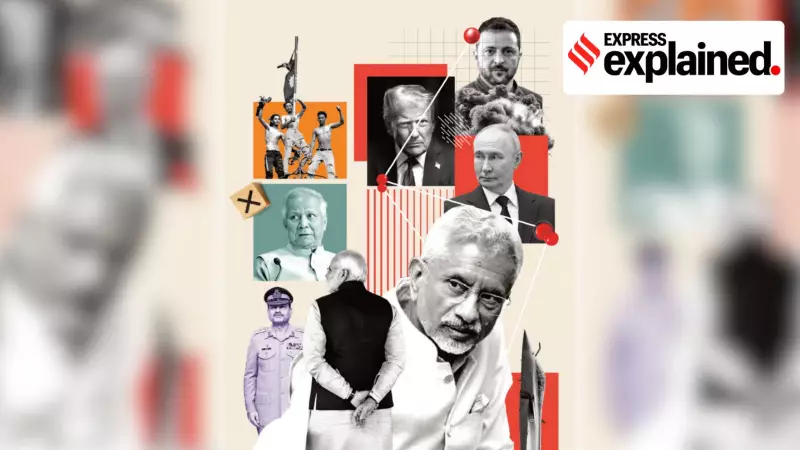
The year 2025 witnessed the dramatic fracturing of the post-World War II global order, forcing India to navigate a landscape of conflict, economic pressure, and strategic recalibration. As New Delhi steps into 2026, its diplomatic choices on trade, volatile neighbours, and relationships with great powers will critically shape its global standing and regional stability. The path ahead demands a delicate balance between strategic autonomy, necessary alignments, and national ambition, with minimal margin for error.
A Tumultuous 2025: The Rupture and Recalibration
The global framework that held for eight decades faced explosive pressures in 2025, largely driven by US President Donald Trump's second-term policies. For India, the year was marked by a brief but lethal conflict with Pakistan, drawing new redlines against terror and nuclear blackmail. The prolonged shadows of the Russia-Ukraine and Gaza wars continued to loom large over international affairs.
Amidst the challenges, India secured some diplomatic positives. Ties with Europe saw improvement, and cautious re-engagement began with both Canada and China, even though the root causes of past strains persist. The relationship with the United States, however, deteriorated sharply after initial optimism. Trump's imposition of 50% tariffs—the highest on any nation—and his claims of credit for halting the India-Pakistan war severely impacted strategic trust, though trade negotiations continue.

In the neighbourhood, Pakistan's political landscape shifted as Army Chief Asim Munir anointed himself Field Marshal, consolidating power. Nepal witnessed a Gen Z-led uprising against corruption, leading to an interim government under former Chief Justice Sushila Karki. Bangladesh remained in turmoil ahead of its 2026 polls, with tensions with India simmering after a year of unrest.
Key Diplomatic Fronts for India in 2026
The coming year presents a series of high-stakes tests across multiple domains:
1. The US Equation: Thaw or Further Turbulence?
The trajectory of India-US relations hinges on the outcome of ongoing trade talks and India's ability to manage Trump's unpredictability, including his potential mediation ambitions between India and Pakistan. The role of the new US Ambassador, Sergio Gor, will be pivotal. Much depends on whether a trade deal can be concluded to ease current tensions.
2. The European Pivot and Major Summits
India is set to energise ties with Europe in a significant way. For the first time, it will host EU leaders Ursula von der Leyen and Antonio Costa for Republic Day celebrations. Visits by German Chancellor Friedrich Merz in January and French President Emmanuel Macron in February will solidify this outreach. Concurrently, India is negotiating a major trade deal with the European Union.
On the multilateral stage, India's diplomatic dexterity will be tested as it hosts the BRICS summit, expected to be attended by Presidents Vladimir Putin and Xi Jinping. Simultaneously, New Delhi aims to host a Quad leaders' summit, contingent on a potential visit by President Trump. These events will be a clear demonstration of India's strategic autonomy and convening power.
3. The Perilous Neighbourhood
The pause in Operation Sindoor has left the door for confrontation with Pakistan ajar. India remains on guard, and any future terror attack traced back to Pakistan will demand a significant military, political, and diplomatic response. The uneasy pause is fragile.
Elections in Nepal and Bangladesh will be critical for regional stability. Nepal will see if old elites yield to younger leaders or if monarchist-aligned groups gain ground. In Bangladesh, security concerns and the potential exclusion of the Awami League could challenge the credibility of the February 2026 polls.
Global Forums and Strategic Watchpoints
India will also leverage its technological prowess by hosting the second edition of the Artificial Intelligence Impact Summit in February, following the first edition in Paris. This platform will showcase India's capabilities in high-tech frontiers.

New Delhi will closely monitor the US-China détente, particularly their battle for dominance in AI and semiconductors—a sector where India is a new but ambitious entrant. Furthermore, having won goodwill by including the African Union in the G20, India plans to hold the next India-Africa Forum Summit to deepen engagement with the continent.
On the peacemaking front, India is deeply invested in the Ukraine peace process, discussing a potential visit by President Volodymyr Zelenskyy. In West Asia, a lasting Arab-Israel peace could revive the stalled India-Middle East-Europe Economic Corridor (IMEC).
In a fractured world, India's 2026 diplomatic agenda is overwhelmingly packed. Its ability to successfully host rival blocs, manage hostile neighbours, secure trade deals, and project leadership on issues like AI will define its position in the new global order. The year demands nimble statecraft where every move counts.