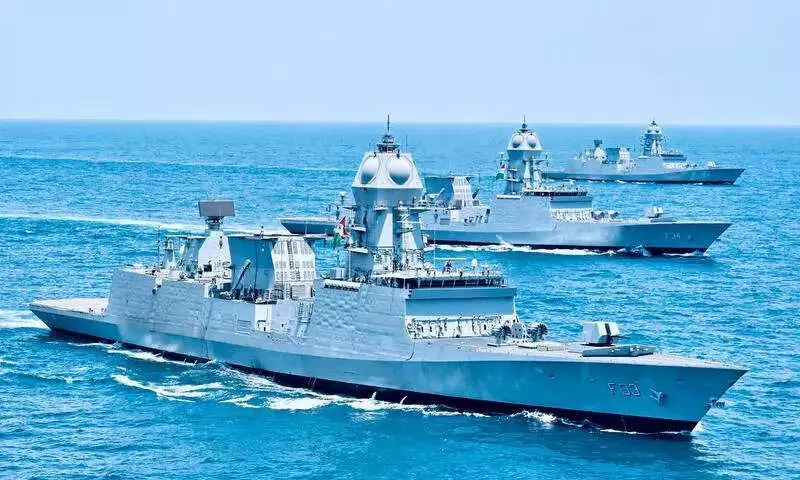
The Eastern Naval Command (ENC) of the Indian Navy, headquartered in Visakhapatnam, is poised for a significant capability upgrade with the planned addition of two new warships to its fleet in early 2026. This move follows a year of substantial inductions in 2025, underscoring a focused effort to bolster India's naval prowess along its eastern seaboard and across the wider Indian Ocean Region.
Major Fleet Expansion Underway
According to Vice Admiral Sanjay Bhalla, the Flag Officer Commanding-in-Chief of the ENC, the command has already commissioned six new warships in 2025. Two more vessels are slated for commissioning in January 2025, making it a total of eight new inductions for the Navy in that year. Out of these, six have been integrated directly into the Eastern Naval Command's operational roster.
Looking ahead, the ENC will welcome two more formidable platforms in January 2026. These are the Taragiri, a Nilgiri-class stealth guided-missile frigate, and the Anjadip, an anti-submarine warfare (ASW) shallow water craft. These inductions are part of a continuous process to modernize and expand the Navy's defensive and offensive capabilities.

Enhancing Multi-Dimensional Warfare Capabilities
The recent inductions have already delivered a major boost across various domains of naval warfare. Vice Admiral Bhalla highlighted that the anti-submarine warfare capacity in coastal waters has been strengthened with the induction of new ASW shallow water crafts, namely INS Arnala and INS Androth.
Furthermore, the surface combat fleet's readiness has seen a quantum leap. The induction of three advanced Nilgiri-class stealth frigates—INS Udaygiri, INS Himgiri, and INS Nilgiri—has substantially augmented the Navy's blue-water capability, allowing it to operate effectively in deep oceans.
In a specialized domain, the arrival of INS Nistar has provided a massive boost to the Navy's underwater rescue and diving proficiency. This niche capability places the Indian Navy among a select group of global navies possessing such advanced expertise.
Indigenous Technology and Broadened Operational Scope
A key feature of the newly inducted ships is their integration of state-of-the-art indigenous sensors and weapon systems. This not only underscores India's growing self-reliance in defense manufacturing but also ensures that the fleet is equipped with cutting-edge technology tailored to specific operational needs.
Vice Admiral Bhalla emphasized that these enhancements have collectively improved the ENC's ability to conduct persistent surveillance, maintain credible deterrence, and ensure robust maritime security. The command, with its full-spectrum capabilities in surface, subsurface, and air dimensions, continues to play a decisive role in safeguarding India's maritime interests.
Over the past year, the ENC's operational responsibilities have encompassed a wide array of missions. These include major deployments, multinational exercises, international cooperation initiatives, coastal security patrols, environmental projects, search and rescue missions, and humanitarian assistance and disaster relief (HADR) operations. These activities have also served to strengthen civil-military bonds in the region.