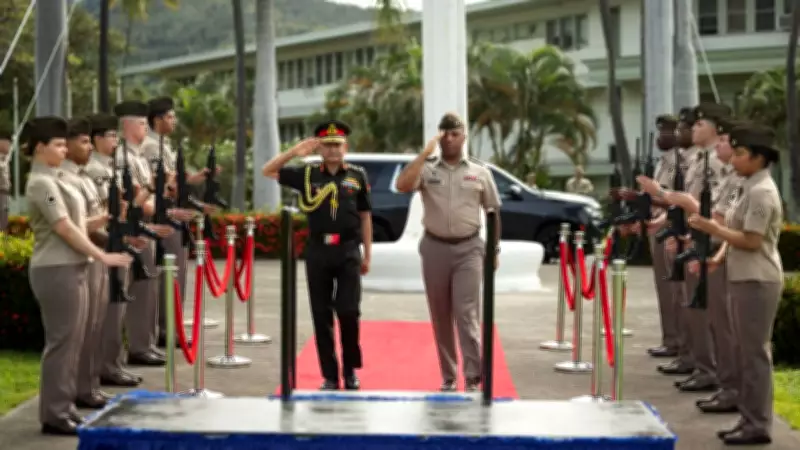
Top military leadership of India and the United States are engaging in high-level discussions to address common concerns in the Indo-Pacific region. Army Chief General Upendra Dwivedi is currently on a visit to the United States, marking the third high-profile visit by an Indian service chief in quick succession. Navy Chief Admiral DK Tripathi visited the US in November last year, while Air Chief Marshal AP Singh traveled to the United States just last month.
Background of Defence Cooperation
Prior to this series of visits, Defence Minister Rajnath Singh and US Secretary of Defense Pete Hegseth signed a 10-year defence framework agreement aimed at deepening the bilateral defence relationship. This agreement was signed on the sidelines of the ASEAN Defence Ministers’ Meeting Plus (ADMM-Plus), held in Kuala Lumpur, Malaysia.
Objectives of General Dwivedi's Visit
The Indian mission in Washington, DC, stated on social media about General Dwivedi's visit: "The visit, which is taking place soon after the recent visits by CNS and CAS, continues the high-level military-to-military exchanges between India and the US. It is expected to further cement the defence ties, a cornerstone of our comprehensive global strategic partnership towards ensuring a free, open and prosperous Indo-Pacific region."

India and the US have been working to strengthen their strategic partnership. Both countries engage militarily through bilateral and multilateral platforms. They are also part of the Quad grouping, along with Japan and Australia, as well as I2U2, with the UAE and Israel. There is a significant overlap in the strategic relationship between the countries, especially in the Indo-Pacific. New Delhi and Washington, DC, share a common vision of a free, open and secure Indo-Pacific region, even as China is increasingly becoming assertive in the region. Both India and China fall under the area of responsibility of the United States Indo-Pacific Command (USINDOPACOM), the largest US combatant command by area.
Meetings and Discussions
Army Chief General Upendra Dwivedi met the commander of the US Army’s Pacific Command, General Ronald P. Clark. The two generals discussed strengthening defence cooperation and advancing the shared vision of the Indo-Pacific. Similarly, Navy Chief Admiral DK Tripathi had met the USINDOPACOM chief, Admiral Samuel J. Paparo, as well as Admiral Stephen T. Koehler, Commander, United States Pacific Fleet, during his visit to the United States in November, and held talks on similar lines.
Defence Equipment and Agreements
The Indian armed forces currently operate many types of defence equipment sourced from the US. Some of these include the C-17 strategic airlifter, C-130 tactical transporter, P-8I maritime reconnaissance aircraft, Chinook heavy-lift helicopter, Apache attack helicopter, submarine-hunting MH-60R helicopters, and the M777 ultra-light howitzer.
The two countries have also signed multiple agreements to enhance military and technological cooperation. These include programmes such as US-India COMPACT (Catalyzing Opportunities for Military Partnership, Accelerated Commerce & Technology), the Logistics Exchange Memorandum of Agreement (LEMOA), the Communications Compatibility and Security Agreement (COMCASA), and the Industrial Security Agreement (ISA). The two sides are also expanding cooperation through TRUST (Transforming the Relationship Utilizing Strategic Technology), formerly known as the Initiative on Critical and Emerging Technology (iCET).
The engagements between the militaries of the world’s two largest democracies demonstrate how the two countries are working to ensure stability in the wider Indo-Pacific region at a time of significant geopolitical churn.