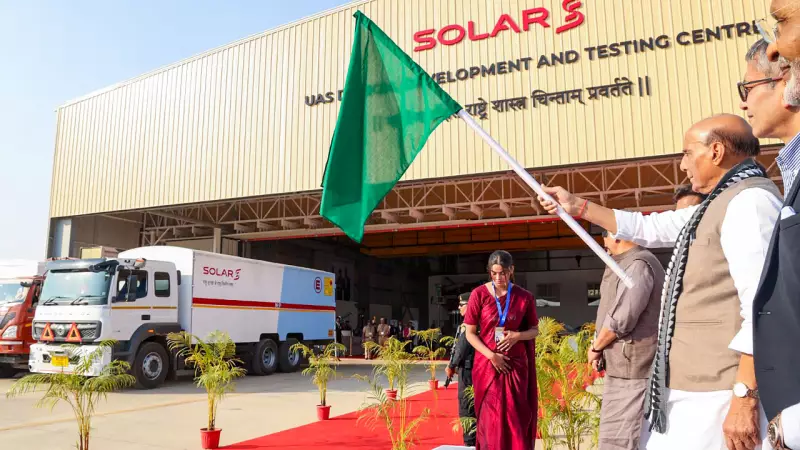
Defence Minister Rajnath Singh made a significant announcement on Sunday. He revealed that an advanced version of the Nagastra drone has been successfully developed. This drone played a crucial role during Operation Sindoor, where it accurately struck terrorist targets.
New Defence Systems Unveiled
The Nagpur-based Solar Defence and Aerospace Plant is behind these innovations. They developed the original Nagastra and have now created a more sophisticated model. Alongside this, the company has introduced 'Bhargavastra'. This is a new micro-missile-based system designed to counter drone threats.
Successful Test and Strategic Importance
Rajnath Singh confirmed that Bhargavastra has already undergone a successful test-launch. He highlighted the unpredictable nature of regional security, noting the advanced drone might be needed given the behaviour of neighbouring countries. The minister inaugurated a new ammunition manufacturing facility at the company's Nagpur plant during his visit.

He praised the company's ingenuity demonstrated in Operation Sindoor. "The Nagastra drone developed by this group was successfully deployed," Singh stated. "This drone struck precisely those who harboured ill intentions towards our country."
Technical Specifications of New Systems
Nagastra-1 operates as a 'kamikaze' or suicide drone. It searches for targets and destroys them by crashing directly into them. The advanced version presumably enhances these capabilities.
Bhargavastra represents a major step in indigenous defence technology. It is India's first homegrown, low-cost counter-drone system. Its purpose is to neutralise hostile drone swarms effectively.
The system utilises micro-rockets and guided micro-missiles for engagement. It features radar detection with a range of up to 6 kilometres. The system can engage targets at distances up to 2.5 kilometres.
New Manufacturing Capabilities
The newly inaugurated facility is a fully automated plant. It manufactures 30mm ammunition, which is extensively used by both the Indian Army and the Indian Navy. This marks an increase in domestic production capacity for critical defence supplies.
During his visit, Rajnath Singh also toured the Pinaka rocket manufacturing facility. He personally flagged off the first batch of guided Pinaka rockets destined for Armenia, showcasing export capabilities.
Reflections on Modern Warfare
The Defence Minister reflected on the intensity of Operation Sindoor. The operation lasted approximately 88 hours, but Singh emphasized that words could not fully capture its scale and ferocity.
"In such operations, every minute, every decision and every resource is crucial," he explained. He observed the evolving nature of global conflicts, noting warfare is becoming increasingly complex and intense.
"In such a situation, preparation for wars should be done on a war footing," Singh asserted, underscoring the need for constant readiness.
Push for Self-Reliance and Private Sector Role
Rajnath Singh recalled past challenges with ammunition shortages that hampered defence preparedness. These experiences reinforced the government's commitment to achieving self-reliance in defence production.
He commended private enterprises for their vital role in making the defence sector 'Aatmanirbhar' or self-reliant. The nation is making steady progress in ammunition production, focusing on manufacturing quality and reliable products.
"Increased involvement of the private sector in manufacturing and research & development is the need of the hour," the minister added. The government is actively focusing on a clear goal: ensuring the private sector's contribution to defence manufacturing reaches 50% or more in the coming years.