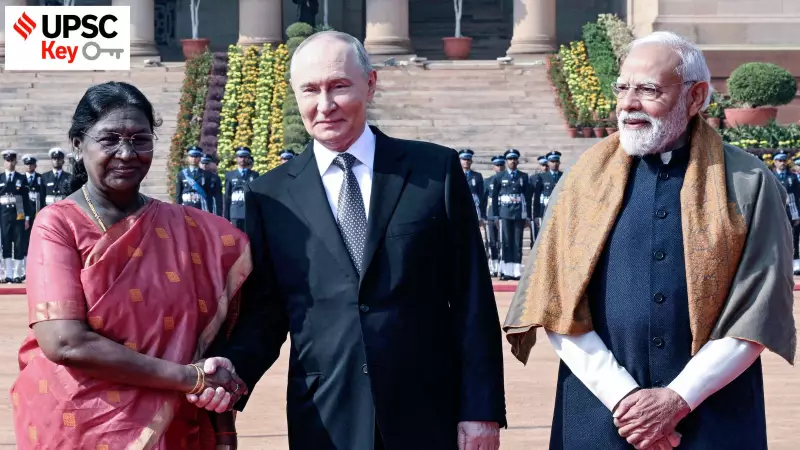
The annual India-Russia summit, held in New Delhi on December 6, 2025, marked a significant deepening of strategic ties between the two nations. The visit by Russian President Vladimir Putin, his first since the Ukraine war began in February 2022, resulted in the signing of 16 agreements and a joint vision to elevate bilateral relations. For UPSC aspirants, the outcomes of this summit, alongside key domestic developments like the RBI's repo rate cut and new labour codes, form crucial contemporary material for both Prelims and Mains examinations.
India-Russia Summit: A Strategic Roadmap to 2030
Prime Minister Narendra Modi and President Vladimir Putin oversaw the signing of multiple pacts aimed at broadening cooperation. The centrepiece was a Programme for Developing Strategic Areas of Economic Cooperation until 2030, with a reiterated target of achieving $100 billion in bilateral trade. Key outcomes included agreements on labour mobility, civil nuclear energy, and enhanced defence collaboration.
A major development was the signing of two pacts related to the movement of workers. The first, on Combating Irregular Migration, aims to curb illegal immigration, a move seen in the context of Indians being recruited by the Russian Army. The second facilitates the Temporary Labour Activity of skilled Indian workers in sectors like construction, agriculture, and IT in Russia, potentially involving up to 70,000 workers over the next few years to address Russia's labour shortage.

In the realm of energy, both sides agreed to broaden nuclear cooperation, including life-cycle support for the Kudankulam Nuclear Power Plant (KKNPP) and discussions on a second site in India for Russian-designed reactors. On Ukraine, PM Modi stated, "India is not neutral, India is on the side of peace," while the joint statement referred to the situation as a "crisis." The leaders also framed India's continued oil imports from Russia as an issue of energy security for its fast-growing economy.
Domestic Policy Shifts: RBI Rate Cut & Labour Reforms
On the domestic economic front, the Reserve Bank of India's Monetary Policy Committee (MPC) unanimously cut the repo rate by 25 basis points to 5.25% on December 6. This move, the first cut after two consecutive pauses, is aimed at supporting growth amid robust GDP projections of 7.3% for FY26 and a benign inflation forecast. The rate cut is expected to reduce borrowing costs, impacting EMIs for home, vehicle, and business loans.
Simultaneously, the implementation of the four new labour codes represents a paradigm shift in India's labour market regulation. By consolidating 29 older laws, the codes—covering Wages, Industrial Relations, Social Security, and Occupational Safety—aim to simplify compliance, extend social security to gig workers, and provide firms with greater flexibility. This reform is critical for improving the ease of doing business and fostering formal job creation, a perennial topic for the UPSC Mains exam.
Key Developments in Pharma & Defence Technology
In a landmark ruling with implications for drug access and patent law, the Delhi High Court rejected an interim injunction plea by pharmaceutical giant Novo Nordisk against Dr. Reddy's Laboratories (DRL) over the drug semaglutide. The court allowed DRL to continue manufacturing and exporting its version, noting that Novo Nordisk's secondary patent for an analogue of the compound amounted to "evergreening," which is prohibited under Section 3(d) of the Indian Patents Act. This case highlights the balance between innovation and affordable access to medicines.
In defence indigenisation, the Defence Research and Development Organisation (DRDO) successfully conducted a high-speed rocket-sled test of a fighter aircraft escape system. This dynamic ejection test, simulating speeds of 800 km/h, validates a critical safety system for pilots and places India among a select group of nations with such advanced in-house testing capability. It marks a significant step towards self-reliance in defence technology and reduces dependence on foreign testing facilities.

Why This Matters for UPSC Aspirants
The convergence of these events provides rich fodder for the UPSC Civil Services Examination. The India-Russia summit touches on GS-II topics like bilateral relations, international groupings, and India's foreign policy in a multipolar world. The RBI's policy and labour codes are core GS-III subjects on the Indian economy, growth, and employment. The semaglutide patent case intersects GS-II (governance) and issues of public health, while the DRDO test is relevant for GS-III (science & technology) and indigenisation of defence. Understanding the interconnectedness of these national and international developments is key to crafting nuanced answers in the Mains examination.