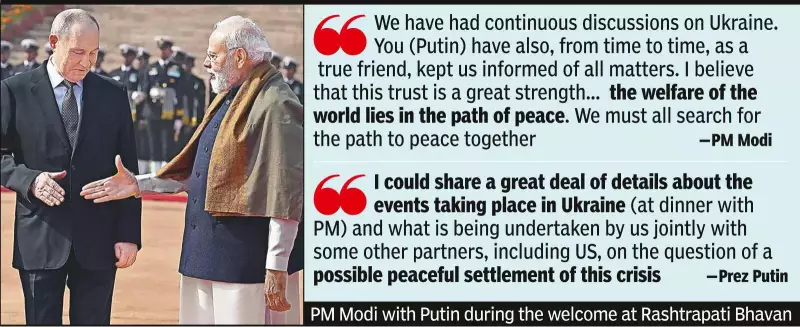
In a significant reaffirmation of a historic alliance, Prime Minister Narendra Modi and Russian President Vladimir Putin concluded a pivotal summit in New Delhi, charting an ambitious course to elevate economic ties and reinforcing a time-tested strategic partnership. The leaders unveiled a comprehensive roadmap aiming to boost bilateral trade to $100 billion by the year 2030, underpinned by over a dozen new agreements.
A Steadfast Partnership in a Turbulent World
Addressing the depth of the bilateral relationship, Prime Minister Modi described the India-Russia bond as a constant guiding force. "Over the past eight decades, the world has witnessed many ups and downs. Humanity has faced numerous challenges and crises. Yet, through all of this, the India-Russia friendship has remained steady like a guiding star," he stated. He emphasized that the relationship, built on mutual respect and deep trust, has stood the test of time.
Echoing this sentiment, President Putin commended India's "independent and self-sufficient" foreign policy. He highlighted that the two nations, along with like-minded countries in forums like BRICS and the Shanghai Cooperation Organisation (SCO), are working towards a more "just and democratic multipolar world order". Russia also reiterated its unwavering support for India's bid for permanent membership in a reformed UN Security Council.

Economic Ambitions and Energy Security Take Center Stage
The core of the summit outcomes was a robust economic agenda. The adopted framework for economic cooperation until 2030 is designed to diversify and balance trade and investment. Key elements include:
- Energy Security: President Putin assured that Russia is ready for uninterrupted shipments of fuel to India, calling it a reliable supplier of oil, gas, and coal crucial for India's development. PM Modi underlined that civil nuclear cooperation remains a vital pillar of the partnership.
- Trade Balance: Foreign Secretary Vikram Misri noted that while defence cooperation, including the Make in India initiative, was discussed, the focus was on ensuring balanced and sustainable trade by facilitating more Indian exports to Russia.
- Critical Minerals & Supply Chains: PM Modi pointed to cooperation in critical minerals as essential for creating secure and diversified global supply chains.
- Free Trade Agreement: Both leaders strongly backed efforts for the early conclusion of a Free Trade Agreement between India and the Eurasian Economic Union.
Key Agreements and Global Issues
The summit witnessed the signing of Memoranda of Understanding (MoUs) across diverse sectors including health, migration, and maritime cooperation. In a move to boost people-to-people ties, India announced a free 30-day e-tourist visa and a 30-day group tourist visa for Russian citizens. A manpower mobility agreement was also signed, which PM Modi said would create new opportunities for both nations.
On the international front, the leaders:
- Called for a peaceful resolution to the Ukraine conflict.
- Endorsed cooperation to keep Afghanistan free of terrorism.
- Stressed resolving the Iran nuclear issue through dialogue.
- Expressed concern over the humanitarian situation in Gaza.
PM Modi also raised the issue of the early release of Indian nationals serving in the Russian army with President Putin. Concluding the talks, President Putin expressed satisfaction with the outcomes, stating, "In general, we are undoubtedly satisfied with the results of the negotiations we just had." The summit has firmly set the trajectory for the next phase of the India-Russia special and privileged strategic partnership.