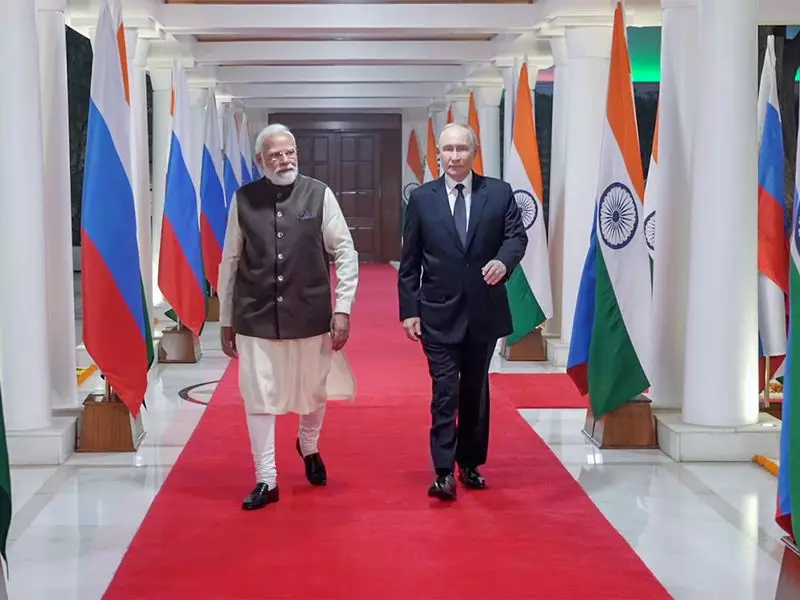
The enduring strategic partnership between India and Russia, a cornerstone of New Delhi's foreign policy for decades, is undergoing one of its most rigorous stress tests. The catalyst is the full-scale war in Ukraine and the subsequent barrage of Western sanctions against Moscow. This geopolitical earthquake has forced both nations to adapt, innovate, and defend a relationship that continues to hold significant strategic value for India, despite mounting pressure from Western allies.
The Bedrock of the Relationship: Defence and Diplomacy
The India-Russia partnership is built on a solid foundation of defence cooperation and consistent diplomatic support. Russia remains India's primary arms supplier, a relationship cemented by landmark deals like the $5.4-billion S-400 Triumf air defence system agreement. Deliveries of this critical system continue, underscoring India's commitment to its national security interests despite the threat of U.S. sanctions under CAATSA (Countering America's Adversaries Through Sanctions Act).
On the diplomatic front, India has notably refrained from condemning Russia's actions in Ukraine at the United Nations. Instead, New Delhi has consistently advocated for dialogue and diplomacy, positioning itself as a voice for the Global South and emphasizing the need to address the war's devastating impact on food and energy security worldwide. This independent stance, while drawing scrutiny from the West, is rooted in a history of reliable support from Moscow on key issues like Kashmir.

Navigating the Sanctions Storm: Trade and Transaction Hurdles
The immediate and most tangible impact of the sanctions regime has been on the practical mechanics of bilateral trade. Traditional payment channels have been disrupted, creating significant obstacles for both countries. The urgent search for alternative financial mechanisms, including a Rupee-Ruble trade arrangement, has become a top priority. However, establishing a smooth and sustainable system has proven complex, leading to reported delays and complications in settling payments, particularly for crucial imports like discounted Russian oil.
Despite these hurdles, trade volumes have surged, primarily driven by India's strategic purchase of Russian crude oil. This move, a pragmatic decision to cushion its economy from soaring global energy prices, has provided Moscow with a vital economic lifeline. It has also transformed Russia into one of India's top oil suppliers. However, this flourishing energy trade has also highlighted the lopsided nature of current exchanges, with India importing far more than it exports to Russia, raising concerns about the accumulating rupee balance in Russian accounts and the need to boost Indian exports to balance trade.
The Road Ahead: Adaptation and Strategic Autonomy
The future of the India-Russia partnership hinges on successful adaptation. Both nations are actively working to de-dollarize their trade and create sanction-proof financial pathways. The expansion of the International North-South Transport Corridor (INSTC) is a key initiative to diversify and secure supply chains, reducing dependency on traditional routes that may be vulnerable to geopolitical pressures.
For India, the core challenge is to safeguard its strategic autonomy. This involves a delicate balancing act: maintaining a time-tested partnership with Russia that serves its defence and geopolitical interests, while simultaneously deepening its ties with the United States and other Western powers in the Indo-Pacific. The relationship with Moscow is no longer as singularly dominant as in the Cold War era, but it remains a critical element of India's multi-aligned foreign policy framework. The partnership, tested by fire, is not breaking but bending and evolving to meet the unprecedented challenges of a sanction-hit world.
Ultimately, the resilience of this bond will depend on the ability of both governments to find technical solutions to transactional problems and to continue identifying mutual strategic interests that transcend the current crisis. The journey ahead is fraught with complexity, but for now, the foundational logic of the India-Russia relationship endures, even as its operational manual is being hastily rewritten.