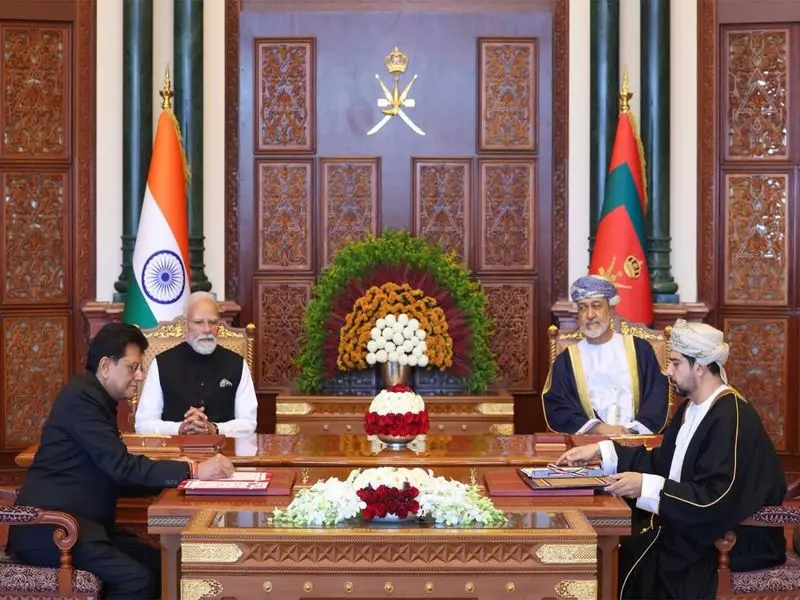
India and Oman have taken a significant leap forward in their longstanding partnership, unveiling a detailed roadmap aimed at deepening cooperation across a wide spectrum of areas. This strategic move was cemented during the state visit of Oman's Sultan Haitham bin Tarik to India, marking his first trip to the country since assuming power in 2020.
A New Chapter in Strategic Partnership
The cornerstone of the enhanced collaboration is a comprehensive joint vision document titled 'A Partnership for the Future', adopted by Prime Minister Narendra Modi and Sultan Haitham bin Tarik. The high-level discussions, held on December 16, focused on injecting new momentum into the bilateral relationship, which is built on centuries-old historical and cultural linkages.
Both leaders emphasized the critical importance of maintaining peace and security in the region. They also reviewed the robust collaboration between their defence forces and explored new avenues to strengthen this vital pillar of the partnership.

Ten Key Pillars of the Enhanced Partnership
The joint statement outlines a ten-point framework designed to guide future cooperation. The key areas identified for deeper engagement include:
- Maritime Security and Connectivity: A major focus is on enhancing cooperation to ensure security and freedom of navigation in the region's vital sea lanes.
- Energy Security and Green Energy: The nations plan to bolster their partnership in the traditional energy sector while simultaneously exploring joint ventures in renewable and green hydrogen projects.
- Digital Payments and Financial Connectivity: Encouraging the use of local currencies (Rupee and Rial) for cross-border transactions and linking India's Unified Payments Interface (UPI) with Oman's similar system is a forward-looking step.
- Trade and Investment: Both sides committed to expediting the conclusion of a Comprehensive Economic Partnership Agreement (CEPA) to significantly boost two-way trade and investment flows.
- Healthcare and Food Security: Collaboration in health, pharmaceuticals, and the food processing industry has been prioritized to enhance resilience.
- Space Cooperation: The partnership will extend into the final frontier, with plans for joint work in space technology and applications.
- People-to-People Ties: Recognizing the strong human bond, the leaders agreed to simplify processes to encourage tourism and cultural exchanges.
- Defence and Security: Building on existing exercises and training programs, the countries will deepen their defence industrial collaboration.
- Education and Skill Development: Partnerships between educational institutions and cooperation in skill development will be fostered.
- Regional and Multilateral Issues: India and Oman agreed to continue close coordination on regional and global issues within multilateral forums.
Concrete Agreements and the Road Ahead
The high-level talks translated into the signing of several concrete agreements and Memoranda of Understanding (MoUs). These pacts cover diverse fields such as information technology, combating financial crimes, and cultural exchange.
A particularly noteworthy outcome was the decision to establish a joint investment fund worth $300 million. This fund is specifically aimed at channeling investments into the burgeoning sectors of technology and innovation in both countries, signaling a strong commitment to future-oriented growth.
The visit underscores Oman's pivotal role as one of India's key partners in the Gulf region. With a large and vibrant Indian expatriate community contributing to Oman's economy and society, the newly adopted roadmap provides a structured and ambitious framework to transform this historically friendly relationship into a more integrated and strategically vital partnership for the coming decades.