

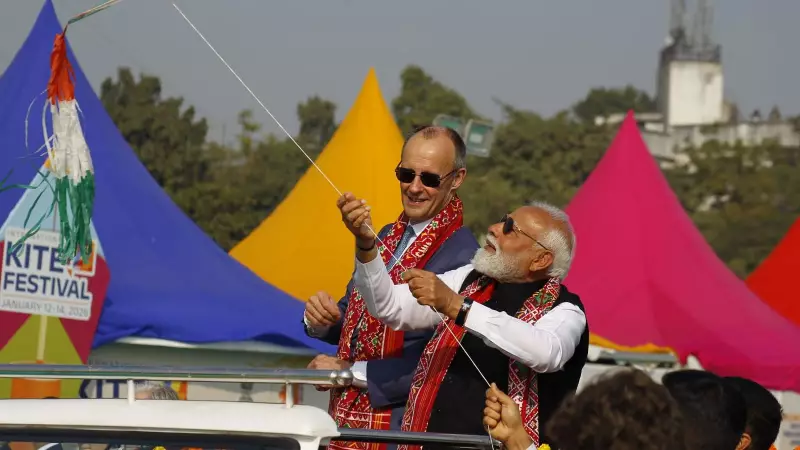
India and Germany Forge Stronger Partnership During Chancellor Merz's Visit
German Chancellor Friedrich Merz completed his first official visit to India this week. The short but productive trip occurred during a period of significant global instability. Both nations demonstrated a clear commitment to strengthening their democratic partnership.
Focus on Global Stability and Economic Growth
Prime Minister Narendra Modi and Chancellor Merz held extensive discussions about the changing global order. Merz spoke openly about the erosion of international stability. He emphasized that both countries needed to collaborate more closely to address these challenges.
The leaders celebrated bilateral trade reaching nearly $51 billion. This amount represents about a quarter of India's total trade with the European Union. They agreed that sustaining this momentum requires a forward-looking vision.

Germany expressed support for concluding the India-EU Free Trade Agreement early. During a CEOs' Forum event, Merz stressed the importance of protecting economic resilience. He warned against creating dangerous one-sided dependencies in global supply chains.
Technology and Defense Cooperation Advance
Technology emerged as a key area for collaboration. Both leaders acknowledged the increasing weaponization of critical technologies worldwide. They agreed that trusted partners must work together closely in response to this trend.
Germany's approach to defense engagement with India has shifted noticeably. Export clearances that were once slow and uncertain now process more efficiently. Most of the earlier backlog has been cleared.
During the visit, both sides announced plans to develop a defense industrial cooperation roadmap. This includes discussions related to submarine technology. India made it clear that defense sourcing decisions depend purely on national interest and operational requirements.
Managing Differences Pragmatically
The two leaders exchanged views on several international issues. They discussed the Russia-Ukraine conflict, developments in West Asia, and the Indo-Pacific region. While perspectives are not identical, both emphasized dialogue, shared principles, and practical coordination.
Germany signaled a more flexible security policy toward India. The country needs to refrain from publicly trying to wean India away from Russia. Differences were managed pragmatically rather than ideologically.
Green Energy and People-to-People Ties
Cooperation in green hydrogen deepened significantly during the visit. The most notable announcement involved a long-term off-take agreement for green ammonia. India's AM Green and Germany's Uniper Global Commodities will partner on this initiative.
People-to-people connections received strong emphasis. Nearly 300,000 people of Indian origin live in Germany. Close to 60,000 Indian students study there. Merz explicitly welcomed Indian students and skilled professionals to Germany.
Prime Minister Modi echoed this sentiment. Both leaders acknowledged that diaspora issues require sensitive handling. Examples include the Baby Ariha case and expulsions of students in virtual classrooms.
Sustaining Momentum Beyond Symbolism
The visit produced substantial outcomes beyond mere symbolism. Participants signed 19 Memorandums of Understanding. They made eight additional announcements, totaling 27 concrete results.
Prime Minister Modi received an invitation to attend the next India-Germany Intergovernmental Consultations in Berlin later this year. This signals both nations' intention to sustain the current momentum in their relationship.
The visit demonstrated that democratic powers can strengthen partnerships during turbulent times. India and Germany showed they share a conviction about working together more closely on global challenges.






