
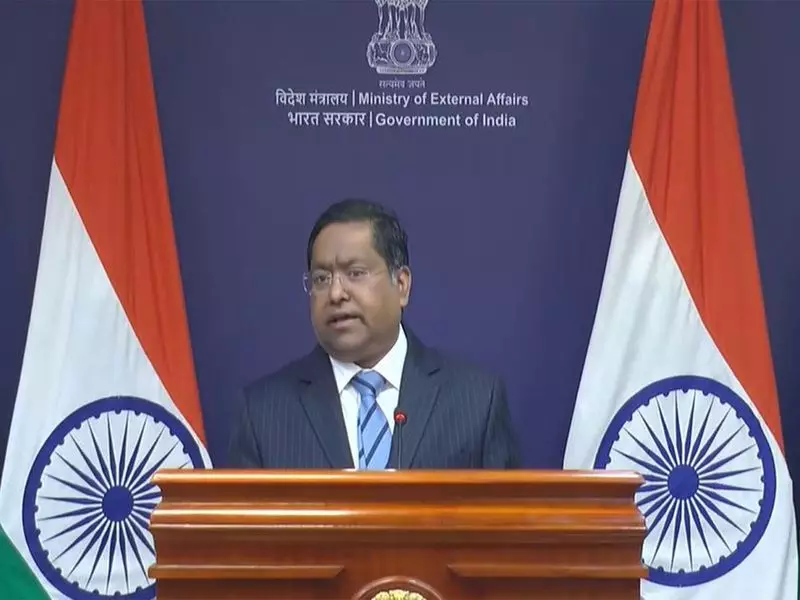
The Ministry of External Affairs (MEA) has issued a firm and unequivocal rejection of China's reported construction activities in the strategically sensitive Shaksgam Valley. India has categorically stated that such actions, undertaken as part of the China-Pakistan Economic Corridor (CPEC), are both illegal and invalid.
India's Strong Diplomatic Stance
In an official statement released on a recent Saturday, the MEA spokesperson, Randhir Jaiswal, articulated India's position. He emphasized that the Shaksgam Valley is an integral part of Indian territory, falling within the union territory of Ladakh. The government has consistently conveyed its strong protest to China against any such infrastructural projects in the area.
The statement clarified that New Delhi never accepted the so-called China-Pakistan Boundary Agreement of 1963, through which Pakistan attempted to cede the area to China. India views this agreement itself as illegal. Therefore, any subsequent activity by Beijing or Islamabad in this region lacks any legal basis and is seen as a direct infringement on India's sovereignty and territorial integrity.
The Context of CPEC and Satellite Imagery
The MEA's strong reaction comes in response to reports based on satellite imagery analysis. These reports indicated that China is accelerating construction work in the Shaksgam Valley. This includes building roads and possibly other infrastructure, which is perceived to be linked to the ambitious CPEC project.
The China-Pakistan Economic Corridor is a flagship component of Beijing's Belt and Road Initiative (BRI). A significant portion of CPEC passes through Pakistan-occupied Kashmir (PoK), a region India claims in its entirety. India's consistent position has been that it opposes CPEC as it is built on territory illegally occupied by Pakistan. The latest developments in Shaksgam, a valley north of the Siachen Glacier, further exacerbate these long-standing disputes.
Strategic Implications and Regional Stability
The Shaksgam Valley holds immense strategic importance due to its location. It borders the Siachen Glacier region, which is the world's highest battlefield. Any permanent Chinese military or dual-use infrastructure in this valley could potentially alter the security dynamics in the entire Karakoram region.
India's firm statement serves multiple purposes. Firstly, it reiterates its legal and historical claim to the territory, leaving no room for ambiguity on the global stage. Secondly, it signals to both China and Pakistan that India will not tacitly accept any fait accompli created by unilateral actions. Thirdly, it underscores India's broader opposition to projects like CPEC that disregard core sovereignty issues.
The development adds another layer of complexity to the already strained India-China relationship, which has seen a military standoff along the Line of Actual Control (LAC) in eastern Ladakh since 2020. India's clear message is that it will vigilantly monitor and diplomatically challenge any activity in areas it considers its own.
By publicly denouncing these actions, India aims to keep international attention focused on what it perceives as China's expansionist behavior in disputed territories. The statement reinforces that normalization of ties with China cannot proceed without respect for mutual sovereignty and territorial integrity.