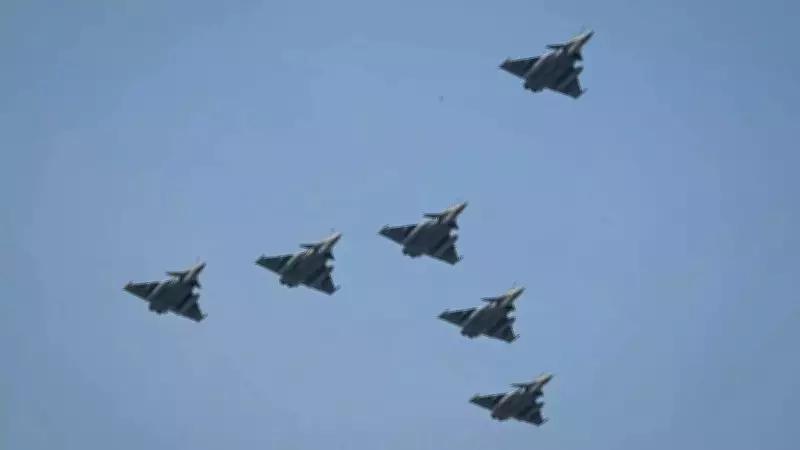
India Greenlights Historic $40 Billion Defence Deal for 114 Rafale Fighter Jets
In a landmark decision that paves the way for what is being termed the 'mother of all defence deals,' India's Defence Acquisition Council (DAC), chaired by Defence Minister Rajnath Singh, has granted approval for the acquisition of 114 Rafale multi-role fighter jets from France. This monumental approval comes just five days before French President Emmanuel Macron's scheduled arrival in India for a state visit, highlighting the strategic timing and importance of this bilateral agreement.
Unprecedented Scale and Strategic Significance
While the defence ministry has not disclosed the exact financial figures, the proposed government-to-government deal is estimated to be worth approximately Rs 3.25 lakh crore (around $40 billion). Once finalized through cost negotiations with France's Dassault Aviation and subsequent approval by the Cabinet Committee on Security, this agreement will stand as India's largest defence procurement since gaining independence in 1947.
The total value of all defence acquisitions cleared by the DAC on Thursday, including the Rafale jets, reaches an impressive Rs 3.6 lakh crore, underscoring a significant modernization push for India's armed forces.

Manufacturing and Delivery Timeline
The acquisition plan involves a strategic manufacturing approach:
- Approximately 20 aircraft will be procured in fly-away condition directly from France, with delivery expected to the Indian Air Force (IAF) fleet by 2030.
- The remaining 94 jets will be manufactured in India through a collaboration between Dassault Aviation and Hindustan Aeronautics Limited (HAL), incorporating substantial indigenous content.
The defence ministry emphasized that "the majority of Multi Role Fighter Aircraft (MRFA) to be procured will be manufactured in India," with the domestically produced jets expected to contain 50-60% indigenous components. This aligns with India's 'Make in India' initiative and aims to boost self-reliance in defence manufacturing.
Addressing Critical Operational Needs
This procurement addresses urgent operational requirements for the Indian Air Force, which currently operates just 29 fighter squadrons against a sanctioned strength of 42 squadrons. The capability gap has become increasingly concerning amid rising threat perceptions from both Pakistan and China, particularly following last year's conflicts with Islamabad.
IAF Vice-Chief Air Marshal Nagesh Kapoor recently praised the Rafale as the "Operation Sindoor hero" for its precision strikes against Pakistan's terror infrastructure and military bases, highlighting the aircraft's proven combat effectiveness in regional conflicts.
Enhanced Fleet Strength and Capabilities
Once the 114-jet deal is completed, the IAF will operate a formidable fleet of 150 Rafale aircraft, combining the new acquisitions with the 36 Rafale jets already in service. The Indian Navy has also placed orders for 26 naval variants of the aircraft, further expanding India's multi-domain Rafale capabilities.
The defence ministry stated that "the procurement of Multi Role Fighter Aircraft will enhance the capability of undertaking air dominance roles across the spectrum of conflict and significantly boost the deterrence capabilities of IAF with long-range offensive strikes."
Additional Defence Acquisitions Approved
Beyond the Rafale jets, the DAC approved several other critical defence purchases:

- P-8I Poseidon maritime patrol aircraft from US aviation giant Boeing for the Indian Navy, significantly enhancing long-range anti-submarine warfare, maritime surveillance, and strike capabilities.
- Combat missiles and high-altitude pseudo satellites for enhanced strategic capabilities.
- Anti-tank mines (Vibhav) and overhaul of vehicle platforms including armoured recovery vehicles, T-72 tanks, and infantry combat vehicles for the Indian Army.
- Electro-optical infra-red systems for Dornier aircraft operated by the Indian Coast Guard.
- 4-MW marine gas turbine-based electric power generators to reduce dependency on foreign manufacturers and ensure self-reliance in naval power generation.
Historical Context and Future Implications
This DAC approval comes nearly 13 years after the defence ministry completed groundwork for the procurement of Medium Multi-Role Combat Aircraft (MMRCA). In April 2019, the IAF issued a request for information to acquire 114 jets at an estimated cost of $18 billion, indicating the lengthy and complex nature of such high-value defence negotiations.
The urgency for these advanced fighter jets is amplified by delays in other indigenous programs. India is unlikely to receive the new fifth-generation Advanced Medium Combat Aircraft (AMCA) in the near future, and HAL's Tejas MkIA production program faces challenges due to dependence on US company GE for engines.
Next Steps in the Procurement Process
A formal contract following the DAC approval will require additional time as the defence ministry must conduct detailed negotiations with Dassault Aviation to finalize costs, weapons packages, and technical specifications. Subsequently, the Cabinet Committee on Security, chaired by Prime Minister Narendra Modi, will need to grant final approval before the deal can be officially signed.
This comprehensive defence package represents a strategic leap forward for India's military capabilities, strengthening deterrence against regional threats while promoting indigenous manufacturing through technology transfer and collaboration with global defence leaders.