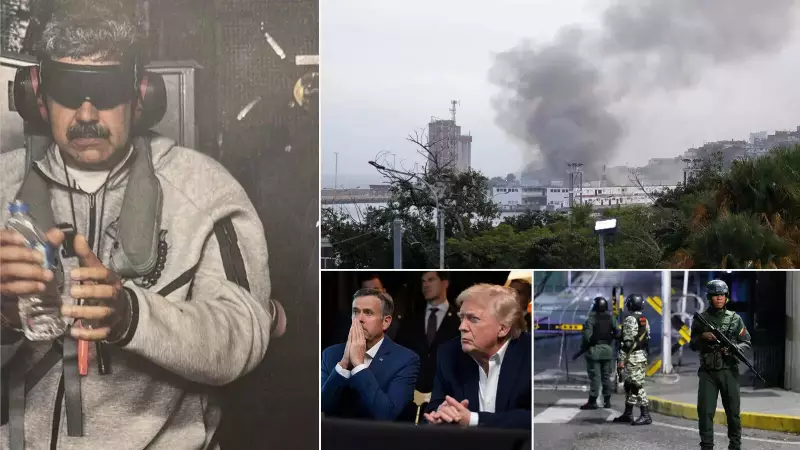
In a high-stakes covert operation that pushed the boundaries of international law and diplomacy, the United States executed one of its riskiest missions in recent years on Venezuelan soil. The target was not a terrorist cell or a weapons cache, but a Colombian businessman named Alex Saab, a key financial operator for the government of President Nicolás Maduro.
The Long Game: Four Months of Covert CIA Surveillance
The operation's success hinged on an unprecedented level of patience and intelligence gathering. For four months, agents from the US Central Intelligence Agency (CIA) conducted clandestine surveillance on Saab's movements and routines within Venezuela. This was no simple task; operating in a country hostile to US interests, under the constant threat of detection by Venezuelan intelligence or military forces.
The surveillance was meticulous. CIA operatives, likely working with limited on-ground assets, tracked Saab's patterns, identifying vulnerabilities and planning for the perfect moment to strike. The intelligence pinpointed that Saab would be traveling from Caracas to the coastal city of La Guaira, a route that presented a narrow window of opportunity. The plan was audacious: intercept his convoy and extract him from Venezuelan territory.

The Two-Hour Raid: A Daring Extraction on Foreign Soil
The operation moved from planning to action on June 12, 2020. As Alex Saab's motorcade traveled towards La Guaira, a team of US operatives, reportedly including members of the Drug Enforcement Administration (DEA), moved in. The raid itself was a swift, military-style intervention lasting approximately two hours.
Details remain shrouded in secrecy, but reports suggest the operatives successfully stopped Saab's vehicles, secured the businessman, and transported him to a waiting aircraft. The extraction plane, a US government Gulfstream jet, then flew him to the West African nation of Cape Verde. This leg of the journey was critical; the US needed a third country to formally arrest Saab based on an existing Interpol Red Notice, as a direct flight to the US from Venezuela was politically and logistically impossible.
Alex Saab was accused by US prosecutors of running a vast corruption network that siphoned hundreds of millions of dollars from Venezuela through a state-run food subsidy program. The US government viewed him as a vital piece in the financial architecture propping up the Maduro regime, which it did not recognize as legitimate.
Geopolitical Fallout and Legal Battles
The immediate aftermath of the raid was a firestorm of diplomatic protests. The Venezuelan government condemned the action as a "kidnapping" and a blatant violation of its sovereignty. It demanded Saab's immediate return, arguing he enjoyed diplomatic immunity due to his role as a special envoy engaged in negotiations with Iran, a claim the US and Cape Verdean courts ultimately rejected.
Saab's arrest in Cape Verde triggered a lengthy 16-month legal battle over extradition. His lawyers fought tirelessly, while the Venezuelan government exerted immense political pressure on Cape Verde. Despite these efforts, Saab was extradited to the United States in October 2021.
In a significant turn of events, Saab later became a cooperating witness for the US Justice Department. His decision to provide information on the inner workings of the Maduro government's financial schemes and corruption was seen as a major intelligence coup for Washington. This cooperation was part of a plea deal that led to his release in a prisoner swap in December 2024, where he was exchanged for ten Americans imprisoned in Venezuela and a fugitive Malaysian defense contractor known as "Fat Leonard."

The operation stands as a stark example of the lengths to which the United States is willing to go to pressure adversarial regimes. It combined classic espionage tradecraft with a bold paramilitary strike, all set against the complex backdrop of US-Venezuela relations. While ultimately successful in apprehending its target, the mission risked a major international incident and continues to be cited by Caracas as an example of US imperialism. The saga of Alex Saab, from covert raid to prisoner swap, underscores the shadowy and high-risk world of modern economic and geopolitical warfare.