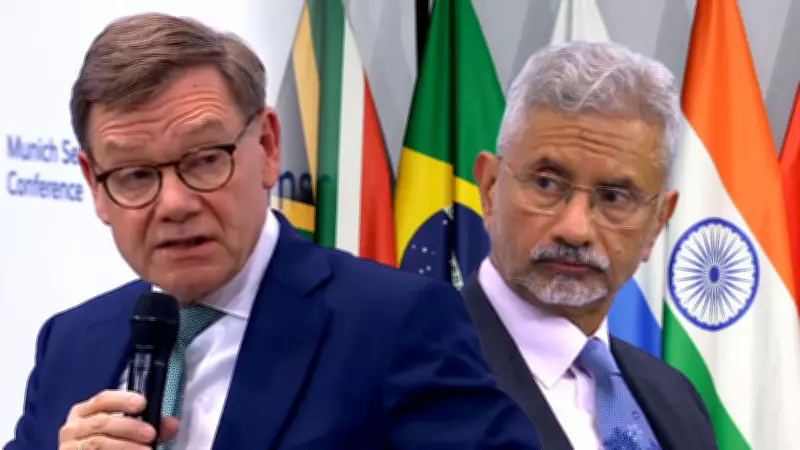
German Foreign Minister Admits Strategic Error in Alienating India Over BRICS Focus
In a significant diplomatic acknowledgment at the prestigious Munich Security Conference, German Foreign Minister Johann Wadephul openly stated that Europe's previous strategy of categorizing India primarily as a member of the BRICS bloc was fundamentally flawed and counterproductive. Wadephul characterized this approach as "wrong," noting that it had the unintended consequence of overshadowing the deep-seated democratic values and strategic trust that form the bedrock of the relationship between India and Europe.
Distinct Position for India in European Strategic Calculations
Wadephul emphasized that India occupies a unique and distinct position within Europe's foreign policy framework. He sharply differentiated India's role from that of China, despite the complex global tensions involving both Russia and Beijing. This clarification comes at a critical juncture, highlighting Europe's intent to recognize India's independent strategic weight rather than conflating it with other major powers within multilateral groupings.
The German minister underscored that shared commitments to democracy, freedom of speech, and the rule of law are the essential pillars for future cooperation. These fundamental principles, he argued, provide a more solid and enduring foundation for partnership than transient geopolitical alignments.

Context of Bilateral Engagement and Trade Agreement
These remarks were delivered following substantive bilateral discussions between Wadephul and India's External Affairs Minister, S. Jaishankar. The timing is particularly noteworthy as it coincides with the recent implementation of a landmark India-European Union trade agreement. This comprehensive pact eliminates tariffs on the majority of goods traded between the two economies, signaling a concrete step toward deeper economic integration.
Europe's recalibration of its approach toward India is not an isolated diplomatic gesture. It represents a broader, concerted effort within European capitals to:
- Deepen and diversify economic partnerships beyond traditional allies.
- Strengthen strategic resilience in the face of an increasingly competitive and multipolar global order.
- Build reliable partnerships based on shared democratic norms and mutual strategic interests.
This shift in perspective from Berlin, a leading voice within the European Union, marks a conscious move away from viewing India through the narrow prism of the BRICS association. It reflects a growing recognition of India's pivotal role as a democratic counterweight and a crucial partner in ensuring stability and upholding a rules-based international system. The admission of past strategic miscalculation paves the way for a more nuanced and robust India-Europe partnership focused on common values and tangible economic cooperation.