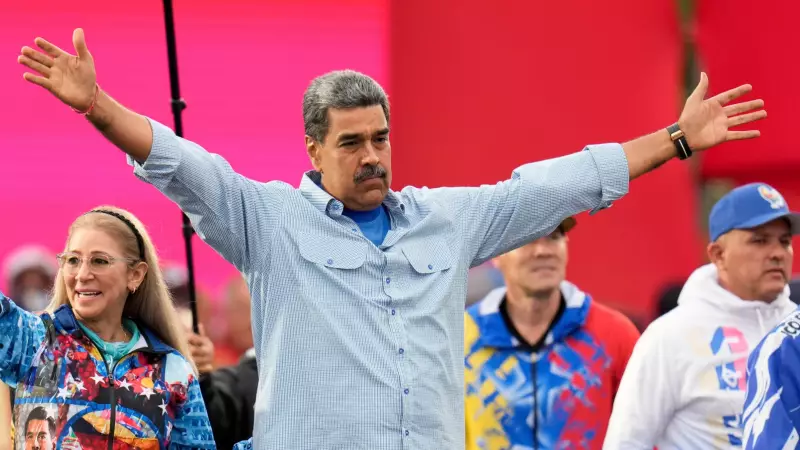
The recent announcement of a $15 million bounty for information leading to the arrest of Venezuelan President Nicolas Maduro has sent shockwaves through international diplomacy. While the US Department of Justice has charged Maduro and other Venezuelan officials with narco-terrorism, conspiracy, and drug trafficking, the prospect of capturing a sitting head of state is not without historical precedent for the United States.
A Controversial History of Foreign Captures
Although the Maduro case is extraordinary due to his current status, the United States has a documented history of pursuing and capturing foreign leaders it deemed hostile or criminal. These actions, often occurring during times of war or intervention, have sparked intense debate about sovereignty and international law. The legal justifications have varied, from wartime authority to charges of international crimes like drug trafficking.
This historical pattern raises critical questions about the limits of extraterritorial jurisdiction and the power dynamics in global politics. The following cases highlight moments where American forces directly apprehended leaders from other nations.

Manuel Noriega: The Drug-Trafficking Dictator
One of the most direct parallels to the current situation with Maduro is the case of Manuel Noriega of Panama. The de facto ruler of Panama in the 1980s, Noriega was once a CIA asset who later fell out of favor with Washington. In December 1989, President George H.W. Bush ordered Operation Just Cause, a massive military invasion of Panama.
The stated goals were to protect American citizens, restore democracy, and bring Noriega to justice. US forces bombed his headquarters, and after he sought refuge in the Vatican's diplomatic mission, they used psychological tactics—including blasting loud rock music—to force his surrender. Noriega was captured, flown to the United States, and tried in a federal court in Miami.
He was convicted in 1992 on charges of racketeering, drug trafficking, and money laundering, serving a 40-year sentence in a US federal prison until his extradition to France and later Panama. His capture set a modern precedent for the US apprehending a foreign leader on criminal charges.
Saddam Hussein: Captured After a Manhunt
Following the US-led invasion of Iraq in 2003, which toppled his regime, former dictator Saddam Hussein became the target of an intense manhunt. American forces issued a deck of playing cards featuring most-wanted Iraqi officials, with Saddam as the Ace of Spades. After months of searching, he was finally discovered on December 13, 2003.
US soldiers from the 4th Infantry Division found him hiding in a "spider hole"—a small, camouflaged bunker—on a farm near his hometown of Tikrit. Disheveled and armed with a pistol he did not use, Saddam was captured without a fight. He was subsequently handed over to the new Iraqi authorities, tried by an Iraqi court for crimes against humanity, and executed in 2006. While not captured as a sitting head of state, his apprehension by US troops remains a defining moment.
Pancho Villa: The Cross-Border Raid
Going further back in history, the US military once launched a punitive expedition into a sovereign nation to capture a revolutionary leader. In 1916, Mexican revolutionary Francisco "Pancho" Villa attacked the town of Columbus, New Mexico, killing Americans. In response, President Woodrow Wilson sent General John J. Pershing and nearly 10,000 US troops deep into Mexican territory to capture Villa.
The "Punitive Expedition" lasted nearly a year but ultimately failed to apprehend the elusive Villa. The incursion severely strained US-Mexico relations and highlighted the complexities and risks of unilateral cross-border military action. While unsuccessful, it represents an early 20th-century attempt to capture a foreign military leader.

Legal Precedents and Diplomatic Implications
The charges against Maduro, like those against Noriega, rely on a broad interpretation of US law that claims jurisdiction over foreign nationals for actions allegedly taken abroad that impact America. Legal experts are divided on the validity and wisdom of such an approach when applied to a sitting head of state, who typically enjoys immunity under international law.
The historical captures show a pattern where the US has acted against leaders during or after regime change (Saddam), following military invasion (Noriega), or in pursuit of a non-state actor (Villa). The Maduro case is unique as he remains in power, making any potential capture an unprecedented act against a functioning government.
These actions have lasting diplomatic consequences. They can be seen as assertions of power but also risk accusations of imperialism and violation of national sovereignty. The global reaction to the bounty on Maduro has been mixed, with allies supporting the move and critics condemning it as an overreach.
As the situation develops, the shadow of history looms large. The precedents set by Noriega, Saddam, and the pursuit of Villa inform today's high-stakes confrontation between Washington and Caracas, testing the boundaries of international law and state power once again.