

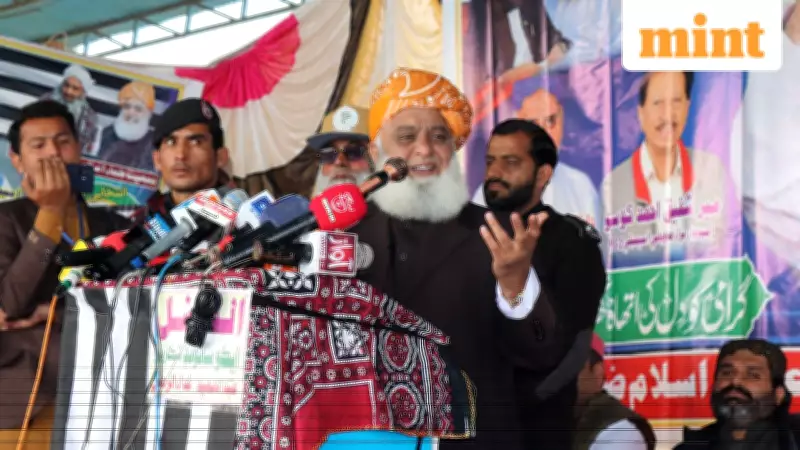
Fazlur Rehman Condemns Pakistan's Afghan Strategy and CPEC Stagnation
In a scathing address, Maulana Fazlur Rehman, the chief of Jamiat Ulema-e-Islam (F), launched a sharp attack on the Shehbaz Sharif-led Pakistan government and the country's security establishment. He criticized their handling of the Afghanistan extremism issue, questioning Pakistan's strategic approach over the past 78 years, particularly its policy toward Afghanistan.
Questioning Decades of Failed Policy
Fazlur Rehman highlighted the glaring contradictions in Pakistan's border management with Afghanistan. He pointed out that while trade from Afghanistan is almost completely blocked, with not a single pomegranate or melon allowed to enter Pakistan, militant infiltration continues unabated. "Why has the country never reflected on how its Afghan strategy has failed so miserably?" he asked, as reported by News18. He challenged the authorities to take decisive action, stating, "Authorities say terrorists are coming from there. If they are coming, stop them. If they are coming, eliminate them. The Afghan government has never objected to your actions," according to NDTV.
CPEC Failures Under Scrutiny
Beyond Afghanistan, Fazlur Rehman strongly criticized the government's handling of the China-Pakistan Economic Corridor (CPEC). Once projected as a transformative project for Pakistan's economy, he asserted that the Shehbaz Sharif-led government has failed to restore Chinese confidence or attract fresh investment. "CPEC has seen no real progress during this tenure because China no longer trusts us," he said, as reported by News18. This critique underscores growing concerns over Pakistan's economic partnerships and diplomatic reliability.

Context of the Islamabad Mosque Attack
The remarks come in the wake of a devastating attack on the Khadija Tul Kubra Imambargah on the outskirts of Islamabad. On Friday, a gunman opened fire and then detonated a bomb, killing 32 people and himself, while injuring over 170 others. Pakistan's Defence Minister Khawaja Mohammad Asif linked the attack to Pakistan-based militants operating from Afghanistan, claiming they were capable of striking even the capital. This prompted a strong reaction from Afghanistan's Taliban government, which condemned the attack but accused Asif of "irresponsibly" linking it to Afghanistan.
Pakistan has repeatedly alleged that Afghanistan shelters militants, including members of the Pakistani Taliban, claims that Kabul has consistently denied. The incident has exacerbated tensions between the two nations, highlighting the complex security dynamics in the region.
Fazlur Rehman's critique adds to the growing domestic and international scrutiny of Pakistan's policies, emphasizing the need for a reassessment of its strategic approaches to both security and economic development.






