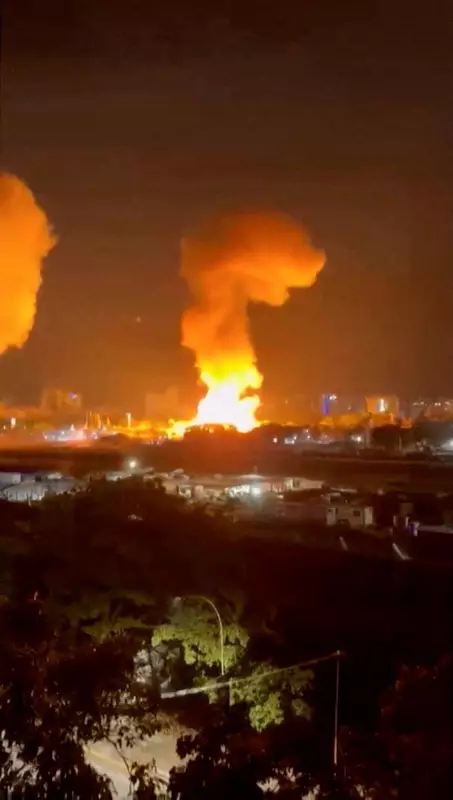
In a move that has sent shockwaves through diplomatic circles, the United States recently conducted a series of airstrikes on Venezuelan territory. The action, aimed at what the US termed 'narco-terrorist' targets, has been met with sharp criticism from strategic affairs experts, particularly in India, who label it 'unbelievable' and a potential catalyst for a dangerous new precedent in international relations.
Experts Condemn 'Unbelievable' US Action
Prominent voices in the strategic community have expressed deep concern over the unilateral military action. Professor Harsh V. Pant, Vice President for Studies and Foreign Policy at the Observer Research Foundation (ORF), did not mince words, stating the strikes were "unbelievable." He emphasized that such actions, undertaken without the sanction of the United Nations Security Council (UNSC), fundamentally undermine the established international legal order. The core of the criticism lies in the precedent it sets, where a powerful nation takes upon itself the role of global enforcer based on its own assessment, bypassing multilateral institutions.
Echoing this sentiment, Ambassador Anil Trigunayat, a former Indian diplomat, highlighted the blatant violation of Venezuela's sovereignty. He pointed out that the United Nations Charter expressly prohibits the use of force against the territorial integrity of any state. Trigunayat warned that this move could embolden other nations to justify their own interventions under similar, self-proclaimed mandates, leading to a more unstable and unpredictable world.

The Context and Immediate Fallout
The US Department of Justice had earlier indicted Venezuelan President Nicolás Maduro and several other top officials on charges of narco-terrorism. The recent airstrikes were framed as a direct response to these allegations. However, experts argue that this justification is tenuous and sets a worrisome standard. The action starkly contrasts with the principles of state sovereignty and non-intervention that form the bedrock of the post-World War II global system.
The immediate consequence has been a further deterioration in the already fraught relations between Washington and Caracas. More broadly, it has sparked a debate on the erosion of international norms. For nations like India, which consistently advocate for a multipolar world order governed by rules and respect for sovereignty, this development is particularly disquieting. It challenges the very principles of diplomatic conflict resolution.
A Dangerous Precedent for Global Order
The overarching fear expressed by analysts is the normalization of such strikes. If the world's sole superpower can routinely use military force against nations it deems transgressors based on its domestic legal processes, it opens a Pandora's box. Smaller nations may feel increasingly vulnerable, and rival powers could cite this precedent for their own adventures, leading to a cycle of escalation and conflict.
Professor Pant succinctly captured this anxiety, stating that the US action "will set a bad precedent." The concern is not merely about Venezuela but about the signal it sends globally. It risks replacing collective security mechanisms, however imperfect, with a might-makes-right approach. This is seen as a step back for global governance and a potential threat to international peace and stability.
In conclusion, the US airstrikes on Venezuela have been met with severe apprehension by strategic experts. The condemnation centers on the unilateral nature of the action, its violation of international law, and the perilous precedent it establishes. As the world grapples with multiple crises, this event underscores the growing tensions within the international system and the urgent need to reinforce, not weaken, the frameworks of multilateral diplomacy and respect for national sovereignty.