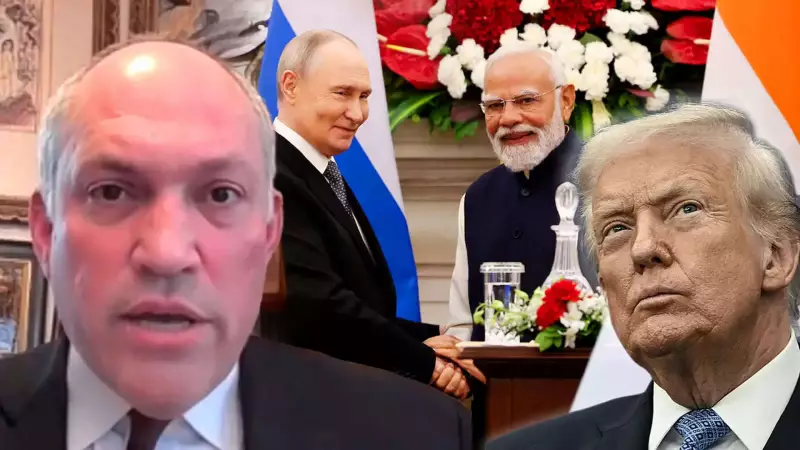
A former senior Pentagon official has launched a sharp critique of United States policy, controversially crediting former President Donald Trump for the current warmth in India-Russia relations. The comments come in the wake of President Vladimir Putin's recent visit to New Delhi.
Trump's Role in a Strategic Shift
Michael Rubin, who served as an advisor to the US Department of Defense, stated that Donald Trump deserves a Nobel Prize for uniting India and Russia. He argued that the growing closeness between Prime Minister Narendra Modi and President Putin is a direct result of Trump's foreign policy actions during his tenure.
Rubin's analysis, however, reveals a deep split in American perception. While Trump's supporters see the strengthened India-Russia bond as a validation of his approach, Rubin noted that the majority of Americans view this strategic shift as a product of Trump's "gross incompetence" in diplomacy.

Accusations of Hypocrisy and Damaged Ties
The former official did not mince words in his assessment of the damage done to US-India relations. He accused Trump of reacting to flattery and even to alleged bribery offers from other nations like Pakistan, Turkey, and Qatar, which ultimately undermined Washington's partnership with New Delhi.
Rubin highlighted a significant point of US hypocrisy, pointing out that America itself continues to purchase Russian energy when it serves its national interests. This, he argues, undermines Washington's criticism of India for doing the same. "Unless the US can provide cheaper, reliable alternatives, it should 'shut up'," Rubin stated bluntly, emphasizing that India will always prioritize its own national interest.
Washington Scrambles as Moscow Offers Steady Supply
The core of the current geopolitical dilemma, according to Rubin, is energy security. He pointed out that President Putin's promise of a steady and affordable fuel supply to India is a compelling offer that the US has not been able to match. This has left Washington scrambling to understand and respond to India's strategic choices.
The situation underscores a complex reality where immediate economic and energy needs are shaping alliances, challenging the traditional post-Cold War order. Rubin's comments reflect a growing concern among some foreign policy experts about the long-term implications of this rift for US influence in the Indo-Pacific region.
This critique, coming from a former insider, adds a significant voice to the debate on how US foreign policy, particularly under the Trump administration, has reshaped global dynamics and pushed traditional partners like India closer to other powers.