

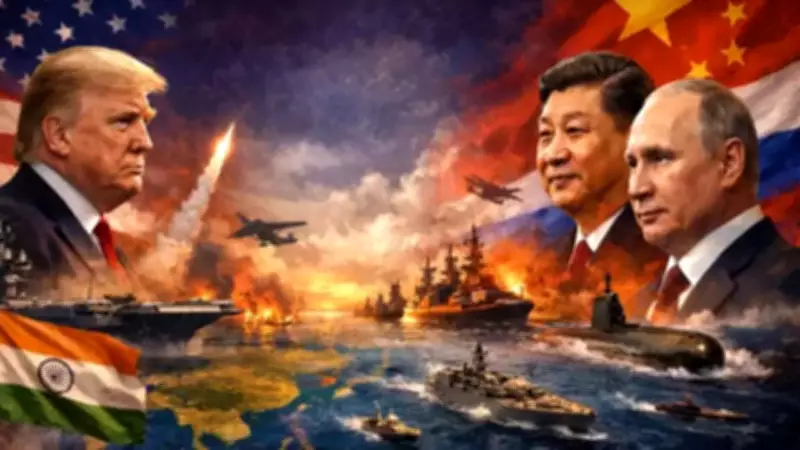
The Donroe Doctrine: A New Blueprint for American Geopolitics
The recently unveiled Donroe Doctrine, a Trump-era corollary to the historic Monroe Doctrine embedded within America's National Security Strategy, is poised to fundamentally reshape global geopolitics for decades to come. Its precise implications and potential trajectories demand thorough, detailed analysis. This doctrine appears to form the ideological core of an escalating Cold War 2.0 between the United States and the so-called "Dragon-Bear" alliance of China and Russia.
Strategic Focus: From Western Hemisphere to Indo-Pacific
While the doctrine's immediate focus centers on securing the Western Hemisphere, its long-term vision is firmly fixed on the Indo-Pacific region. The primary MAGA objective is to prevent Chinese hegemony across Asia. The Western Hemisphere is being fortified through control over critical resource access and command of strategic-military metrics in the Arctic. However, the ultimate goal remains projecting American power into the Indo-Pacific to deter the advancing Chinese juggernaut.
Within this context, the Doctrine actively seeks to establish a new hemispheric balance. President Trump demonstrates greater interest in becoming the undisputed hegemon of the Western Hemisphere rather than merely leading the Western world. The Trumpian perspective demands that the Western Hemisphere remain exclusively under American influence—a warning to both resident powers like Venezuela, Cuba, and Colombia, and external trespassers including China, Russia, and Iran.

Reconfiguring Global Alliances and Responsibilities
The Trans-Atlantic order is undergoing significant re-framing with new metrics and nuanced approaches. Greenland's status remains non-negotiable, even at the cost of alienating dependable ally Denmark and potentially endangering NATO cohesion, because Chinese and Russian submarines and destroyers must be kept at bay. Russia will be largely delegated to European nations to manage, with America providing only clandestine assistance for occasional strategic provocations like Operation SPIDER WEB (the Ukrainian drone strike on Russian nuclear assets in May 2025) or the more recent December 2025 strike on the Putin compound in Valdai.
Thus, while the Russian bear remains in America's peripheral cross-hairs, wealthy European nations are expected to assume primary responsibility for the military burden—both in terms of blood and treasure. In West Asia, having neutralized the Axis of Resistance, the United States looks toward Abraham Accords signatories and potential signatories to pioneer a new strategic discourse. This shift moves away from traditional oil dependence and Islamic fundamentalism, embracing instead modern conversations around artificial intelligence, data centers, renewable energy, luxury developments, and real-estate investments.
The Dragon-Bear Counterstrategy and Capacity Assessment
The Dragon-Bear alliance designs its strategy by combining Chinese technological and economic prowess with Russian military capabilities to collectively challenge American global dominance. In the techno-economic domain, China demonstrates remarkable resurgence, potentially holding a clear advantage. During recent trade conflicts, China not only absorbed American tariff blows but retaliated with a stunning rare-earth embargo that forced Trump to seek peaceful resolution.
Noted academic Rush Doshi's net assessment reveals decisive metrics favoring China: steel production capacity thirteen times larger, cement production twenty times greater, shipbuilding capacity two hundred times superior, and warship production three times more extensive. China currently produces approximately half of global chemicals, 67-70% of electric vehicles, over three-quarters of world batteries, 80% of consumer drones, 90% of solar panels, and 90% of refined rare earths.
However, current evidence suggests American military capabilities significantly outperform Sino-Russian capacities, as demonstrated by recent events in Syria, Iran, and Venezuela. As competition in this New Cold War intensifies, while multiple theaters will prove significant, the ultimate argument will be settled in the Indo-Pacific region.

Donroe Statecraft: From Isolationist Misconception to Global Strategy
Viewing Trump as an isolationist represents a fundamental error—he operates as a globalist meticulously preparing American statecraft for anticipated eventualities. Tariffs served as the initial arrow in the Donroe statecraft quiver, with Liberation Day and accompanying measures reportedly generating eighteen trillion dollars according to presidential claims. Trump has now pledged a staggering 1.5 trillion dollars to rebuild military capabilities as the Donroe Doctrine's centerpiece.
The success of Operation ABSOLUTE RESOLVE in Venezuela, which extracted Maduro, effectively silenced de-dollarization cries and facilitated one of history's greatest energy realignments. A significant portion of Venezuela's 300 billion barrels of oil (representing 18% of global reserves) now falls under American control. In high-end frontier artificial intelligence, America appears dominant with daily AI investments reaching one billion dollars, projected to hit three billion by 2030. In capital, computational power, and agentic AI development, the United States maintains global leadership.
While the battle remains evenly poised, the Donroe Doctrine could potentially tilt scales and help America regain decisive advantage.
India's Strategic Response and Opportunities
The critical question emerges: how should India respond to the Donroe Doctrine? What strategic and tactical adjustments become necessary? Are there favorable intersection points? If the doctrine's purpose genuinely involves checkmating Chinese hegemony in Asia, long-term Indo-American interests demonstrate significant congruence. China remains unequivocal that only one tiger can occupy Asia's summit.
The only viable path for two tigers on opposing slopes involves developing homegrown deterrence capabilities combined with smart, external balancing of Chinese influence. If India can successfully navigate trade negotiation challenges with America, could a larger strategic bargain emerge encompassing technological partnerships, capacity building, market access, and deterrence development?
Given the massive geopolitical pivot toward hard power and aggressive tactics, with technology driving national security like never before, India must fire on two cylinders simultaneously. First, aggressive, decisive steps toward mastering Fourth Industrial Revolution technologies—artificial intelligence, quantum computing, robotics, autonomous systems, energy innovation, and data leveraging. Second, resourcing military instruments with substantially greater vigor, accelerating the ongoing national security transformation by an order of magnitude.





