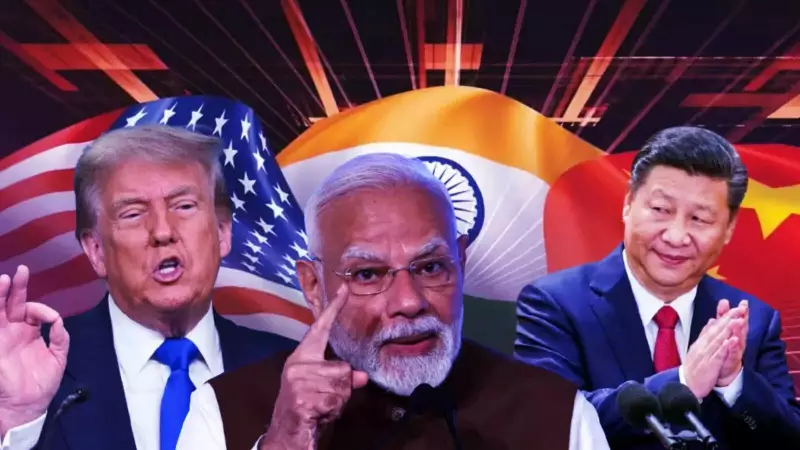
A provocative new theory is gaining ground among certain Chinese strategic thinkers, painting a picture of an imminent global power shift. According to this narrative, China is firmly on a path to the top, while the United States and India are left to scrap for a distant second place. This perspective, articulated by analysts like Keji Mao, suggests a fundamental breakdown in Washington's long-standing strategy towards New Delhi.
The End of American "Strategic Altruism" Towards India
Keji Mao, an analyst at China's International Cooperation Center and founder of the South Asia Research Brief, roots his argument in recent history. He claims that since the late 1990s, the United States practiced what Chinese scholars term "strategic altruism" towards India. This involved Washington absorbing diplomatic costs to bring New Delhi into the global fold, with the landmark U.S.-India civil nuclear deal being the prime example. The underlying logic was that a democratic, rising India would naturally help balance China's influence in Asia.
Mao asserts this logic has now collapsed. He points to actions during Donald Trump's second term, including steep tariffs on Indian goods, higher visa fees, tighter outsourcing rules, and dismissive rhetoric, as evidence of a structural shift. He dismisses the notion that this was merely a "Trump anomaly." Instead, Mao argues the root cause is American anxiety over its own declining strength, which now outweighs concerns about external threats like China. In this view, the U.S. is turning its allies into "blood bags," squeezing them for immediate gains rather than investing in long-term strategic partnerships.

India, Mao contends, is particularly vulnerable. Having enjoyed U.S. indulgence but lacking the industrial might of Japan or Europe, it is seen as "conspicuously ungrateful" when it resists pressure. He suggests this growing friction could eventually reduce tensions between Beijing and both Washington and New Delhi, creating a realignment favorable to China.
Questioning the Linear Narrative: Flaws in the "Decline and Rise" Thesis
While Mao's logic offers a coherent and comforting narrative for Beijing, it rests on several fragile assumptions. The first is a linear view of American decline. History shows a more cyclical pattern. From the Sputnik shock and Vietnam to Japan's rise in the 1980s and the 2008 financial crisis, predictions of America's eclipse have been frequent. Yet, each time, the U.S. has adapted through innovation, institutional strength, and its alliance networks.
Current evidence does not show a U.S. retreat from Asia. Despite trade disputes, Washington has deepened security ties with Japan, Australia, the Philippines, and South Korea, expanded technology controls targeting China, and maintained a robust military posture in the Indo-Pacific. These are not the actions of a power conceding second place.
China's Domestic Challenges and Geopolitical Constraints
Mao's confidence also leans on assumptions about China's unstoppable economic rise, which recent data complicates. While exports surged and growth met targets in 2025, underlying momentum has softened. Investment is contracting for the first time since 1998, retail sales growth is weak, and the property crisis persists, prompting pledges for broader fiscal support in 2026.
Economic stress is compounded by political anxiety. Reports indicate Xi Jinping probed a record number of senior officials for corruption in 2025, following purges of top generals. Such internal turbulence, as noted by Alfred Wu of the National University of Singapore, constrains how aggressively China can act on its global ambitions.
Furthermore, geography remains a powerful constraint. China shares borders with 14 nations, many of which, like India, Japan, and Vietnam, have unresolved disputes or strained relations with Beijing. As former Singaporean diplomat Bilahari Kausikan observed, while every country wants good relations with China, few in the region would "meekly acquiesce to China occupying the apex of a regional hierarchy." This limits Beijing's ability to convert economic weight into political dominance.

India's Independent Trajectory: Beyond a "Battle for Second"
The analysis that consigns India to a permanent second place misses the dynamics of its unique rise. India's strengths lie in its demographics, services sector, digital public infrastructure, and strategic geography. Unlike China, it does not face the same rapid demographic aging. Its market size and political pluralism make it an attractive alternative for global firms seeking diversification.
India's geographic position, astride key Indian Ocean sea lanes and sharing a border with China, grants it inherent leverage. It cannot be easily sidelined by Washington or coerced by Beijing. While frictions with the U.S. under Trump are real, they are not a rupture. Structural interests—like balancing China and securing supply chains—continue to pull the relationship back together. India's rise is powered by domestic reform and its own market scale, not solely by American indulgence.
The Danger of Overconfidence and the Path Ahead
For Beijing, the danger lies in mistaking temporary U.S.-India strains for a permanent realignment. Overconfidence could lead to miscalculation, especially as domestic challenges grow. Analysts warn that hubris could tempt China towards aggressive overreach in areas like trade, Taiwan, or pushing new global rules. Some calculations suggest even a blockade of Taiwan could shrink China's GDP by 7-9%, severely impacting its superpower aspirations.
The more probable future is one of prolonged, contested coexistence. China will rise but be constrained by internal and external factors. The U.S. will adapt rather than fade. India will carve out a larger, more independent role on the world stage. The world is too complex and dynamic for a simple hierarchy; power is a mosaic, and influence is accumulated in multiple domains. The narrative of a straightforward race for first and second place is a simplification that obscures the true, multifaceted nature of twenty-first-century geopolitics.