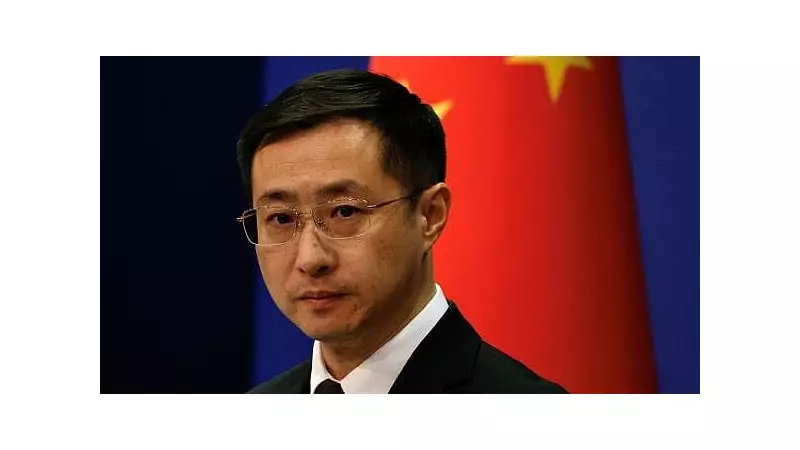
China has launched a sharp diplomatic critique against the United States, accusing it of attempting to sabotage improving relations between Beijing and New Delhi. The accusation was made by Chinese Foreign Minister Wang Yi during a press conference on the sidelines of the National People's Congress in Beijing on Thursday, March 7.
Beijing's Accusation: Washington's "Strategic Suppression"
Wang Yi explicitly stated that China has noticed the United States has been "pulling strings" and creating obstacles behind the scenes in the context of China-India relations. He framed this alleged American activity as part of a broader pattern of Washington's "strategic suppression of China's development." The Foreign Minister's comments represent a direct and public allegation of US meddling in the bilateral dynamics between the two Asian giants.
This accusation comes at a time when India and China have been engaged in prolonged military and diplomatic talks to resolve a tense border standoff that began in May 2020. Despite over 20 rounds of corps commander-level meetings, complete disengagement and de-escalation at remaining friction points like Depsang and Demchok are yet to be achieved.

China's Call for Independent India-China Engagement
Emphasizing Beijing's preferred approach, Wang Yi called for India and China to handle their affairs independently, free from external influence. He asserted that the two nations possess the capability and wisdom to manage their relationship mutually. The Chinese position advocates for resolving differences through dialogue and consultation, positioning external involvement as unhelpful and disruptive.
The Foreign Minister also highlighted that the current state of China-India relations maintains "generally stable" development. He pointed to ongoing diplomatic communications, including the meeting between the two countries' foreign ministers in Russia last year, as evidence of positive engagement. Wang Yi expressed China's readiness to work with India to advance bilateral relations in a healthy and stable manner on the basis of mutual respect and mutual benefit.
Context and Implications of the Diplomatic Salvo
This public accusation is significant for several reasons. Firstly, it attempts to externalize the challenges in the India-China relationship, suggesting that a third party (the US) is a primary spoiler. This aligns with China's frequent narrative against what it perceives as US-led efforts to contain its rise globally, including through partnerships like the Quad, which includes India, the US, Japan, and Australia.
Secondly, the statement appears to be an effort to appeal to Indian strategic autonomy, urging New Delhi to sidestep closer ties with Washington in favor of a purely bilateral framework with Beijing. However, this comes against the backdrop of deep Indian mistrust following the 2020 Galwan Valley clash, which marked the most serious military conflict between the two nations in decades.
The development underscores the complex geopolitical triangle involving Washington, Beijing, and New Delhi. As India continues to strengthen its strategic and defense partnerships with the United States and other Quad members, China is making a visible effort to drive a wedge and caution India against aligning too closely with the US camp. The future trajectory of India-China relations will likely depend not just on border negotiations but also on how New Delhi navigates these competing pressures and its own assessment of national interest.