

Chandigarh Administration Submits Holistic Development Plan for High Court to UNESCO Heritage Body
CHANDIGARH: The Chandigarh administration has formally submitted a comprehensive concept note outlining a holistic developmental plan for the Punjab and Haryana High Court to the Government of India. In a significant procedural step, the central government has forwarded this detailed document to the Foundation Le Corbusier in Paris for expert review and necessary action. The high court has been officially apprised of this crucial development.
Addressing Architectural Challenges Through Strategic Planning
The Union Territory administration, in its meticulously prepared concept note, has addressed multiple components and challenges related to the historic high court building. The document comprehensively explains current architectural limitations, functional requirements, and preservation needs. Importantly, the administration has informed both the Government of India and the Foundation Le Corbusier about the Chandigarh Heritage Conservation Committee's perspective on the subject, emphasizing the critical need for balanced development that respects heritage while meeting contemporary demands.
Three-Part Conceptual Framework for Transformation
The concept note is structured into three distinct segments that provide a complete framework for the proposed development:

- Context and Significance: This section establishes the historical and architectural importance of the high court within Chandigarh's Capitol Complex.
- Challenges and Evolution: This segment details the functional and spatial limitations that have emerged over decades of use.
- Concept Vision: This portion outlines the transformative approach to addressing shortcomings while preserving heritage integrity.
The Concept Vision segment articulates a clear philosophy: "The Holistic Development Plan offers a transformative opportunity to redress these shortfalls while conserving the site's unique built heritage. To paraphrase Le Corbusier, it restores to the complex 'space and light and order' — harmonising modernist legacy with contemporary judicial demands through sensitive expansion, rational planning, and enhanced public accessibility."
Addressing Functional Deficiencies Through Design Innovation
The concept note specifically addresses glaring deficiencies in facilities, infrastructure, parking availability, and public space within the high court complex. The proposed solution involves consolidating and reorganizing scattered outbuildings at the rear of the complex into a clean, purist-inspired mass that interlinks with adjacent structures through light-filled atriums. This architectural approach aims to create functional coherence while maintaining aesthetic harmony with the original design principles.
The Chandigarh Heritage Conservation Committee, recognizing the delicate balance between development and conservation, has agreed to forward the concept design to the Foundation Le Corbusier. This submission is intended for inclusion in the under-preparation International Management Plan for the UNESCO World Heritage Site. The approval process, supported by extensive studies and impact assessments, will now commence to ensure the proposed development not only respects the site but significantly enhances its architectural character.
Historical Context and Growing Pressures
In the Challenges and Evolution segment, the administration notes that archival drawings from 1954 already proposed additional buildings to accommodate the court's growing workload. Instead of following this planned expansion, multiple structures proliferated organically over time to meet emergent needs. The concept note states: "Today, surging litigation, footfall, and vehicular loads left the complex under-provisioned across key parameters: courtrooms, office spaces, areas for litigants and lawyers, and open public realms."

Architectural Significance and UNESCO Recognition
Explaining the context and significance, the administration emphasizes that Chandigarh's Capitol Complex — set against the Shivalik foothills with its expansive public spaces and monumental buildings — embodies the ideals of India's emerging democracy: transparency, order, and modernity rendered "in raw concrete." The note references Le Corbusier's vision of Chandigarh as "a city of trees, of flowers and water, of houses as simple as those at the time of Homer, and of a few splendid edifices of the highest level of modernism, where the rules of mathematics will reign."
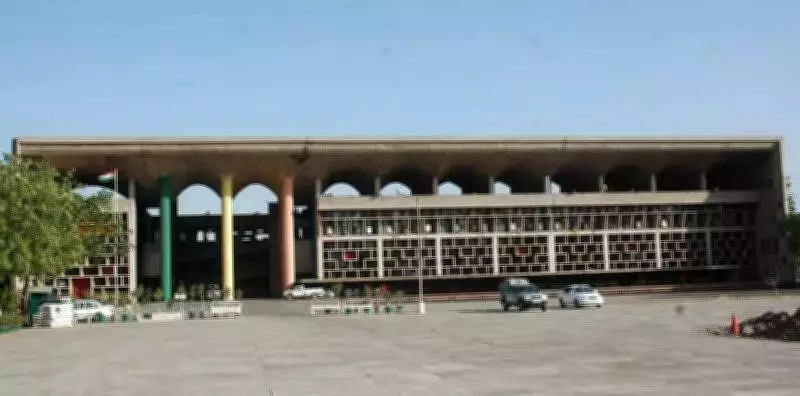
Completed in 1950, the Punjab and Haryana High Court, with its iconic inverted parasol form, was the first such edifice on the Capitol site. In 2016, the Capitol Complex — along with 16 other Le Corbusier projects across seven countries — was inscribed on UNESCO's World Heritage List as The Architectural Work of Le Corbusier, an Outstanding Contribution to the Modern Movement.
Implementation Process and Expert Engagement
While the process to design the detailed holistic expansion and developmental plan for the high court is already underway, the Union Territory administration recently engaged a Delhi-based architectural firm through an expression of interest process. This firm has been tasked with a dual mandate: drafting a comprehensive development plan and securing necessary approvals from the Government of India, the Chandigarh Heritage Committee, and UNESCO's heritage bodies.
The submission to Foundation Le Corbusier represents a critical milestone in this ambitious project that seeks to balance architectural preservation with functional modernization of one of India's most significant judicial buildings.





