Canadian Leader Delivers Forceful Rebuttal to US President's Remarks
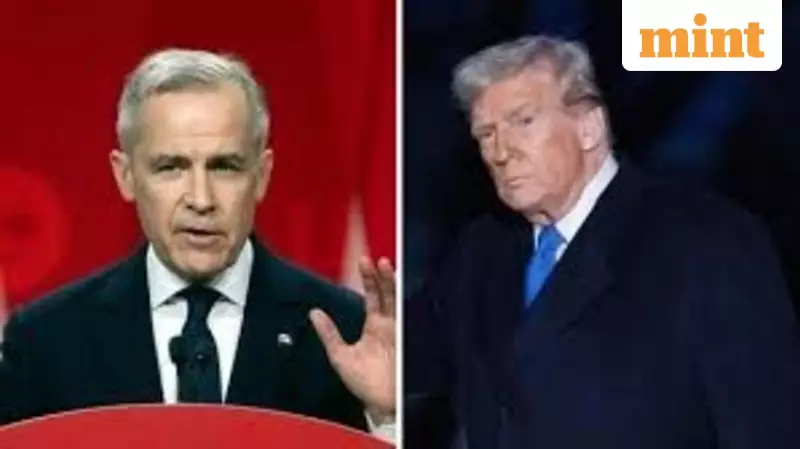
In a striking diplomatic exchange at the World Economic Forum in Davos, Canadian Prime Minister Mark Carney issued a sharp response to former US President Donald Trump's controversial comments about Canada's relationship with its southern neighbor. The verbal clash highlighted growing tensions between the two traditionally close allies over issues of sovereignty, defense, and economic independence.
Trump's Provocative Assertion at Davos Gathering
During his appearance at the annual gathering of global leaders on Wednesday, Donald Trump made headlines with his blunt assessment of the Canada-US relationship. The former president claimed that "Canada lives because of the United States" while criticizing what he perceived as Canadian ingratitude for American military protection.
Trump specifically referenced his proposed Golden Dome missile defense system, which he said would extend protection to Canadian airspace. "Canada gets a lot of freebies from us, by the way. They should be grateful also, but they're not," Trump stated during his remarks. "I watched your prime minister yesterday. He wasn't so grateful."

The comments came in response to Carney's Tuesday speech at the same forum, where the Canadian leader had encouraged mid-sized nations to unite against what he described as aggressive superpower tactics.
Carney's Firm Defense of Canadian Sovereignty
Prime Minister Carney responded directly to Trump's remarks during a national address on Thursday, delivering what many observers described as one of the most forceful defenses of Canadian sovereignty in recent memory. "Canada doesn't live because of the United States," Carney declared unequivocally. "Canada thrives because we are Canadian."
While acknowledging the historical partnership between the two nations, Carney emphasized that Canada's success stems from its own values, institutions, and people. "Canada and the United States have built a remarkable partnership," he noted, "but that partnership has always been between sovereign equals."
Broader Context of Carney's Davos Address
The exchange occurred against the backdrop of Carney's broader critique of the current global order during his Tuesday speech at the World Economic Forum. The Canadian prime minister, a former central banker who took office last year, declared that the international rules-based system has essentially collapsed.
Carney warned that the world has entered a new era where powerful nations increasingly use economic integration as a tool of coercion against smaller countries. This assessment was particularly notable given Canada's historical economic dependence on and military partnership with the United States.
Since assuming office, Carney has pursued policies aimed at reducing Canada's reliance on its southern neighbor:
- Signing a limited trade agreement with China to diversify economic partnerships
- Implementing billions of dollars in new defense spending to enhance military capabilities
- Evaluating potential investments in the Golden Dome missile defense system, despite concerns about its $175 billion to $1.1 trillion estimated cost
Defense Cooperation and Modernization Efforts
The defense relationship between Canada and the United States remains complex despite the current tensions. Both countries continue to collaborate through the North American Aerospace Defense Command (Norad), a joint organization that has monitored North American airspace for decades.
In 2022, Canada announced a substantial C$38.6 billion ($28 billion) plan to modernize the Norad system. This initiative includes:
- Development of a new radar network created in Australia to detect incoming missiles
- Enhanced surveillance capabilities for both conventional and advanced threats
- Improved coordination mechanisms between Canadian and American defense forces
Prime Minister Carney personally unveiled details of this modernization program in March, emphasizing Canada's commitment to continental security while maintaining national sovereignty in defense decision-making.

Technological and Strategic Considerations
The proposed Golden Dome missile defense system that Trump referenced represents a significant point of discussion in Canada-US defense relations. While the system is designed to defend North America against various threats including ballistic missiles, hypersonic weapons, and advanced cruise missiles, it relies on untested space-based technology.
Canadian officials are carefully evaluating whether to participate in this ambitious project, weighing the potential security benefits against the enormous financial costs and technological uncertainties. This deliberation reflects Carney's broader approach to defense policy: seeking enhanced protection while avoiding excessive dependence on any single partner.
The Davos exchange between Carney and Trump has brought these underlying tensions to the surface, revealing how even long-standing alliances must adapt to changing global dynamics and evolving national priorities.