In a momentous political event, Tarique Rahman, the acting chairman of the Bangladesh Nationalist Party (BNP), made a dramatic homecoming to Dhaka on Thursday, ending a 17-year exile. His return to a nation in the grip of deep political turmoil was marked by massive crowds and symbolic gestures, setting the stage for a significant shift in the country's political dynamics.
A Historic Homecoming and Symbolic Gestures
Rahman arrived from London, accompanied by his wife Zubaida Rahman, daughter Zaima Rahman, and their pet cat Zeebu. Stepping onto Bangladeshi soil for the first time in over a decade and a half, he was greeted by scenes of fervent celebration from supporters. In a poignant act captured by AFP, he removed his shoes, stepped onto the grass outside the airport, and scooped up soil in a gesture of reverence for his homeland.
According to reports from The Daily Star, he then boarded a 'bulletproof bus' painted in the red and green colours of the Bangladesh national flag. The convoy, under heavy security, made its way through the capital as party videos showed Rahman waving to the surging crowds that had gathered to welcome him back.

'I Have a Plan': Rahman's First Speech on Home Soil
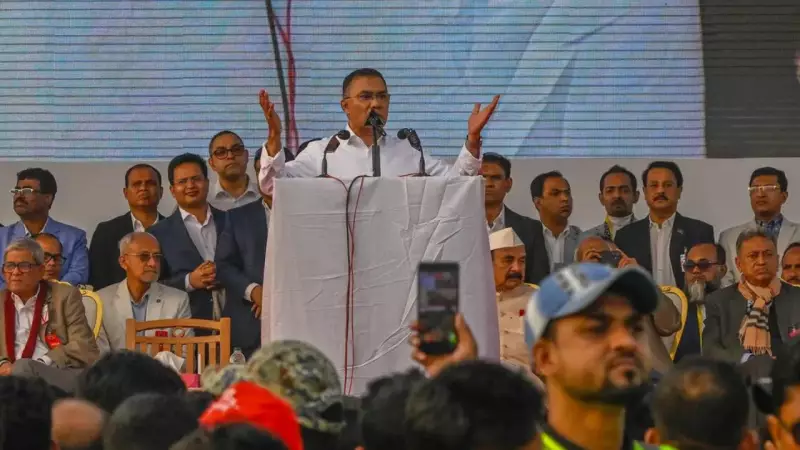
In his first address after landing, quoted by the Bangladesh-based newspaper Prothom Alo, Rahman drew a powerful parallel between the country's recent political crisis and its foundational struggle. He equated the public defence of the nation's sovereignty in 2024 to the 1971 Liberation War that led to Bangladesh's independence.
"Just as the people of this country achieved independence in 1971, people from all walks of life, all together, defended the independence and sovereignty of this country in 2024," he stated. Rahman declared that the people of Bangladesh now seek to reclaim their right to speech and democracy.
Invoking the spirit of Martin Luther King Jr., he offered his own refrain: "I have a plan." He emphasized that implementing this vision would require the participation of every citizen. His speech called for unity across all communities—"people from the hills, plains, Muslims, Hindus, Buddhists, Christians"—to build a safe Bangladesh where everyone can move freely and without fear.
Remembering slain student leader Osman Hadi, Rahman said repaying the "blood debt" of martyrs from 1971 and 2024 required building the "desired Bangladesh." Shortly after his arrival, he also posted a photograph on Facebook captioned, “Back in Bangladesh skies after 6,314 days!”
Implications for Bangladesh's Politics and India
Rahman's return is strategically crucial as it positions him as the most prominent face of the BNP. This is especially significant given his mother, former Prime Minister Khaleda Zia, is ailing and unable to lead the party. He is expected to visit the 80-year-old former leader, who is undergoing treatment at Evercare Hospital in Dhaka, where BNP supporters have gathered in a show of force.
His homecoming is set to reshape not only Bangladesh's internal politics but also its critical relationship with neighbouring India. Bilateral ties have been strained since the 2024 political upheaval that led to the exile of former Prime Minister Sheikh Hasina. Hasina left a violence-hit Dhaka in August 2024 after crowds surrounded her residence, forcing her to seek refuge in India. Her continued presence there influences the diplomatic dynamic between New Delhi and Dhaka.
With national elections on the horizon, the absence of Hasina and the renewed momentum behind the BNP under Rahman's leadership raise the stakes considerably for both nations. India is already navigating unease due to unrest in Bangladesh following the assassination of Osman Hadi and the killing of a minority community member, Dipu Chandra Das. Rahman's return adds a volatile new dimension to this complex geopolitical equation, potentially affecting how Dhaka and New Delhi recalibrate their relationship in the coming months.