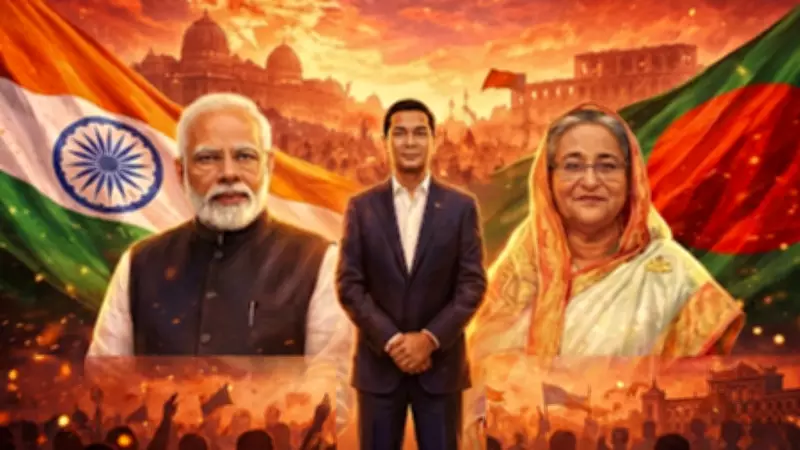
Bangladesh's Political Landscape Transformed by BNP's Decisive Electoral Mandate
The 13th national parliamentary elections in Bangladesh have delivered a commanding mandate to the Bangladesh Nationalist Party (BNP), marking a decisive political shift following months of political turbulence. Beyond the sheer scale of victory, the outcome has drawn significant attention for the return of several controversial leaders whose past convictions, subsequent acquittals, and alleged anti-India connections are poised to reshape regional diplomatic calculations.
Electoral Reset and Regional Implications
The polls, which saw BNP chief Tarique Rahman secure a two-thirds parliamentary majority, represent a fundamental reset after the mass uprising that led to the ouster of former prime minister Sheikh Hasina. The BNP-led alliance captured 212 seats, securing more than a two-thirds majority in Parliament, while the Jamaat-e-Islami-led alliance won 77 seats. Notably, Hasina's Awami League was barred from contesting the elections entirely.
Hasina fled to India in 2024 amid the unrest, after which Nobel laureate Muhammad Yunus headed an interim administration. Since her departure, relations between Dhaka and New Delhi have remained strained. While Prime Minister Narendra Modi congratulated Rahman on his party's "decisive victory" and expressed hope for strengthening ties, the electoral success of figures with complex histories adds intricate layers to India-Bangladesh engagement.

Controversial Figures Return to Political Prominence
Lutfozzaman Babar: From Death Row to Landslide Victory
Former state minister for home affairs Lutfozzaman Babar, contesting on a BNP ticket, secured a sweeping win in the Netrokona-4 constituency with 160,351 votes, defeating his Jamaat-e-Islami rival by a margin of 121,042 votes. His return marks a dramatic reversal of fortune. In 2014, a special tribunal sentenced him to death in the 10-truck arms haul case, one of Bangladesh's largest arms smuggling investigations involving weapons allegedly intended for the Indian separatist group ULFA. However, in 2024, the Bangladesh high court acquitted Babar and several others, overturning the earlier death sentences.
Abdus Salam Pintu: Grenade Case Acquittal and Alleged Anti-India Links
Former BNP vice-chairman Abdus Salam Pintu has returned to Parliament after securing 198,867 votes in Tangail-2, the highest tally in his district. His political comeback follows nearly 17 years behind bars for his alleged involvement in the 2004 grenade attack on an Awami League rally that killed 24 people. In December 2024, he was released from prison after the high court acquitted him. Pintu has also been accused of aiding the Pakistan-based militant group Harkat-ul-Jihad-al-Islami (HuJI) in carrying out attacks against India, though these specific allegations lack official confirmation.
ATM Azharul Islam: War Crimes Convict Turned Parliamentarian
Jamaat-e-Islami leader ATM Azharul Islam won the Rangpur-2 seat with 135,556 votes. Azharul had been sentenced to death in 2014 after being convicted by the International Crimes Tribunal for crimes against humanity during the 1971 Liberation War. In 2025, Bangladesh's Supreme Court overturned his conviction, terming the earlier judgment flawed. His acquittal triggered polarized reactions, with student groups at Dhaka University and Rajshahi University staging protests accusing the interim administration of "rewriting history."
Hasnat Abdullah: Anti-India Rhetoric and Electoral Success
In Cumilla-4, National Citizen Party candidate Md Abul Hasnat, widely known as Hasnat Abdullah, won with 166,583 votes. Hasnat has drawn attention in India for his sharp rhetoric, including warnings that India's northeastern states could be "isolated" and suggestions about offering refuge to separatist groups if Bangladesh were destabilized. His rise indicates growing political space for figures adopting overtly nationalist or anti-India positions, a development closely monitored in New Delhi.

Extradition Demand Creates Diplomatic Complexity
The BNP's return to power has revived Dhaka's demand for the extradition of former prime minister Sheikh Hasina from India, creating an early diplomatic challenge. Soon after the party's landslide win, senior BNP leader Salahuddin Ahmed stated that the new government would pursue her return, with the matter to be handled "according to the law" between foreign ministries.
Hasina has been in New Delhi since August 2024 after being removed from office. In November 2025, a special tribunal in Bangladesh sentenced her to death in absentia for crimes against humanity linked to the violent crackdown on protesters during the 2024 unrest. India has confirmed receiving Dhaka's official extradition request, with the Ministry of External Affairs stating the request is being "examined." Hasina has rejected the charges as politically motivated and expressed willingness to face proceedings in what she described as a neutral and fair international forum.
BNP's Foreign Policy Doctrine: "Friend Yes, Master No"
In its election manifesto unveiled by Tarique Rahman, the BNP outlined a firmer foreign policy approach under the slogan "Friend Yes, Master No" and a doctrine described as "Bangladesh Before All." While India was not explicitly mentioned, the document emphasized taking stricter stands on issues including alleged "border killings," "push-ins," smuggling, and securing Bangladesh's fair share of water from shared rivers like the Teesta and Padma.
Rahman reinforced this message in his first public address after results were declared, stating that Bangladesh's foreign policy would be guided by the principle that "people come first," with national interest determining external engagement, including with New Delhi. His adviser Humayun Kabir made pointed remarks about regional radicalization, referring to "Hindu extremism and far-right intolerance" in India while emphasizing that Bangladesh would pursue balanced relations without limiting partnerships to any single country.
Strategic Implications for Regional Diplomacy
The BNP's emphatic victory may restore electoral legitimacy after a turbulent political chapter, but the composition of the new Parliament introduces uncertainty about policy direction. The return of leaders once sentenced in major criminal cases, alongside figures associated with hardline rhetoric on India, complicates the diplomatic landscape at a sensitive moment in bilateral ties.
For India, which developed close security coordination and counter-insurgency cooperation with Dhaka under Hasina's administration, the transition requires careful diplomatic calibration. Issues including border management, cross-border militancy, water sharing, and minority safety are likely to resurface more prominently in coming months. Whether the BNP's mandate translates into substantive policy shifts or remains anchored in domestic political positioning will determine the trajectory of India-Bangladesh relations in this new political era.