

Bangladesh's Political Landscape Transforms Ahead of Crucial Elections
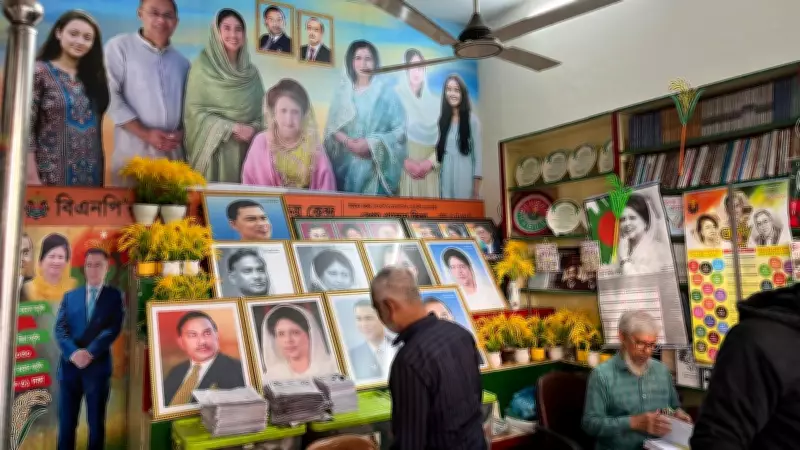
As Bangladesh approaches its February 12, 2026 national elections, a striking visual transformation has swept through the capital city of Dhaka. The political posters that once prominently featured former Prime Minister Sheikh Hasina and the Awami League's "boat" symbol have been completely replaced by images of Bangladesh Nationalist Party (BNP) leaders, particularly Begum Khaleda Zia, her son Tarique Rahman, and her late husband Ziaur Rahman.
A Tale of Two Political Headquarters
At the heart of this political shift lies a dramatic contrast between the two main political parties. The BNP's office in Nayapaltan, Dhaka, buzzes with activity as a steady stream of visitors purchases party memorabilia from a ground-floor store. Badges featuring the BNP's "dhaaner sheesh" (sheaf of paddy) symbol remain particularly popular among supporters, alongside posters, books, and T-shirts celebrating party leadership.
"We are asking people to go out and vote, they have been deprived of this for the last 17 years," declared Goyeshwar Chandra Roy, BNP's standing committee member and the party's most prominent Hindu leader, in an exclusive interview.

Just two kilometers away in Gulistan, the Awami League's former headquarters presents a starkly different picture. The imposing building stands abandoned, emitting an overpowering stench of urine and serving primarily as a parking space for local flower suppliers' tempos. Local residents describe the area as having transformed into a makeshift toilet and storage facility for nearby shops.
Political Absence Creates Electoral Vacuum
The 2026 elections mark a significant departure from previous electoral cycles in 2014, 2018, and 2024, when Awami League posters dominated the urban landscape. This time, the Awami League has been banned from participating in the polls, with its leaders either having fled the country or gone into hiding. The party's supporters and activists have become virtually invisible across Bangladesh.
Political analysts note that with no strong competitor in the electoral battlefield, the BNP is positioned for a clear victory. The only remaining question concerns the scale of their triumph, with BNP leaders hoping to secure a comfortable majority in the 300 directly-elected seats of the Bangladesh Parliament.
"BNP has a strong network of partymen at the grassroots, and is ahead of its rivals," explained Kazi Mohammed Mahbubur Rahman, professor of political science at Dhaka University. "In the absence of the Awami League, secular voters may opt for the BNP. The people were frustrated with the Awami League's electoral rigging and want to vote for change."
Constitutional Reforms and Electoral Significance
Bangladesh has undertaken the unprecedented task of holding both national elections and a constitutional referendum on the same day. The proposed reforms seek to restore balance between executive and legislative branches through several key changes:
- Limiting the Prime Minister's term to a maximum of two five-year terms
- Establishing a bicameral Parliament system
- Restoring the neutral caretaker government system
- Empowering the Election Commission with greater authority
With approximately 12.7 crore registered voters (about 6.4 crore men and 6.2 crore women) in this nation of over 18 crore people, the electoral process carries significant weight for Bangladesh's democratic future. India has consistently called for credible, inclusive, and participatory elections that would allow all major political parties to participate.
BNP's Vision and Minority Perspectives
The BNP, now led by Tarique Rahman, has positioned itself as seeking to establish "a new political culture oriented towards the future, opposite to politics of revenge and retribution," according to its official manifesto. Party leaders emphasize their commitment to creating a unified national identity by overcoming political divisions.
Regarding minority communities, senior BNP leader Goyeshwar Chandra Roy highlighted positive developments: "Although the Hindu minority population is small, our pujas have increased manifold. This shows the Hindu minority community is free to celebrate their festivals without targeting."

BNP supporters echo this sentiment of seeking stability, with one supporter wearing pictures of Tarique Rahman's wife Zubaida and daughter Zaima stating simply: "We want to live peacefully, in a stable Bangladesh."
Symbolic Changes Reflect Political Shifts
The political transformation extends beyond mere poster changes. At the Awami League's deserted office, a poster now labels it as the "international fascism and massacre research institute." The street outside has been symbolically renamed from Bangabandhu Avenue to Shahid Abrar Fahad Avenue, commemorating a student allegedly killed by Awami League youth wing activists in 2019.
As painters and electricians work to prepare BNP offices for the upcoming elections, the political writing appears clearly on Dhaka's walls. After twenty years out of power, the Bangladesh Nationalist Party stands poised for a significant electoral comeback, while the Awami League's absence creates an unprecedented political vacuum in Bangladesh's democratic landscape.





