

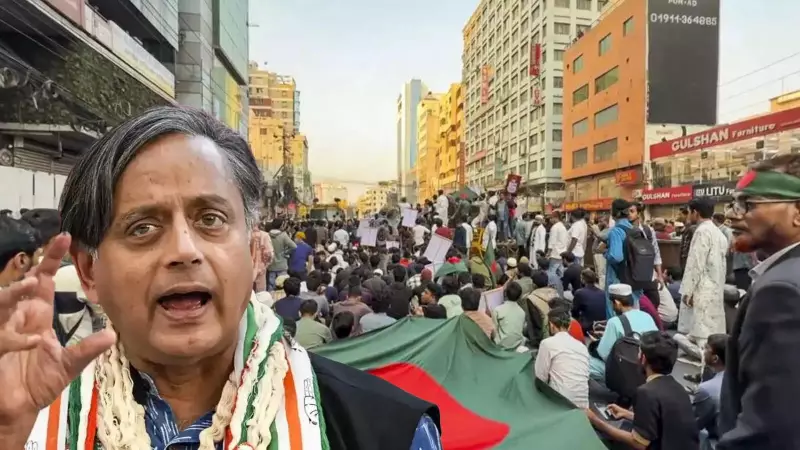
A major parliamentary report has sounded a stark alarm, declaring the escalating crisis in neighboring Bangladesh as India's most significant strategic challenge since the 1971 war. The assessment comes from the Parliament's Standing Committee on External Affairs, chaired by Congress MP Shashi Tharoor.
Five Deep Fault Lines Driving the Crisis
The committee's report, tabled in Parliament, pinpoints five critical and interconnected fault lines that are fueling the instability across the border. The panel identifies weakening political institutions and a sharp shrinkage of democratic space as primary internal drivers. Compounding this is rising Islamist radicalism and severe economic distress among the populace.
Externally, the report highlights the growing influence of China and Pakistan in Bangladesh's affairs as a major concern for New Delhi. This combination of internal fragility and external maneuvering has created a perfect storm, with public anger simmering and the future of elections remaining highly uncertain.

Immediate Triggers and Threats to India
The urgency of the committee's warning was underscored by fresh violence that erupted in Bangladesh shortly after the report was tabled. The unrest was triggered by the killing of a youth leader, Sharif Osman Hadi. The situation deteriorated rapidly, with streets witnessing arson, attacks on media offices, and even a direct threat to India's diplomatic mission in the port city of Chattogram.
This volatility on the ground directly translates to a security challenge for India's eastern flank. The committee explicitly warns that prolonged instability in Bangladesh poses a direct threat to India's eastern security and compromises its long-term strategic interests in the region.
Why This is India's Biggest Test in Decades
The comparison to 1971 is deliberate and grave. Over five decades ago, India was deeply involved in the creation of Bangladesh following a war with Pakistan. Today, the threat is not of a conventional military conflict but of a gradual descent into chaos in a strategically vital neighbor. Bangladesh shares a long and porous border with several sensitive Indian states, making any internal collapse a direct national security issue.
The Tharoor-led panel's analysis suggests that India must navigate this complex crisis with extreme care. The factors at play—political vacuum, radicalism, economic woes, and rival geopolitical players—present a multidimensional problem that requires a nuanced and sustained diplomatic and strategic response from New Delhi to safeguard its own interests.






