

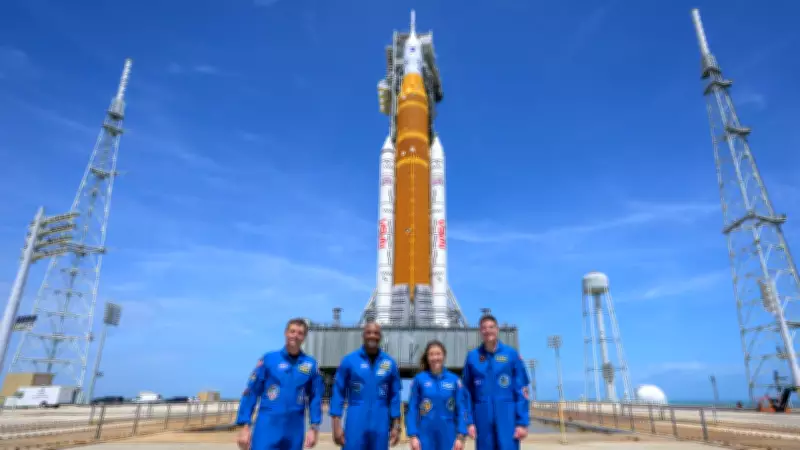
NASA's Artemis II Mission Launches: A New Chapter in Lunar Exploration
More than five decades after the historic Apollo 11 mission first placed humans on the lunar surface, NASA has embarked on a monumental return journey to the Moon. On April 1, 2026, with the launch occurring on April 2 according to Indian Standard Time, the Artemis II mission successfully blasted off from the Kennedy Space Center. This mission carries four astronauts on an ambitious 10-day voyage that will take them toward and around the Moon, marking a significant milestone in space exploration.
This launch represents the first time since Apollo 17 in 1972 that humans have traveled beyond low Earth orbit. However, despite this historic achievement, Artemis II will not include a landing on the lunar surface. This decision has generated considerable curiosity and skepticism among observers and space enthusiasts worldwide.
Why No Lunar Landing? Engineering and Safety Priorities
If NASA successfully landed astronauts on the Moon in 1969, why is the agency not repeating that feat immediately with Artemis II? The answer lies in a combination of engineering realities, rigorous safety validation protocols, modern program design, and a far more ambitious long-term vision than the Apollo program ever pursued.

Artemis II is fundamentally a crewed test flight designed to validate the Space Launch System rocket and Orion spacecraft under actual deep-space conditions. The 10-day mission serves as a comprehensive rehearsal with astronauts on board. Early in the flight, the crew will perform critical system checkouts and manual maneuvers in high Earth orbit, including practicing proximity operations near the spent upper stage of the rocket.
These maneuvers are absolutely essential for future missions where astronauts will need to dock with a lunar lander or the planned Gateway space station in lunar orbit. NASA's current approach deliberately mirrors the methodology of the Apollo era. Before the historic Apollo 11 landing, missions like Apollo 8 sent astronauts around the Moon without attempting a descent. Artemis II fulfills a similar purpose today, proving that humans can safely travel to deep space and return before attempting the complex landing phase.
Apollo vs. Artemis: Different Eras, Different Objectives
The Apollo program was primarily driven by Cold War competition with the Soviet Union. Its objective was singular and urgent: land a human on the Moon before the end of the 1960s and demonstrate technological superiority. NASA achieved this remarkable feat in just eight years, progressing from its first human spaceflight to the Apollo 11 landing in 1969. The program benefited from substantial funding, high political priority, and a narrow, focused goal. Once that goal was accomplished, the Apollo program concluded within a few years.
In stark contrast, the Artemis program operates in a completely different context. There is no single deadline or symbolic finish line. Instead of aiming for a one-time achievement, NASA is working to establish a long-term, sustainable human presence on the Moon. This vision includes building infrastructure that can support continuous exploration and, ultimately, serve as a stepping stone for missions to Mars. This fundamental shift from speed to sustainability dramatically alters how missions are designed and executed.
The Critical Role of Artemis II Before Any Landing
Artemis II exists because NASA cannot afford to skip essential steps when human lives are at stake. The mission is meticulously designed to test critical systems in real deep-space conditions before attempting a landing later in the decade. Key objectives include:

- Monitoring the spacecraft's life support systems to ensure air supply, water management, and carbon dioxide removal function flawlessly in the deep-space environment.
- Measuring radiation levels, which are significantly higher beyond Earth's protective magnetic field, to assess risks to astronaut health.
- Testing manual control and maneuvering capabilities, practicing operations that will later be required for docking with a lunar lander.
Before committing to the lunar trajectory, the spacecraft will remain in a high Earth orbit "safe zone," allowing engineers to verify all systems and execute an abort if necessary. Once on the lunar path, the mission will follow a free-return trajectory, ensuring the spacecraft naturally loops around the Moon and returns to Earth even in the event of a major system failure.
The mission will also rigorously test the high-speed re-entry phase, the most dangerous part of the journey, where the Orion capsule must withstand extreme heat and pressure. In essence, Artemis II is about proving that NASA can safely send humans to the Moon and bring them back home before attempting to land them on the lunar surface.
Addressing the Heat Shield Challenge
During the uncrewed Artemis I mission in 2022, Orion's heat shield experienced unexpected cracking during re-entry. Engineers identified the issue as related to how heat accumulated during the spacecraft's specific trajectory. For Artemis II, NASA opted to modify the re-entry profile rather than replace the entire heat shield. This decision makes testing with a human crew aboard even more critical before proceeding to a landing mission.
Why Modern Lunar Missions Are More Complex
Landing on the Moon today is substantially more complex than it was in 1969. Contemporary missions must adhere to stricter safety standards and are engineered for long-term sustainability rather than brief visits. The Artemis program aims to establish a sustained human presence, requiring new infrastructure such as the Gateway lunar space station, advanced next-generation spacesuits, and novel landing systems. NASA is not merely trying to land astronauts; the agency is working to ensure they can live, work, and conduct research safely on the Moon over extended periods.
Dispelling the 'Lost Technology' Myth
A common misconception suggests that NASA has somehow lost the technological capability to land on the Moon. In reality, Apollo-era systems like the Saturn V rocket were retired, and their manufacturing supply chains no longer exist. Modern missions are being constructed using entirely new technologies and contemporary engineering standards. This represents not a loss of capability, but a deliberate transition to a new generation of systems designed for fundamentally different, more ambitious goals.
The Core of the Public Debate
The lengthy gap between the Apollo and Artemis programs has inevitably led to comparisons. For some observers, the absence of an immediate landing raises legitimate questions. However, it is crucial to understand that Apollo was engineered for speed and symbolic success, while Artemis is designed for endurance and establishing a long-term presence. The two programs share a destination, but they embody profoundly different purposes and visions for humanity's future in space.
The Legacy and Future of Artemis II
Artemis II will not land on the Moon, but it will validate the essential systems required for deep-space human exploration and demonstrate that humans can once again travel safely beyond low Earth orbit. The mission is a pivotal step in a broader vision. NASA aims to use the Moon as a proving ground and stepping stone for future crewed missions to Mars and beyond. The focus has shifted from merely reaching the Moon to building a lasting presence that can support deeper exploration of our solar system.
Artemis II is not bypassing a Moon landing because NASA cannot accomplish it. The mission is proceeding in this manner because a successful landing is part of a much larger, more complex strategic plan that requires meticulous, step-by-step preparation. Apollo proved that humans could reach the Moon. Artemis is striving to prove that humanity can stay there. That fundamental difference is precisely why Artemis II is flying past the Moon instead of landing on it during this critical test flight.





