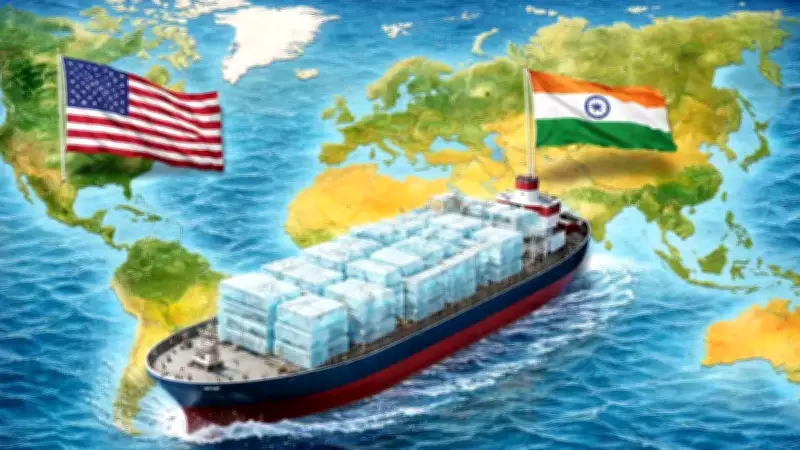
The Forgotten Era When America's Ice Cooled Sweltering Colonial India
In modern India, ice is an ubiquitous summer necessity—clinking in glasses of lassi, chilling water for air coolers, and providing relief when temperatures soar past 50°C. Today, producing ice is as simple as switching on a freezer. However, for nearly four decades during the 19th century, India relied on imported "white gold" shipped all the way from America, transforming frozen water into a premier luxury item that traveled halfway across the globe.
Bombay's Ice House: A Monument to Frozen Luxury
A distinctive white, domed building approximately 16 feet high once stood prominently on Apollo Road in erstwhile Bombay. Now the site of the K.R. Cama Oriental Institute on Shahid Bhagat Singh Road in south Mumbai, this structure was originally the Bombay Ice House, constructed in 1843 with an impressive capacity to store around 150 tonnes of ice. This facility served as a critical hub during a period when ice was imported into British India's presidency towns as an exclusive luxury commodity sourced from New England in the northeastern United States.
Historical records, including David Dickason's 1991 essay 'The 19th Century Indo-American Ice Trade,' reveal that ancient cooling methods existed long before this transoceanic trade. As early as 400 BC, Persian engineers mastered techniques of storing mountain ice in underground, naturally cooled containers. Similarly, the Mughals in India utilized Himalayan ice transported on horseback, given the absence of electricity, railways, or industrial advancements. The British colonial administration, however, found these traditional methods prohibitively expensive and labor-intensive, while locally produced "Hooghly ice" from shallow pits was often gritty, slushy, and unfit for consumption. This created a perfect market gap for a cleaner, more reliable alternative.

Frederic Tudor: The Visionary 'Ice King' Who Pioneered a Global Trade
In the 1830s, Boston merchant Frederic Tudor—later celebrated as the "Ice King"—revolutionized global commerce by capitalizing on this demand. Born in 1783 into a respected Bostonian family, Tudor initially shipped ice to the southern United States and the Caribbean. After suffering financial setbacks in the coffee trade, he embarked on an audacious venture: transporting ice from the freshwater lakes of New England to the scorching climate of Calcutta.
Tudor, alongside partners Samuel Austin and William Rogers, began trading in India in 1778 after Lord Cornwallis extended commercial opportunities. By 1833, they were shipping precisely squared slabs of ice across the Atlantic and Indian Oceans. These shipments were stored in double-walled warehouses insulated with sawdust or tan to minimize melting during the arduous four-month journey. Tudor eloquently captured the essence of his trade in his personal 'Ice House Diary,' writing: "In a country where at some seasons of the year the heat is almost unsupportable, where at times the common necessity of life, water, cannot be had but in a tepid state—Ice must be considered as outdoing most other luxuries."
The historic voyage of the ship Tuscany, which departed Boston on May 12, 1833, and arrived in Calcutta on September 6 carrying 180 tonnes of ice, astounded the public. Remarkably, 100 tonnes remained intact upon docking, demonstrating the efficacy of Tudor's preservation methods.
The Lucrative Ice Markets and Monopolistic Control
The export of American ice to India rapidly evolved into a legitimate and profitable trade. Massachusetts, with its high-altitude freshwater lakes along the eastern Atlantic shore, produced substantial quantities of superior-quality ice. Scientists like Michael Faraday noted that ice from sources such as Wenham Lake was particularly valuable due to its lack of salt and air bubbles, resulting in slower melting rates.

In Bombay, the firm of Jahangir Nuseervanji Wadia handled ice distribution, while Jamshetji Jeejeebhoy famously introduced ice cream at a dinner party, catering to the elite Anglian society. Tudor's enterprise not only generated millions in revenue but also secured significant favors from colonial authorities. From Calcutta alone, he amassed profits exceeding $220,000 over two decades. The trade enjoyed privileged status: ice was transported directly to warehouses without customs formalities, unloading was permitted at night, dedicated docking spaces were assigned, shipments were duty-free, and ice houses were leased to Tudor at nominal rents.
Between 1856 and 1882, an astounding 353,450 tonnes of ice were shipped across South and East Asia, including Australia. Some allocations were reserved for medical hospitals in presidency towns, and during periods of low supply, ice was rationed. Tudor effectively monopolized the "white gold" trade, and ancillary products like New England apples, Spanish grapes, and American butter, transported alongside the ice, also became coveted, high-value commodities.
The Thaw: Decline of the American Ice Trade
Several factors contributed to the gradual decline of this transcontinental trade. Frederic Tudor's death in 1864 marked a significant turning point. Concurrently, technological advancements such as Dr. John Gorrie's ice-making machine introduced modern refrigeration methods. Diminishing ice quality from American sources further eroded the trade's viability.
The establishment of the Bengal Ice Company in 1878 and the proliferation of local ice plants—numbering as many as 66 by 1925—sealed the fate of the British-American ice import business. The Calcutta Ice House was demolished in 1882, and the Bombay Ice House served as a warehouse before its demolition in the 1920s. Today, only the Chennai Ice House remains, repurposed into a residence with circular verandas and multiple windows.
Despite its historical significance, this unique trade receives scant mention in contemporary literature of the era. It stands as a poignant souvenir of how British colonial luxuries, even something as fundamental as ice, left an indelible chill on India's socioeconomic landscape, eventually icing out its own imported commodity as local industries emerged.