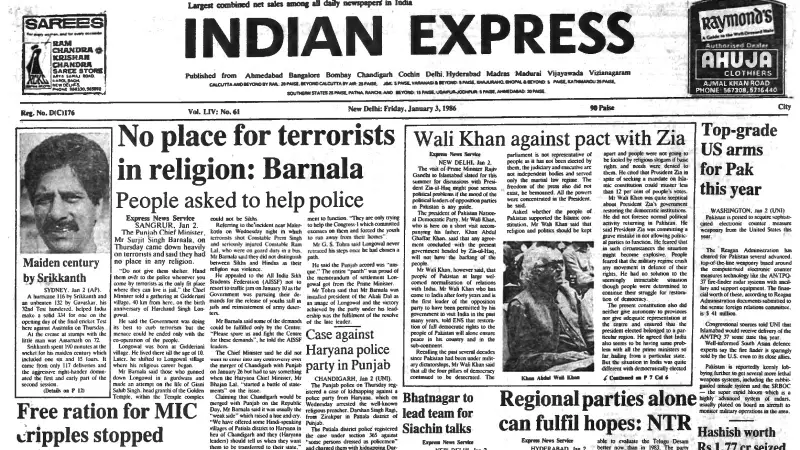
January 3, 1986, was a day of significant developments across geopolitics, sports, and law enforcement, as recorded in the archives. The most prominent news involved a major US foreign policy decision concerning South Asia, while on the cricket field, an Indian opener announced his arrival with a blistering knock.
Reagan Administration Approves Advanced Weaponry for Pakistan
In a move with considerable regional implications, the administration of US President Ronald Reagan cleared a substantial arms package for Pakistan on this day. The package included several advanced, top-of-the-line weapons systems centered on sophisticated computerized electronic countermeasures technology.
A key component of this deal was the AN/TPQ37 fire-finder radar system, along with necessary ancillary and support equipment. This cutting-edge technology was designed to locate enemy artillery positions. According to official documents the Reagan administration submitted to the US Senate Foreign Relations Committee, the total financial worth of this military aid was $41 million.

Srikkanth's Hurricane Innings Lights Up Sydney Test
On the sporting front, Indian cricket fans had reason to celebrate as opener Krishnamachari Srikkanth smashed a spectacular maiden Test century against Australia. The explosive knock came on the opening day of the final Test match at the Sydney Cricket Ground.
Srikkanth's 116 runs came from just 117 deliveries in a display of aggressive batting that lasted 190 minutes. His innings was decorated with 15 fours and one six. He was well-supported by the legendary Sunil Gavaskar, who remained unbeaten on 132—his 32nd Test hundred. With Mohinder Amarnath (72*) at the other end, India ended the day at a commanding 334 for the loss of just one wicket.
Other Key Headlines From The Day
In political circles, there was anticipation and concern regarding a proposed visit. Prime Minister Rajiv Gandhi's trip to Islamabad, slated for the summer to hold discussions with Pakistani President Zia-ul-Haq, was seen as potentially problematic. This assessment was based on the mood of opposition leaders in Pakistan, notably Wali Khan, president of the Pakistan National Democratic Party, who was in New Delhi at the time accompanying his father, Khan Abdul Ghaffar Khan.
In a major narcotics bust, the Directorate of Revenue Intelligence (DRI) in Bombay (now Mumbai) seized a record 2.95 tonnes of hashish. The contraband, with an estimated street value of ₹1.77 crore, was packed in 163 bags, marking one of the significant hauls of that period.
The events of January 3, 1986, thus painted a vivid picture of a nation navigating complex international relations, celebrating sporting brilliance, and combating organized crime—themes that remain relevant decades later.