

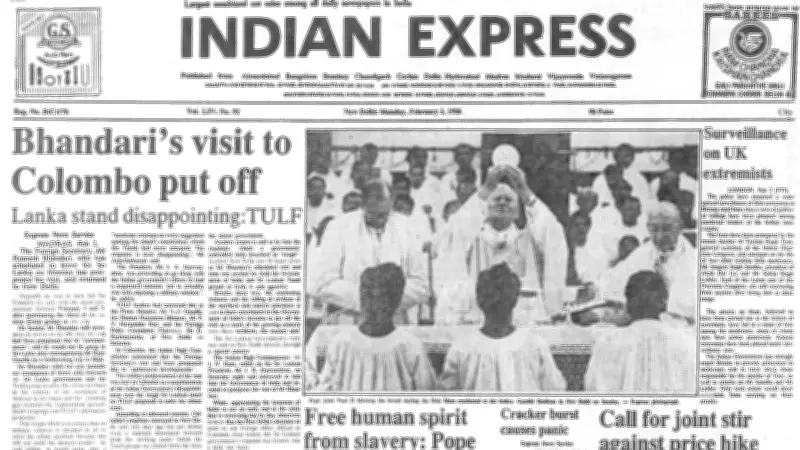
A Look Back at February 3, 1986: Diplomatic Shifts, Papal Unity, and Political Allegations
This historical snapshot from The Indian Express front page dated February 3, 1986, reveals a day of significant diplomatic, religious, and political developments in India. The original editorial content has been uniquely expanded to provide deeper context and analysis while preserving all factual details.
India-Sri Lanka Diplomatic Talks Unexpectedly Postponed
In a notable diplomatic development, Foreign Secretary Romesh Bhandari postponed his scheduled visit to Sri Lanka, returning to New Delhi instead. He was originally set to depart on February 3 for Colombo to engage in crucial talks with the Sri Lankan government between February 3 and 5. A key aspect of his mission involved ascertaining the views of various Eelam groups in the city prior to the discussions.
When questioned by journalists about the sudden change, Bhandari cited "circumstances" as the reason for the postponement, without providing further elaboration. This move highlighted the delicate and often unpredictable nature of international relations during that period, particularly concerning regional stability and ethnic conflicts.

Pope John Paul II Advocates for Interfaith Collaboration in Delhi
During his visit to Delhi, Pope John Paul II delivered a powerful message calling for inter-religion collaboration in a joint struggle against global challenges. He emphasized the need to combat hunger, poverty, ignorance, persecution, discrimination, and every form of slavery of the human spirit through unified efforts.
Elaborating on his appeal, the Pope stated that a joint endeavour was essential, noting, "today as Hindus, Muslims, Buddhists, Jains, Parsees and Christians, we gather in fraternal love to assert this by our very presence here." This speech underscored the Vatican's commitment to fostering religious harmony and addressing socio-economic issues through collective action during his historic trip to India.
Atal Bihari Vajpayee Denounces Espionage Case Allegations
Bharatiya Janata Party president Atal Bihari Vajpayee strongly criticized the inclusion of his name in the chargesheet of an espionage case involving Ram Swarup. He labeled the action as "patently dishonest and motivated," asserting that dragging innocent individuals into serious crimes like espionage was more of a political stunt than a matter of national security.
Vajpayee maintained that he had no connection to the case, not even as a witness, and argued that such tactics undermined the integrity of legal and political processes. This incident reflected the tense political climate and the use of legal frameworks for potential partisan gains during that era.
Controversial US Trip for Bhopal Gas Leak Victims
A delegation of Madhya Pradesh government officials and victims of the Bhopal gas leak disaster embarked on a trip to New York on February 3, financed from the state's "gas relief" fund. The journey, however, faced public scrutiny due to the selection of only well-to-do individuals, including a government doctor and an engineer, as representatives of the gas victims.
The trip was expected to cost over Rs 2 lakh, raising questions about the allocation of relief resources and the criteria for victim representation. This controversy highlighted ongoing challenges in disaster management and transparency in the aftermath of one of India's worst industrial tragedies.
These events from 1986, as captured in The Indian Express, offer a fascinating glimpse into India's multifaceted landscape of diplomacy, faith, politics, and social justice during a pivotal year.






