Surge in Distress Calls from Overseas Indian Workers Exposes Systemic Vulnerabilities
A flood of distress calls from Indians working overseas—many trapped in exploitative jobs, unpaid wages, or unsafe conditions—has intensified scrutiny on the vulnerabilities of migrant workers, particularly in Gulf nations. More than 16,000 grievances poured into government portals over the past year, highlighting issues ranging from fraudulent recruitment to fatal workplace accidents and delays in repatriating mortal remains.
Parliamentary Data Reveals Alarming Complaint Statistics
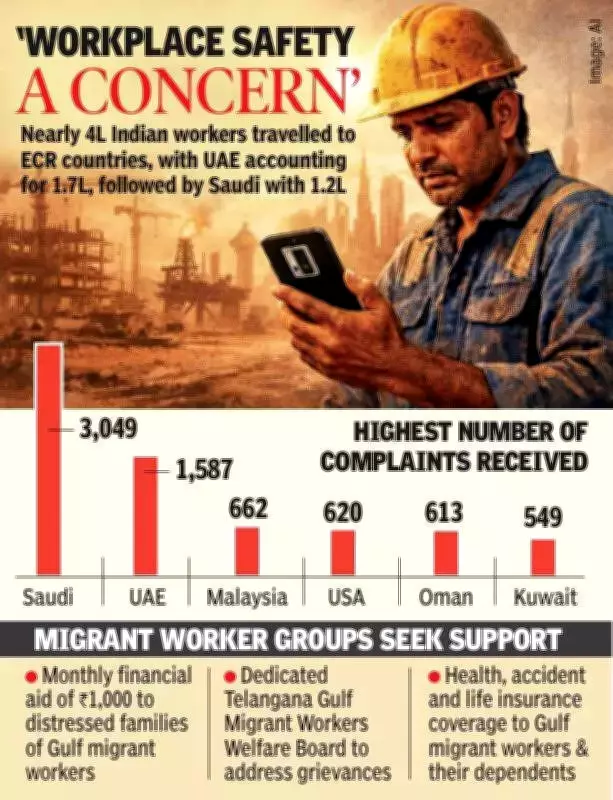
Data tabled in Parliament shows that the Centre's key grievance platforms for overseas Indians—MADAD and CPGRAMS—together received 16,127 complaints from migrants facing a range of problems abroad. Saudi Arabia topped the list with 3,049 complaints, followed by the United Arab Emirates with 1,587 and Malaysia with 662.
Significantly, six of the top 10 countries with the highest number of complaints fall under the emigration check required (ECR) category. These include 18 countries, largely in the Middle East and Southeast Asia, where Indian citizens with ECR status on their passports must obtain clearance from the protector of emigrants before taking up overseas employment. This safeguard is meant to protect unskilled and semi-skilled workers from exploitation.

The United States ranked fourth with 620 complaints, followed closely by Oman with 613 and Kuwait with 549. The data emerges amid a sharp rise in migration to ECR countries in 2025. Official figures indicate that nearly four lakh Indian workers travelled to ECR countries during the year, with the UAE accounting for 1.7 lakh workers and Saudi Arabia for 1.2 lakh.
Fraudulent Recruitment and Workplace Safety Concerns
Vamshi Goud, president of the Gulf Workers Awareness Centre (GWAC), highlighted the scale of the issue from Telangana alone. "We have as many as 15 lakh workers spread across various ECR countries, mostly in Gulf nations, who migrated over the last decade," he said.
"Most complaints involve fraudulent recruitment agents who promise white-collar jobs but eventually force workers into labour-intensive roles. We also receive a large number of cases related to unpaid wages or salaries lower than what was promised," Goud added.
Workplace safety remains another major concern. "Fatal accidents due to the absence of safety gear, excessive work pressure leading to injuries and deaths, and employers withholding workers' passports are among the most common and disturbing issues reported to us," he explained.
According to GWAC estimates, most workers earn between Rs 18,000 and Rs 25,000 per month, with a large proportion hailing from Adilabad, Nizamabad, and Karimnagar districts.
Repatriation of Mortal Remains Poses Major Challenge
Beyond exploitation and wage disputes, the repatriation of mortal remains has emerged as one of the most difficult challenges. Vasanth Reddy, vice-president of GWAC, stated, "One of the major problems we faced in recent times is bringing back the bodies of workers who die abroad."
"In one instance, a worker died of a heart attack, and it took nearly two months to repatriate his body. Delays happen due to lack of proper documentation, incomplete information from complainants, non-cooperative foreign sponsors or employers, and lengthy embassy procedures," he said, adding that in several cases, association members had to intervene and coordinate with sponsors to ensure the bodies were finally brought back.
Growing Demands for Institutional Support and Welfare Measures
Against this backdrop of rising complaints and persistent structural gaps, migrant worker groups have stepped up their demands for institutional support. Petitions submitted to MPs and MLAs call for:

- Establishment of a dedicated Gulf welfare board
- A comprehensive census of Gulf migrant workers
- Extension of social security and welfare benefits to families back home
Bheem Reddy, a member of the NRI advisory committee, emphasized, "We are seeking simplification of the registration and renewal process for the Gulf workers welfare fund, immediate assistance for workers facing emergencies such as accidents, deaths, job loss, unpaid wages or exploitation abroad, and financial support for repatriating deceased workers and helping their families."
Key Demands Outlined in Petitions
The petitions put forth several specific demands to address the crisis:
- Provide a monthly financial assistance of Rs 1,000 to distressed families of Gulf migrant workers affected by job losses and economic instability abroad.
- Set up a dedicated Telangana Gulf Migrant Workers Welfare Board to address grievances, rehabilitation, and long-term support.
- Extend health, accident, and life insurance coverage to Gulf migrant workers and their dependants.
- Establish district-level migrant worker help desks for documentation support, emergency assistance, and grievance redressal.
- Ensure legal aid and diplomatic intervention for workers facing exploitation, wage theft, detention, or contract violations in Gulf countries.
- Offer education support and scholarships for children of Gulf migrant workers.
- Launch skill development, re-skilling, and employment programmes for returnee migrants.
- Provide low-interest loans and self-employment support for returnees through state-run financial institutions.
- Create and maintain a comprehensive database of Telangana's Gulf migrant workers for effective policy planning and crisis response.
The situation underscores the urgent need for systemic reforms to protect Indian migrant workers abroad, particularly in Gulf nations where exploitation risks remain high despite existing safeguards.