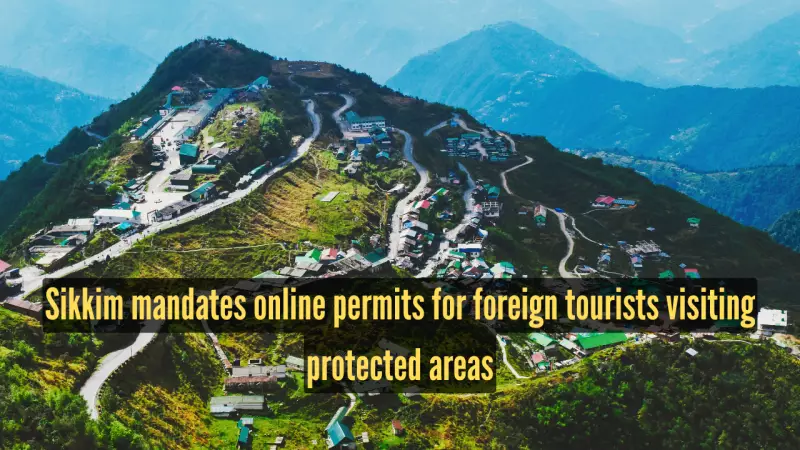
In a significant move aimed at enhancing security and modernizing procedures, the Sikkim government has completely abolished the issuance of physical permits for foreign nationals wishing to visit the state's protected and restricted areas. With immediate effect, all clearances must now be obtained online through a dedicated digital system.
Digital Mandate for National Security
This decisive shift, announced by the state's Department of Tourism and Civil Aviation, comes following strict directives from the Union Ministry of Home Affairs (MHA). No Protected Area Permit (PAP) or Restricted Area Permit (RAP) will be issued in physical form under any circumstances. Foreign visitors are now required to secure their permits digitally via the official online permit cell before arriving at any permitted location in Sikkim.
Officials have clarified that the primary driver behind this change is national security, given Sikkim's sensitive and strategic position along the volatile India-China border. The fully digital framework is designed to tighten scrutiny and enable better monitoring of foreign tourist movements in these vulnerable regions.

Where Can Foreign Tourists Go?
Under the current regulations, foreign tourists are permitted access to only a few specific sites within Sikkim, provided they have the necessary digital authorization. These locations are Tsomgo (Changu) Lake in East Sikkim, and the Yumthang Valley along with Zero Point in North Sikkim. An official confirmed that the era of physical paperwork for these visits is now conclusively over, with all permits being processed exclusively through the online portal.
Despite the stringent rules, Sikkim remains a popular destination. Official data reveals that the state welcomed 17.12 lakh (1.712 million) tourists in 2025, including more than 71,000 foreign nationals. Authorities argue that the new online system could simplify the process for international visitors by eliminating paperwork, reducing queues, and removing uncertainty. It also cuts down dependence on local intermediaries, promoting greater transparency.
Broader Strategic Context and Infrastructure Concerns
The permit policy revision coincides with high-level discussions in New Delhi concerning Sikkim's strategic and developmental challenges. Recently, Sikkim Member of Parliament Indra Hang Subba met with Union Defence Minister Rajnath Singh to address critical issues.
A major point of discussion was the precarious state of the North Sikkim Highway, which was severely damaged during the devastating Teesta flash floods in October 2023. The floods disrupted civilian mobility and hampered defence logistics to northern border sectors. While the Border Roads Organization has restored a temporary route between Mangan and Naga, MP Subba expressed serious concerns about its long-term viability, citing its vulnerability to landslides, especially during monsoons and winters.
Subba urged the Defence Minister to fast-track the approval and construction of a permanent alternative alignment to ensure safe, all-weather connectivity for both local residents and defence operations in North Sikkim.
Together, the move to a digital permit regime and the push for resilient infrastructure underscore Sikkim's delicate balancing act. The state must navigate its identity as a sought-after tourist destination, home to stunning high-altitude lakes and valleys, while steadfastly addressing imperative national security and developmental needs.