Madhya Pradesh: A Top Travel Destination for All
I have always been vocal about my belief that Madhya Pradesh ranks among the top three travel destinations in India for explorers of every kind and budget. I will refrain from naming the other two to maintain harmony! From the majestic tigers of Kanha to the serene river islands of Hanuwantiya, Madhya Pradesh has consistently captivated me as a traveler, especially as a solo adventurer.
An Unplanned Journey Through Madhya Pradesh
I embarked on a 15-day holiday in Madhya Pradesh with no fixed itinerary, embracing the philosophy of "let's see where the road takes me." This segment of my trip commenced from Kanha National Park. The drive from Kanha was seamless, offering scenic views and a solitary atmosphere. My intended destination was Bandhavgarh National Park.
The taxi driver generously shared insights on must-visit places, activities, and local cuisine in Madhya Pradesh, effectively serving as an unofficial tour guide. It was he who introduced me to the site we are about to explore. He mentioned "Pathar ke ped," which left me utterly puzzled. Approximately 70 kilometers from Kanha National Park, en route to Bandhavgarh (with a minor detour), lies Ghughwa Fossil National Park.

Unveiling Ghughwa Fossil National Park
Unfamiliar with this location, I quickly searched Google and was met with images of a dinosaur head. I wondered if this was a local amusement park featuring styrofoan replicas. However, Ghughwa Fossil National Park proved to be far more profound. As someone who cherishes the adage "old is gold," I was on the verge of experiencing what I would later describe as one of the most remarkable journeys of my life.
In the 1970s, researcher and archaeologist Dr. Dharmendra Prasad discovered this site. Ghughwa Fossil National Park in Dindori was officially established as a National Park in 1983 to safeguard rare plant and animal fossils dating back 40 to 150 million years. I arrived eager to witness this marvel.
Exploring the Fossil Displays
After purchasing a ticket at the entrance, I wandered into the nearest building. Ghughwa defies typical national park expectations. While "national park" usually conjures images of forests, animals, and birds, this was a different realm. The "forest" aspect will be addressed shortly, and for wildlife, all I encountered was a deceased bat suspended from overhead electrical lines.
I entered a room resembling an old classroom, where various "rocks" were on display. Unaware of their significance, I read the informational plaques. These were fossils millions of years old, including what appeared to be eggs—possibly dinosaur eggs, though unconfirmed, they were undoubtedly fossilized. My perspective shifted; these "old rocks" captivated me, leading to a thorough 30-minute examination of every detail. As the sole visitor, I assumed my tour had concluded, but it was merely the beginning.
The Grounds: A Walk Through Ancient History
A guide approached outside the display room and invited me to explore the site. I eagerly agreed. A brief walk from the building revealed a parched forest. Under the bright sun, with the dead bat overhead, the setting seemed desolate. As we walked, the forest floor rustled loudly, prompting me to mutter about the "noisy forest." A few more visitors joined, and the guide shared fascinating facts about the park.
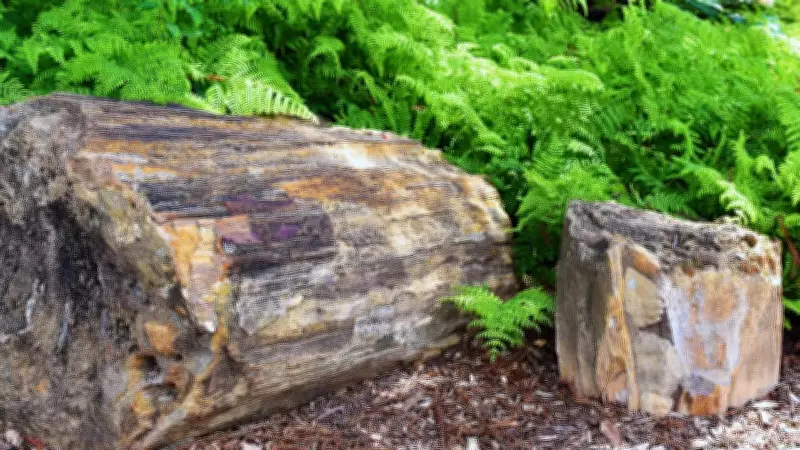
Believing knowledge could be acquired while seated, I decided to rest on one of the numerous rocks scattered about. As I settled, the guide directed the group's attention toward my location. "The rocks you see here," he said with air quotes, "like this one, are approximately 65 million years old." To my astonishment, I was sitting on a 65-million-year-old fossil.
Sitting on a Petrified Eucalyptus Tree
Yes, I sat on a 65-million-year-old fossil, and I would do it again. It felt like participating in the grand narrative of continental shifts and millennia of history etched into stone. In that moment, I became a minuscule part of Earth's history. Specifically, it was a fossilized eucalyptus tree from when this area belonged to the southern supercontinent Gondwanaland.

We have all studied this in school, but that day, I learned that the Indian landmass was once connected to Africa and Australia, forming a vast supercontinent. The petrified fossil before us belonged to a tree species now exclusive to India. Its presence in Ghughwa, distant from modern-day Australia, validates the supercontinent theory. Over eons, continental drift fragmented this massive landmass into Africa, South America, Antarctica, Australia, and the Indian subcontinent.
Understanding Petrified Fossils
That day, I gained insight into petrified fossils. For the uninitiated, petrified tree fossils form through permineralization. When a tree falls, it is rapidly buried by sediment, volcanic ash, or mud, shielding it from decay. Mineral-rich groundwater containing silica infiltrates the wood over time, replacing organic material cell by cell. As original tissues dissolve, minerals crystallize, preserving intricate details like tree rings and cellular structures.
A Unique National Park Experience
Beyond my inadvertent seat on a fossilized tree, the experience was enthralling, educational, and distinct from conventional national park visits. Before me lay a desiccated forest (likely due to the season) and clusters of incredibly ancient "former trees" from lands now known as Australia and beyond.
Did I cherish the experience? Absolutely.
Will I return? Absolutely.
Should travelers consider this national park? Absolutely.