Some places become known for monuments, markets or famous skylines. Dong Valley, tucked away in the far eastern corner of Arunachal Pradesh, is known for something less tangible. Each morning, before much of the country has stirred awake, daylight reaches this remote settlement near India's borderlands. The first rays spread across mountain ridges, river valleys and dense forests long before they touch cities thousands of kilometres away.
According to Arunachal Tourism, Dong is among the locations from which the earliest sunrise in India can be witnessed. The small village lies near Walong in the Lohit district, a region shaped by rugged mountains, fast-flowing rivers and long stretches of forest. For many visitors, the appeal is not simply the sunrise itself but the feeling of reaching a place that remains largely detached from the pace of modern travel.
Dong Valley: The remote village where India's first sunrise happens
Dong sits on the left bank of the Lohit River, around seven kilometres from Walong. The settlement is home to the Meyor community, whose presence in this part of Arunachal Pradesh stretches back generations. Life here remains closely connected to the landscape, with mountains and rivers continuing to shape daily routines. The village gained wider attention at the turn of the millennium. As noted by Arunachal Tourism, people from different parts of India and abroad travelled to Dong on 1 January 2000 to witness the millennium sunrise. The event brought brief international attention to a place that otherwise remains far removed from mainstream tourism circuits.

Even now, visitors often describe the journey itself as a significant part of the experience. Roads wind through steep terrain, while changing weather and mountain conditions can make travel unpredictable. That sense of distance has helped preserve the valley's quiet character.
Mountains, pine forests and the Lohit River surround Dong Valley
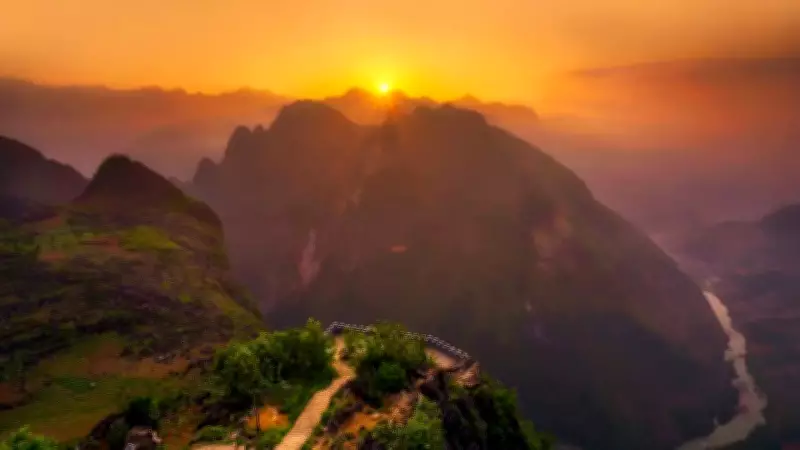
The scenery surrounding Dong is defined by dramatic contrasts. Snow-covered peaks rise beyond heavily forested slopes, while the Lohit River cuts through the valley below. Thick pine forests cover large sections of the hillsides, creating a landscape that shifts constantly with changing light and weather.
Early mornings are particularly striking. As daylight gradually reaches the eastern horizon, mountain ridges emerge from darkness one after another. Unlike viewpoints that rely on built attractions or tourist infrastructure, Dong's appeal comes largely from its natural setting.
An iron-floored suspension footbridge spans the Lohit River near the village, linking areas that were once more difficult to access. The structure has become a familiar feature for travellers making their way towards the valley.
The Meyor community and Dong Valley's cultural heritage
Visitors arriving in Dong encounter more than a sunrise destination. The village offers a glimpse into the traditions of the Meyor people, one of the indigenous communities of Arunachal Pradesh's eastern frontier.
Cultural life in this region remains closely tied to local customs, seasonal cycles and community gatherings. Traditional practices continue alongside gradual modernisation, creating a setting that feels distinct from larger towns elsewhere in the state. For travellers, respectful interaction with residents often becomes one of the most memorable aspects of a visit.
Walong, Kibithu and other famous places near Dong Valley
Dong is usually explored together with several nearby attractions. Walong serves as the main gateway to the area and carries historical significance linked to the 1962 India-China conflict. As per Arunachal Tourism, the surrounding landscape combines mountain scenery with reminders of a turbulent chapter in the region's past.
Kibithu, located further east, is often mentioned among the easternmost inhabited settlements in India. Its position near the international border gives it a unique geographical importance.
Natural hot springs in the wider region attract visitors seeking a different experience after days spent travelling through mountain terrain. Dong Krong is another nearby location that forms part of the broader exploration route for travellers moving through the valley.

Rather than a single landmark destination, the area functions as a collection of small settlements, viewpoints and natural sites connected by winding mountain roads.
How to reach Dong Valley, India's first sunrise point
Reaching Dong requires planning and patience. Most travellers first make their way to Arunachal Pradesh through Assam before continuing towards eastern Arunachal by road.
The nearest major access point is usually Dibrugarh in Assam, which has air and rail connections with several Indian cities. From there, travellers continue towards Tezu, then onwards through the Lohit Valley towards Walong.
The final stretch to Dong is completed from Walong. Road conditions can vary depending on the season, and travel times are often longer than distances might suggest. Visitors should also ensure they obtain the necessary permits required for entry into Arunachal Pradesh before beginning the journey.
The effort involved in reaching Dong partly explains its enduring appeal. Unlike destinations built around convenience, this remote valley rewards those willing to travel deep into India's eastern mountains, where the day begins a little earlier than anywhere else in the country.