The sun rises over the golden grasslands, painting the sky with pearly opalescent hues. You arrive with a secret hope tucked in your heart—perhaps today, the elusive Amur falcon will grace you with its presence. Settling into your camp chair, you acknowledge the exigencies that make walking impossible. A pang of envy strikes as you watch dog walkers and fellow birders saunter freely through the tall grass.
The First Sighting
Your eyes scan the horizon, and in a clump of dark trees, you spot a large tobacco-brown raptor. It poses statuesquely, an eagle of uncertain make—possibly a lesser or greater spotted eagle, or more likely a tawny. Even with your 8 X 40 binoculars, details remain elusive. The little 24X Limux camera only captures a dark, vague smudge. For open spaces like these, a powerful spotting scope feels essential.
Suddenly, the eagle executes a sideways dive off its branch and vanishes into the undergrowth. A little agitation follows, but the bird does not reappear. You shift your focus to the transmission wires and poles, knowing raptors favor these as lookout posts. Sure enough, in the distance, a smaller, slimmer raptor stands guard. It scans up, down, and side to side with a guardsman's posture. Paler than the hefty eagle, it remains a mystery—a hawk, harrier, buzzard, or falcon, but alas, not the Amur.

Jousting Eagles and Common Kites
Swiveling the binoculars, you discover two eagles on another tree. One perches at the edge while the other attempts to oust it. The perched bird destabilizes, and they joust mid-air before flying exasperatedly behind you. Hoisting yourself out of the chair quickly proves challenging, especially with a camera and binoculars securely around your neck.
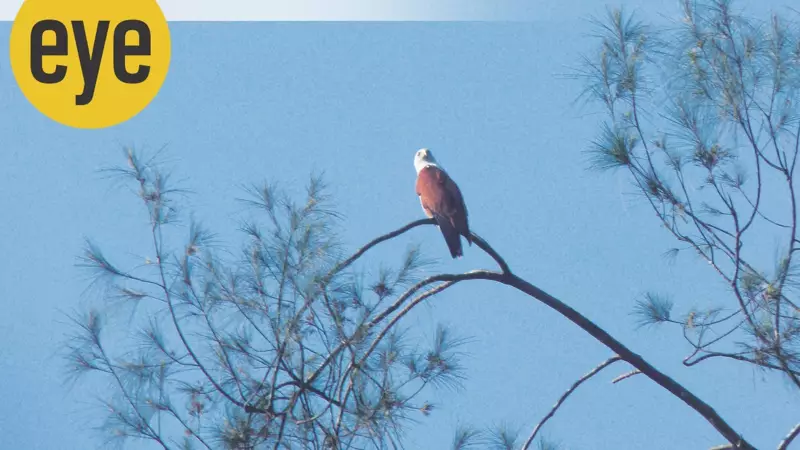
The only raptors that oblige by wafting over are the Brahminy kites—the commonest here, yet always a pleasure. Their rich autumn russet wings contrast beautifully with detergent-white heads, throats, and breasts. This spiffing white rivals lawyer's collars in its crispness. Briefly, two big eagles appear in the sky behind a soaring pair of kites but quickly distance themselves, disappearing behind trees.
Dogs: Boon or Bane?
Dogs brought for morning runs add a dynamic element. Ardent birders argue they disturb birds, hindering hunting and scaring them off. For ground-nesting birds, they can spell disaster. This morning, two well-built dogs—one beige, the other liver-colored—saunter jauntily through the golden grass. Their tails wag happily, tongues loll, and they largely ignore their owners' shouts and whistles.
Selfishly, you realize that if mobile, you might resent their commotion. They could even chase you, especially if you were stalking a bird. Yet, immobile in your chair, you follow them keenly through binoculars, hoping they might flush a harrier from a tussock or a covey of francolin concealed in the grass. Alas, no such luck.
Other Avian Visitors
Beyond raptors, the transmission wires host a variety of birds. Bee-eaters, Indian robins, drongoes, and doves perch precariously. A blunt, bullet-headed silhouette indicates a shrike, waiting with the air of an executioner. The grassland teems with life, each species adding to the morning's tapestry.
Thermals and Timing
As the morning progresses, warmth intensifies. You know this is when thermals rise—columns of warm air from hot rocks that raptors use for easy circling. However, the heat makes it difficult to drag your chair under tree cover. Late afternoon and early evening offer other good times to visit this vast laterite plateau, though staying awake then may prove more challenging than an early 6 a.m. start.
In such habitats, experience teaches that parking beside or under the shadow of a thorny bush or tree pays off. Sitting quietly, you can scan the vast expanse of golden grassland and sky from the shade. Occasionally, a pleasant surprise awaits: a shrike, buzzard, or even an eagle may choose the same bush as a lookout spot. It might fly down to pick up an incautious mantis or lizard, bashing and consuming its meal just a couple of feet away. Every feather and windblown tuft becomes clear without binoculars.

Most likely, the bird is aware of your presence. Birdwatchers are often 'birdwatched' by birds themselves. There can be nothing more flattering than being observed by a mighty bird of prey, completing the circle of this serene morning on the grasslands.