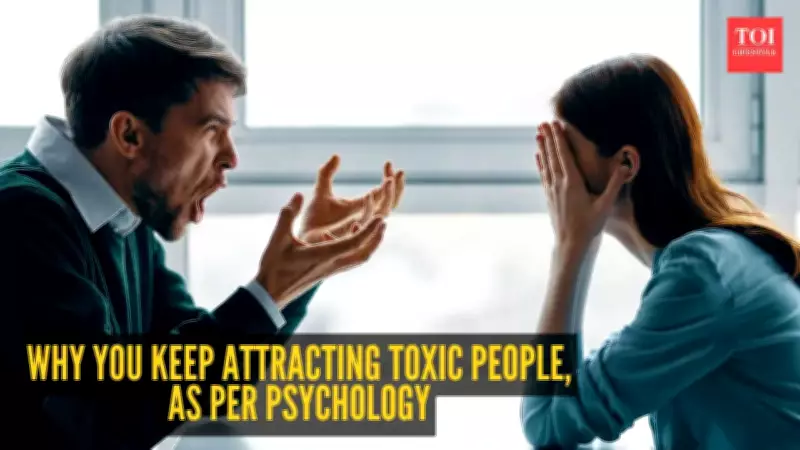
It is confusing, isn't it? You meet someone who treats you poorly, makes you feel small, or creates chaos in your life, and yet something about them feels familiar. Not comforting, not safe, but familiar. Psychology teaches us that toxic people often seem strangely familiar, not because they are good for us but because they may be echoing patterns we have seen before. That sense of familiarity does not mean they are good for you. It means your brain recognises the pattern, even if that pattern is toxic. Here are five psychology-backed reasons for this phenomenon.
1. They Mirror Your Past Relationship Patterns
We often find ourselves attracted to patterns we recognise, even if they are not healthy. If past relationships, whether with family, friends or exes, were marked by criticism, volatility or emotional separation, these characteristics might seem strangely familiar. Not because you are attracted to pain, but because your brain picked up early on that this is how relationships operate. When you grew up in a home where criticism was constant, or where someone's mood changed unpredictably, your nervous system adapted to that environment. You learned to expect it. You learned to navigate it. And now, when someone shows those same traits, your brain says, 'I know this. I have done this before.' But knowing a pattern does not mean it is healthy. What feels familiar might just be what you have survived, not what you should accept.
2. Your Brain Likes the Familiar Better Than the Unknown
The mere-exposure effect in psychology suggests that the more you are exposed to something, the more safe and trustworthy it feels, even if it is not good for you. Sometimes familiarity can be mistaken for compatibility. Think about it. If you are in a new relationship with someone who is always kind, steady, and respectful, that might feel odd at first. Too calm. Too steady. Too little drama. Your brain, wired to expect the familiar, might even interpret that stability as 'not intense enough' or 'not exciting.' But when you meet someone who is unpredictable, critical, or emotionally distant, your brain lights up. It says, 'This feels right. I know this.' But that 'right' feeling is not about compatibility; it is about recognition. Your brain would rather stick with the bad than risk the unknown.

3. You Might Be Subconsciously Trying to Heal Old Wounds
Psychologically, we are attracted to things that are similar to unresolved emotional experiences, hoping that it will be different this time. This can lead us to be attracted to similar toxic relationships repeatedly. For example, perhaps you grew up with an emotionally unavailable parent. Maybe you had a partner who constantly criticised you. And now, you find yourself in relationships with people who show the same traits. It is not because you want to be hurt. It is because you are trying to heal something old. You are unconsciously hoping, 'If I can make this person love me, if I can get this person to change, if I can finally make them stay, then maybe the old wound will finally heal.' But toxic people do not heal old wounds. They reopen them. And the cycle repeats. Healing does not happen by recreating the pain. It happens by recognising the pattern, stepping away from it, and choosing something different.
4. Intermittent Kindness Can Create a Powerful Bond
Toxic relationships are rarely bad all the time. If they were, you could walk away easily. Instead, they reel you in with emotional whiplash, giving you affection one minute and then suddenly freezing you out. This constant back and forth feels so intense, which is why it is so easily mistaken for real intimacy. You find yourself chasing the 'good version' of them, waiting desperately for the next nice moment to stick. But that dizzying high is not love; it is an addiction loop. The breadcrumbs of warmth hook your brain, keeping you stuck on a roller coaster your heart knows is killing you.

5. Your Boundaries May Have Been Shaped Around Accommodating Others
If you spent your whole life walking on eggshells to keep the peace, toxic behaviour will not feel like a red flag; it will just feel like a random day. When you grow up believing your worth is entirely tied to how much disrespect you can tolerate, your internal alarm system breaks down. You do not feel righteous anger when someone crosses the line; you just feel a weird, exhausting sense of familiarity. But 'familiar' is not the same thing as safe. Your old boundaries were built to accommodate everyone else's mess. It is time to tear them down and rebuild them to finally protect you.
The Truth About Familiarity
Familiarity does not mean something is good for you. It just means you have been there before. And sometimes, being there before means you have survived something harmful. The goal is not to chase familiarity. The goal is to choose. To recognise the pattern. To step away from what feels familiar but hurts. And to choose something that feels strange at first, but is actually good for you. Toxic people feel familiar because your brain recognises the pattern. But that does not mean you have to stay in it. You can choose differently. You can choose someone who is steady, kind, and consistent. Someone who does not make you chase them. Someone who does not create chaos. Someone who feels unfamiliar at first, but feels like home after. That is the kind of familiarity you should be looking for, not the one that hurts, but the one that heals.