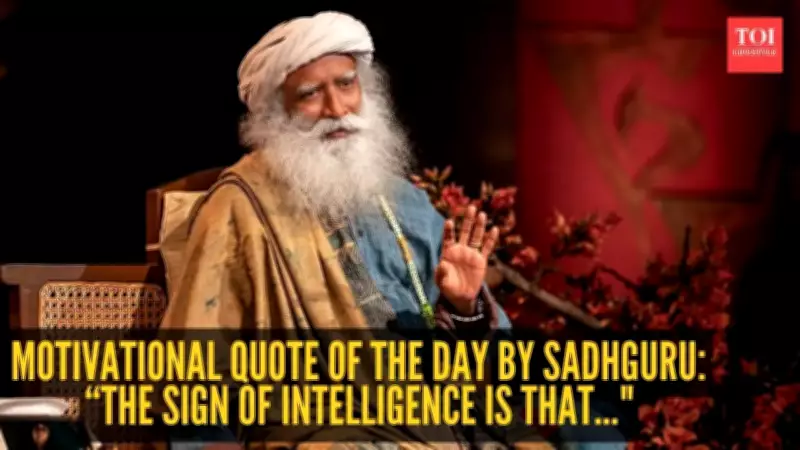
Sadhguru's Wisdom: Why Constant Wondering, Not Certainty, Is True Intelligence
In a society that venerates the "5-year plan" as a sacred blueprint for success, we are often pressured from high school onward to chart our life's course with unwavering certainty. This cultural obsession treats uncertainty as a character flaw—a sign of being lost or unmotivated. However, if we examine history's most brilliant minds, they rarely followed rigid maps. Instead, they navigated with a compass of curiosity and a multitude of questions.
The Blunt Brilliance of Sadhguru's Quote
Jaggi Vasudev, widely known as Sadhguru, delivers a powerful critique of this "certainty culture" with a quote that is both blunt and insightful: “The sign of intelligence is that you are constantly wondering. Idiots are always dead sure about every damn thing they are doing in their life.” This statement serves as a gut punch to our desire for safety through certainty. Sadhguru emphasizes a crucial point: the moment you become certain about something, you cease to examine it. When you stop looking, you halt the learning process entirely.
The Peril of Possessing All the Answers
Consider the last time you encountered a "know-it-all." Such interactions are not only exhausting but also indicative of stagnation. Individuals who believe they have the perfect strategy, worldview, or career path are essentially wearing blinders. They view the world as a completed puzzle, having already seen the picture on the box. In contrast, Sadhguru's philosophy portrays intelligence as a dynamic, living entity that requires space to evolve. When you "wonder," your mind remains open, scanning for new information, adapting to changes, and identifying potential issues before they escalate into disasters.

The Science Supporting Curiosity
This perspective is not merely spiritual; it is grounded in fascinating psychological research. The Dunning-Kruger Effect illustrates how individuals with minimal knowledge about a subject often exhibit the highest confidence in their abilities, unaware of their own ignorance. Conversely, true experts frequently experience less certainty because they grasp the complexity of their field. A recent study published in Nature Human Behaviour explored "cognitive flexibility," finding that those comfortable with uncertainty adapt to change more rapidly. In today's world—where AI reshapes job roles every few months and the economy fluctuates unpredictably—this flexibility is not just a desirable trait but a vital survival mechanism. If you are "sure" your job will remain unchanged in two years, you are likely not paying attention to the evolving landscape.
How to Cultivate Being "Comfortably Unsure"
So, how can we practically embrace "wondering" without feeling adrift? It involves shifting from a mindset of "I need to be right" to one of "I need to be curious." Here are three actionable strategies:

- Practice the "I Don't Know" Power Move: In meetings or conversations, when you are not entirely certain, try saying, "I’m actually not sure yet; I’m still wondering about X." Initially, this may feel terrifying due to societal conditioning that equates uncertainty with weakness. In reality, it positions you as the smartest person in the room by demonstrating honesty and openness, fostering genuine dialogue rather than one-sided lectures.
- Apply the "What If?" Filter: Before making significant decisions, run them through a "What If?" filter. Ask questions like: What if my main assumption is incorrect? What if the market shifts unexpectedly? What if there is a better approach I haven't considered? This practice is not about paranoia but about keeping your "wondering" muscle active. It enabled companies like Netflix to pivot from mailing DVDs to streaming, even while dominating their original market.
- Conduct Small-Scale Experiments: Avoid betting your entire life on a single "sure thing." If you are curious about a new career path or side hustle, test it in a low-risk, manageable way. Treat your life as a laboratory. When you are "wondering," every failure becomes a valuable data point rather than a catastrophe.
Why "Wonder" Is the Ultimate Advantage Today
We are navigating a world that is constantly shifting beneath our feet. The individuals who will thrive in this decade are not those with the most rigid plans but those who persistently ask, "How can this be improved?" and "What am I overlooking?" Sadhguru's quote serves as a poignant reminder that intelligence is not measured by memorization capacity or the volume of one's opinions. It is defined by the quality of your attention. When you wonder, you engage authentically with the world as it is, not as you presume it should be.
So, what is one "certainty" you are prepared to release today? Embracing uncertainty might just be the key to unlocking true intelligence and adaptability in an ever-changing environment.