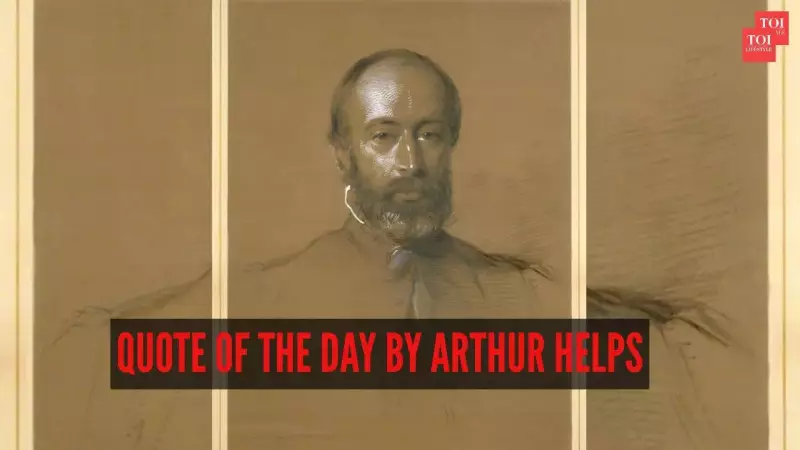
In the bustling intellectual landscape of Victorian England, Arthur Helps carved a unique niche as a writer of profound moral and reflective thought. Born in 1813 and passing in 1875, Helps was not just an essayist and historian, but a social thinker whose work continues to offer guidance on living a meaningful life. His unique position as Clerk of the Privy Council during Queen Victoria's reign granted him an insider's view of power, yet his writings reveal a soul more concerned with character than politics.
From Cambridge to the Council: The Making of a Reflective Mind
A graduate of the prestigious Trinity College, Cambridge, Arthur Helps developed a distinctive literary voice. His style masterfully blended intellectual precision with a deep, humane concern for ethical living. While he served at the very heart of the British Empire's governance, his true calling was contemplation. Helps was inherently a thinker who explored the inner world of duty, kindness, and personal ethics, standing apart from the mere pursuit of power that surrounded him.
His legacy is encapsulated in works like "Friends in Council" and "Essays Written in the Intervals of Business". These collections are not mere period pieces; they are vessels of practical wisdom, dissecting the responsibilities of leadership and the foundations of a good society with clarity that transcends his era.

The Perennial Quote: A Battle Cry Against Spiritual Mediocrity
One of his most enduring contributions is a powerful quote that serves as a timeless reminder. While the exact wording varies, its core message champions a courageous and balanced approach to existence. Helps advocates for a life where practical necessities do not extinguish the flames of imagination and ideals.
The quote's essence is a call to "refuse to be average." This isn't about outperforming others in a social race, but about resisting inner stagnation. It warns against letting one's mindset be dictated solely by convenience, dull routine, or external demands. For Helps, true living requires conscious curiosity about ideas, a steadfast commitment to one's values, and an awareness of one's spiritual core, even when it is the harder path to choose.
Combating the "Chill" of a Conformist World
Arthur Helps astutely identified the "chill of your spiritual environment"—a metaphor for the draining atmosphere of cynicism, hopelessness, and compromised ideals that can pervade daily life and workplaces. He recognised that many people find themselves in settings that discourage sincerity and lofty aspirations.
His advice is to actively protect one's inner warmth and sense of purpose. It is a directive to guard against the influence of those who have surrendered their idealism, lest their disillusionment weaken your own convictions. This struggle for integrity and heart in a conformist world is as relevant in today's corporate offices and digital spaces as it was in Victorian drawing rooms.
Ultimately, Arthur Helps provides a framework for harmony. His wisdom guides us in navigating the eternal tension between realism and idealism, responsibility and imagination. He teaches that a fulfilling life is not about choosing one over the other, but about planting one's feet firmly on the ground while allowing one's spirit to soar. In an age of relentless routine and pressure to conform, the Victorian clerk's reflective writing remains a vital compass for personal authenticity and balanced living.