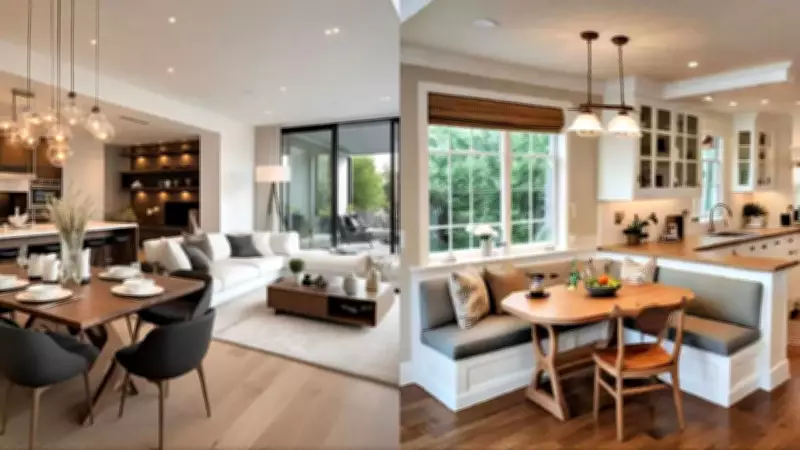
The Evolution of Home Design: From Open-Plan to Broken Plan Living
For decades, open-plan living has dominated modern home design, celebrated for its sociable atmosphere, abundant natural light, and seamless flow between kitchen, dining, and living areas. This architectural approach creates visually impressive, spacious environments where life unfolds without barriers. However, the reality of residing in one expansive room has exposed significant drawbacks that are now reshaping residential design globally.
The Limitations of Open-Plan Living
Noise travels freely across undivided spaces, creating acoustic challenges that disrupt concentration and relaxation. Work responsibilities bleed into personal time, while privacy becomes increasingly elusive, particularly for households navigating hybrid working arrangements and busier home lives. International design exhibitions are now reflecting this changing sentiment, showcasing layouts that prioritize thoughtful consideration, flexibility, and alignment with how people actually experience their living environments.
The Rise of Broken Plan Living
Broken plan living represents an evolution of the open-plan concept, introducing strategic partial divisions that create distinct functional zones without completely enclosing spaces. Designers employ partitions, floor-to-ceiling shelving units, and low-level dividers to segment larger rooms while preserving visual connectivity and movement flow. The result is a home where different areas develop their own identity and purpose without requiring traditional doors for separation, creating environments that feel connected yet organized rather than chaotic.

Sam Allen, Managing Director at Noisy&Co, a UK-based hybrid creative agency specializing in immersive brand experiences and exhibition design, draws insights from international shows to identify layout trends influencing UK homes. In an exclusive interview, he revealed, "Major design exhibitions demonstrate a strong appetite for spaces that both breathe and function effectively. Exhibition designers have long understood that spatial division profoundly impacts how people navigate environments and experience them emotionally. This sophisticated thinking is now meaningfully translating into residential design principles."
Zoning Strategies for Contemporary Life
Rather than allowing rooms to serve every purpose simultaneously, zoning introduces clear intentionality: specific corners designated for focused work, dedicated areas for relaxation, and defined spaces for social gathering. This approach borrows directly from exhibition design, where guiding visitors through environments in deliberate, considered sequences represents fundamental practice. Each zone develops a distinct purpose, atmosphere, and visual identity that differentiates it from adjacent areas.
"Exhibitions represent masterclasses in spatial storytelling," Sam explained. "Every section is meticulously designed to evoke specific emotional responses. When homeowners apply this level of intentionality to residential spaces, rooms become more purposeful and daily life becomes easier to manage effectively."
Research published in the journal Architecture supports this transition. Authors Elena Martínez and colleagues documented in their study, "Spatial Configuration, Sensory Load and Cognitive Performance in Open vs Partitioned Environments," that "Open-plan environments significantly increase sensory exposure, negatively impacting attentional control and perceived environmental comfort compared to partitioned layouts." This scientific investigation demonstrates measurable disadvantages of completely open designs, including noise propagation, distraction susceptibility, and sensory overstimulation, while providing empirical grounding for why zoning and partial divisions enhance usability and align with needs for focus, privacy, and functional separation.

The Resurgence of Privacy in Home Design
International design exhibitions clearly indicate a renewed desire for privacy within residential spaces. Quiet, enclosed areas like dedicated home offices, reading nooks, or simply rooms with functional doors are returning to homeowner wish lists and designer portfolios. The proliferation of hybrid working represents a significant contributing factor, as millions now spend substantial portions of their workweek at home where fully open layouts provide inadequate refuge for concentrated tasks.
Beyond practical considerations, there exists growing appreciation for spaces facilitating rest away from digital screens, auditory disturbances, and general household activity. "Privacy has evolved into a sought-after feature in contemporary home design," observed Sam. "We notice parallel trends at exhibitions where brands create immersive, enclosed environments recognizing that people crave moments of stillness and focused engagement. Residential architecture is beginning to reflect these same fundamental human needs."
A 2026 study published in the MDPI Architecture Journal provides scientific corroboration, noting that "Open-plan workplaces are often associated with increased sensory exposure... spatial configuration may influence perceived security and attentional states." Although focused on professional environments, this peer-reviewed research substantiates key arguments that open layouts amplify sensory overload and diminish concentration capacity, directly supporting shifts toward zoning, enclosure, and controlled environments in homes, especially with hybrid work becoming commonplace.
Multi-Functional Rooms with Defined Boundaries
Contemporary homes face unprecedented functional demands, with individual rooms often required to serve as home offices during daytime hours, dining spaces in evenings, and relaxed sitting areas on weekends. The design challenge involves making these multiple functions feel intentional rather than improvised through strategic furniture placement, area rugs, and layered lighting that signal transitions between zones, granting each activity its own territory without permanent structural modifications.
"The objective involves avoiding that disorienting sensation where everything occurs within one room yet nothing feels properly defined," Sam elaborated. "Exceptional design makes each space's purpose immediately apparent. When individuals enter an area, they should instinctively understand how it's intended to be utilized based on visual and spatial cues."
Research by Hiroshi Tanaka and Laura Bennett, published in the Journal of Interior Architecture and Spatial Design, documents this phenomenon: "Households increasingly adopt 'micro-zoning' strategies, creating distinct functional areas within previously open-plan interiors to accommodate work, rest and social activities." Their 2026 study introduces the precise concept of zoning within open spaces, connects this architectural shift directly to hybrid working patterns, and validates the effectiveness of multi-functional rooms with clear boundaries.
Flexible Dividers: Doors, Screens, and Partitions
International design exhibitions showcase increasing numbers of sliding doors, curtain panels, folding screens, and flexible partitions that offer something traditional open-plan layouts cannot provide: genuine choice. The ability to open spaces completely for Sunday family lunches then close sections for quiet Monday morning work represents, for many households, far more practical than fixed layouts in either direction.
Authors Sophie Dubois and colleagues established in an Environment and Behavior study that "A marked preference shift towards adaptable interiors with controllable boundaries reflects a growing need for privacy, autonomy and emotional regulation within the home." This research confirms privacy as a primary driver in modern home design, supports the proliferation of sliding doors, partitions, and flexible dividers, and demonstrates this represents a global behavioral shift rather than merely a passing design trend.
"Flexibility represents everything in contemporary design," Sam emphasized. "The most successful exhibition spaces we develop are those capable of transformation depending on immediate requirements. Homeowners are beginning to desire that same adaptability. It's fundamentally about possessing the capability to switch between open and closed configurations precisely when needed."
The Future of Residential Layouts
Open-plan living is not disappearing entirely but is no longer perceived as the universal solution for every home. What global design exhibitions demonstrate is that people increasingly seek balance in their living environments. They desire spaces capable of opening completely to breathe and facilitate connection, yet also closing off to provide focus and privacy when life demands it.
Sam Allen concluded, "The influence of exhibitions like Salone del Mobile matters profoundly because these events establish design agendas. Ideas showcased on those exhibition floors typically permeate residential spaces within several years. Currently, those ideas center on flexibility, intentionality, and recognizing the value of creating spaces that genuinely support how people actually live their daily lives."
For homeowners contemplating renovations or new builds, the message is straightforward and empowering: the optimal layout isn't necessarily the most open one, but rather the configuration that works most effectively for your specific household needs, routines, and lifestyle preferences.