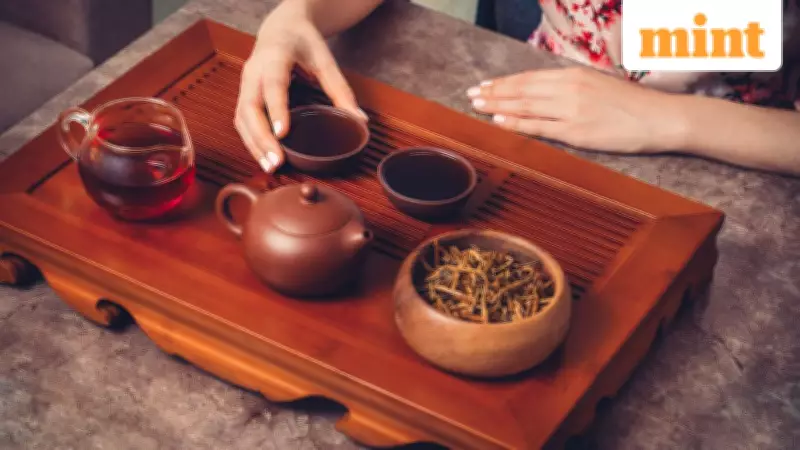
Rediscovering Black Tea Through Taiwan's Ruby Cultivar
Over the years, I have unconsciously built a mental map of tea, setting my preferences to Indian and south Asian black teas, Chinese whites, Taiwanese oolongs, and Japanese greens—perhaps even a Kenyan purple. This map is shaped by habit and familiarity. However, every now and then, a tea comes along that nudges those borders, as happened this week with a surprising discovery.
A Secret World of Taiwanese Black Teas
Some time ago, Taiwanese producer and exporter Sean Hsu Hao Sheng of Trilliant Tea sent me a few oolong samples. I reciprocated with some Indian black teas, and keeping the tea exchange going, he replied with Taiwanese black teas. More famous for its oolongs, these black teas felt like being let into a secret world. Among the teas I received, the Ruby black tea, Taiwan's most famous black tea, was one I was eager to try.
It is also known as Taiwan Tea #18, part of a numbering system that refers to cultivars developed by the Taiwanese Tea Research and Extension Station. The cultivar is called Red Jade and is indigenous to Taiwan, now protected. This unique origin adds to its allure and distinctiveness in the global tea market.

Tracing the History of Taiwanese Black Tea
Sean shared the story of Taiwanese black tea, tracing it back to older methods of tea processing described in the mid-19th century by Robert Fortune, the Scottish botanist who transported tea plants and knowledge from China to India. These steps, involving sun-withering, careful oxidation, repeated heating and rolling, shaped early black tea production. Over time, they evolved in India under colonial plantations and in China as well.
Interestingly, both black tea and oolong originated in Mount Wuyi in northern Fujian, sharing overlapping processes. In Taiwan, where tea-making styles were inherited from China, these processes evolved as tea makers and producers adapted and refined them. The development of new cultivars created a uniquely Taiwanese terroir and range. I had assumed oolong to be their prime representation of craftsmanship, but the black tea is not far behind and seems to be a style that is seeing growth.
Tasting the Ruby Black Tea: A Disarming Experience
The name 'Ruby' refers to the liquor, and it was indeed a deep, glowing ruby red in my cup. I brewed it as I do most black teas, western style, for six minutes in boiling water. The liquor was a rich red, and my first sip disarmed me. The color and the idea of a black tea had primed my mind and palate to expect maltiness and briskness.
It immediately felt different, not like Indian or Sri Lankan black teas. There was a pronounced woodiness, but it was more rounded and lighter too. Notably, it lacked that astringency which our teas are known for. Then there was the aftertaste, a lingering finish that I have come to expect in oolongs and was pleasantly met with here.
I had this tea a few times over the week, and each began with the same moment of confusion when my palate expected malt and bite, making me stop and turn my full attention to what I was tasting. It takes me a few sips before I settle to enjoy the pleasant woodiness. I still try to place it within a familiar spectrum. The Darjeeling autumn flush is mellow and woody, I think, but I do not believe they are similar. Unfortunately, I did not have a batch to compare both.
The Biggest Difference: Rich Flavor with Low Astringency
The biggest difference between the Ruby black and other black teas, says Sean, is in its rich flavor with low astringency, a factor he attributes to innovations upon traditions. For me, it served as a welcome reminder to keep an open mind and that an interesting cup of tea may well disorient you before it befriends you.
This experience highlights how tea cultures evolve and adapt, offering new perspectives and flavors. It encourages tea enthusiasts to explore beyond their usual preferences and embrace the diversity that the world of tea has to offer.