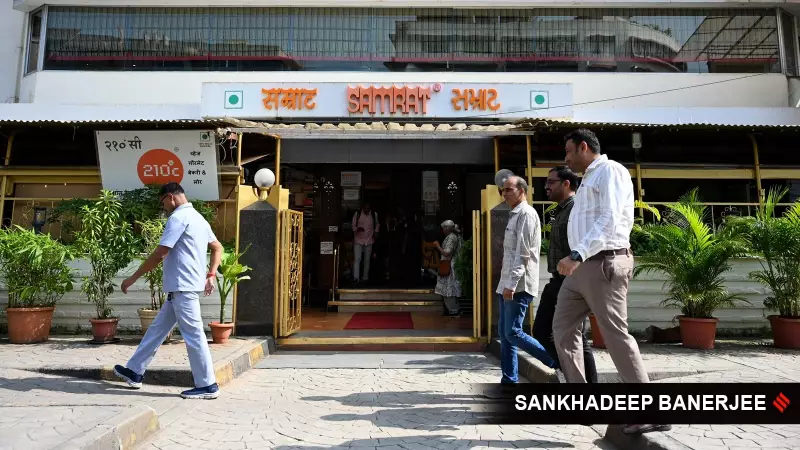
From Platform Canteen to Dining Institution
The story of one of Mumbai's most beloved vegetarian restaurants began not in a kitchen, but on a railway platform. In the 1940s, Gopichand Gupta arrived in Mumbai from Punjab seeking better opportunities and found himself running a canteen on Platform 2 of Grand Central Station, selling everything from samosas and chai to beedis and cigarettes.
When his eyesight began to fail him, Gopichand decided to switch to what he thought would be an easier business - a hair salon. He rented a shop from Venkatesh Krishna Kamat, who already had significant restaurant interests across the city, including the famous Satkar opposite Churchgate station. Being neighbors, the two men developed a friendship that would eventually lead to something much bigger.
The Birth of a Restaurant Empire
Gopichand floated an idea to his landlord and neighbor: "Let's start a restaurant together." Kamat agreed, and in 1972, four families - the Kamats, Shahs, Pais, and Guptas - joined forces to establish Samrat on Jamshedji Tata Road in Churchgate.

"I had failed my BSc final exam and my father said, 'It's alright, it is time to join the business,'" recalled Ishwar Gupta, Gopichand's son, who was 73 at the time of the original interview. They secured the premises in January and by October, they were operational with a 100-seater ground-floor restaurant serving thalis alongside Punjabi and South Indian fare.
Their market research had revealed a gap: there were only two air-conditioned restaurants offering Gujarati thalis - Purohit and Thackers. This insight helped them position Samrat perfectly to cater to the office crowd and local residents.
Building a Loyal Customer Base
The restaurant became an instant success. "We have had a solid customer base since day one," said Ishwar Gupta. "Our lunch crowd is mostly office-goers, and evenings see families dining in. Even today, about 70-75% of our lunch orders are thalis, and we sell between 300-700 thalis daily."
Ishwar chuckled while recalling the early management structure: "In the early days, there were 10-15 people on the management side alone because four families were involved!"
Having grown up managing the cash counter at his father's railway canteen, Ishwar was no stranger to the food business. "I sold chai for 10 paise and Charminar cigarettes for 15 paise. I remember on Budget Day, when the price rose to 17 paise, people cursed us!" he remembered fondly.
Expansion and Evolution
The success of Samrat led to further ventures. In 1974, the families launched Asiatic, which they later converted into a department store. By 1981, they added a 130-seater first floor at Samrat, and in 1983, they opened Status, another thali restaurant serving Punjabi and South Indian fare at Nariman Point to cater to the office crowd there.
Through the decades, Samrat has remained a Churchgate institution, weathering challenges including seven difficult years when Metro construction dug up the road outside, causing business to drop by 40%. "But this Diwali - our first after the Metro opened and construction barriers went off - was better than before," Ishwar noted.
The secret to their consistency? Daily presence and quality control. Ishwar continues to eat both meals at Samrat - chapatis and sabzis from the thali for lunch, and khichdi for dinner - to ensure the kitchen's quality remains intact.
The Next Generation Takes Over
When the new millennium arrived, a new generation stepped in. Ishwar's son Aditya Gupta, a hospitality graduate from Sophia Polytechnic, entered the business in 2001 and launched Relish, a multicuisine restaurant known for its sizzlers, platters, chocolate fondue, and chimichangas.
In 2012, the Gupta family - Ishwar, Aditya, and his younger brother Anuj - decided to branch out independently. "We started with Quattro, an Italian and Tex-Mex restaurant, in 2012, and then launched Spice Club, a modern Indian restaurant, in 2014," said Aditya.

Today, Quattro has outlets in Churchgate, Lower Parel, Juhu, and Breach Candy, while Spice Club operates in Chennai, Bengaluru, Kolkata, and Dubai. "There is a growing demand for vegetarian food, and we want to cater to it," said Aditya, adding that they're expanding to Pune and Belapur, with plans to open soon in Lonavala.
From a small railway canteen to a multi-restaurant empire, the Gupta family has built a lasting legacy in Mumbai's culinary landscape, proving that with the right recipe of quality, consistency, and adaptation, a simple thali can become an institution.