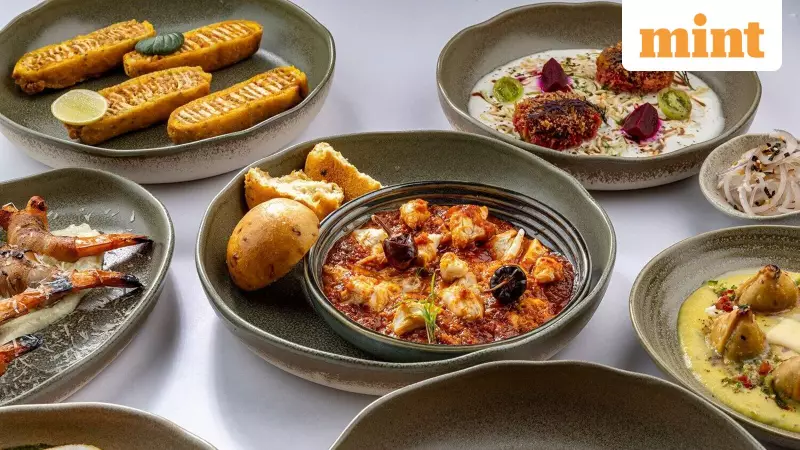
Nisaba Restaurant Opens at Humayun's Tomb Complex in Delhi
This weekend marks the opening of Nisaba, a new restaurant on the first floor of the Humayun's Tomb Museum Complex in Delhi. The facade blends seamlessly with the heritage precinct through its jaalis, sandstone elements, and careful play of light. Inside, minimalist interiors with sleek contours and clean lines ensure the food remains the star attraction.
A Space Anchored by Art and Mythology
A sculpture by artist Dhananjay Singh anchors the restaurant space. Known for his organic forms crafted from bronze and metal wire, Singh's work reflects nature's bounty. It also alludes to the restaurant's name, Nisaba, which references the Sumerian goddess of grain, nourishment, and writing.
This much-anticipated opening represents chef Manish Mehrotra's first restaurant under his own banner, Manish Mehrotra Culinary Arts (MMCA). Partners and entrepreneurs Amit Khanna and Binny Bansal back the venture.

Chef Mehrotra Starts with a Clean Slate
Many of Mehrotra's inventive creations from his years at Indian Accent have been widely imitated across the country. Dishes like blue cheese naan, pulled kathal taco, and besan laddoo tart inspired countless copies. His signature style of serving sorbets in pressure cookers also saw endless replication.
At Nisaba, Mehrotra begins with a fresh approach. "Here, you will find relatable comforting flavors—nothing is intimidating," says the chef. "This is an Indian menu for a global Indian."
The Menu: Familiar Flavors with Innovative Twists
The restaurant offers 42 dishes that create an interplay between the familiar and the innovative. Each creation contains details that touch upon personal memories. For instance, fried chironji in the baked rasmalai adds a crunchy texture that evokes nostalgic memories of grandmother's desserts.
Mehrotra introduces another layer of texture with nolen gur makhana. Regional flavors receive subtle elevation through creative interpretation. Mushroom chops, reminiscent of Bengali chop, come served on a bed of mushroom makhani. Stuffed sweet pepper brings zing to delicate chicken reshmi, Himachal gucchi, and shroom naan.
Traditional buknu, a spice mix from Uttar Pradesh homes valued for both flavor and medicinal properties, appears in samosas served with Moradabadi dal and "everything chutney."
"I don't want to label the food at Nisaba," Mehrotra explains. "We are not calling it modern Indian or regional Indian. Dining habits across the country have changed in the last 25 years—our menu seeks to represent that growth."
Reflecting the Evolution of Modern Indian Dining
In many ways, Nisaba represents the latest stage in the evolution of modern Indian fine dining. This journey began with bold experimentation, molecular gastronomy, and deconstructed dishes. Chef-led establishments like Indian Accent, Junoon by Vikas Khanna, Gaggan Anand's Bangkok restaurant, The Bombay Canteen, Masque, and Tresind Studio in Dubai followed.
These restaurants added sophisticated touches to regional flavors, bringing unique vocabulary and ideology to their menus. The current chapter shows increased maturity, driven by subtlety in approaching Indian cuisine.
Changing Dining Preferences
Raaj Sanghvi, CEO of culinary events and rating platform Culinary Culture, has noticed this shift. According to Sanghvi, diners no longer respond to theatrics or gimmicks. Today's innovation appears quieter, more confident, and firmly rooted in flavor, often marked by simple presentation.
"This is a conscious move away from the tasting-menu-only format that Manish helped popularise at Indian Accent," Sanghvi observes. "The focus now is on flexibility and allowing diners more choice in how they experience the food."
Delhi's Dining Scene Receives a Boost
Nisaba represents the first of several major restaurant launches expected in Delhi this year. Another significant opening will be Gaggan Anand's RaGa, scheduled for later in 2026. Both establishments bring renewed focus to Delhi as a serious dining destination.

Sanghvi notes that while Mumbai and Bengaluru pushed boundaries and built strong chef-driven dining cultures, Delhi's identity became overly dependent on legacy and hotel restaurants. "Manish's Nisaba and Gaggan's RaGa have the potential to decisively shift that balance back," he says.
"What makes it more significant is that both chefs could have chosen to open anywhere in the country, yet both have consciously chosen Delhi. That alone signals renewed confidence in the city as a serious dining destination."
Accessible Fine Dining
Both restaurants avoid labels like 'traditional' or 'formal' dining. According to Mehrotra, Nisaba occupies the space between casual and fine dining with accessible price points. Sanghvi notes that both Mehrotra and Anand, who once operated exclusively at the top of the dining pyramid, now recognize the most exciting opportunities lie in the middle ground.
"Indian diners have changed, palates have evolved and there is a growing preference for food that feels less formal, more relaxed and more fun," Sanghvi explains. "That said, both restaurants will still feature signature dishes like Gaggan's Yogurt Explosion and Manish's Dairy Dal. And honestly, thank god for that. Imagine going to a Rolling Stones concert and not hearing Satisfaction or Start Me Up!"
A New Chapter for Chef Mehrotra
For Mehrotra, Nisaba represents a whole new chapter in his culinary journey. He took a brief hiatus from professional kitchens in 2024 to spend time with his daughter, who had just completed class XII. During this period, he limited his social media presence, occasionally posting images from his terrace garden.
This pause prepared him for the next stage of his career. Once he finalized the restaurant concept, Mehrotra created 120 dishes for consideration. After numerous trials, he narrowed the selection to 42 dishes for the opening menu.
"But the ones that didn't make it to the launch menu are still being worked upon," he adds. "You will see an iteration of them later on."
A Culinary Journey Across India
The menu reads like a journey across India, featuring dishes like Madurai soy kola with sambar onion and crispy rice gunpowder, or beetroot goat cheese dahi vada with fresh green tomatoes and nutmeg miso rice. Mehrotra has focused on winter ingredients including Kashmiri haaq and turnips, and saag in a dish of jammy eggs, pine nuts, and makki ki roti.
Standout dishes include chilli tomato crab ghotala, claypot Motihari mutton with airy hing sattu kachoris, and mutton seekh kebab doused in blue cheese butter served with baked naan. The dessert section features house potato chips with chashni miso and vanilla bean ice cream—a playful take on chip and dip.
"How can a cuisine move forward if it does not adapt or progress?" Mehrotra asks. "Nisaba brings into focus that culture of care and honesty that accompanies Indian cooking from across regions."