8 Famous Foods That Aren't Actually From the Countries You Think
Food possesses a remarkable ability to adopt new identities across cultures. A culinary creation might begin in one nation, evolve through adaptation in another, and eventually become so deeply associated with its adopted home that its true origins fade from collective memory. Over centuries, migration, trade routes, and cultural exchanges have quietly reshaped recipes, ingredients, and cooking techniques. What starts as simple adaptation can gradually transform into cherished tradition. This is why numerous dishes we confidently link to specific countries actually carry far more complex and international histories. Behind their familiar names lie journeys across borders, through kitchens, and across generations, reminding us that cuisine rarely belongs exclusively to one place. It travels, transforms, and settles wherever people make their homes. Explore eight famous foods that are not actually from the countries you likely associate them with.
Chicken Tikka Masala
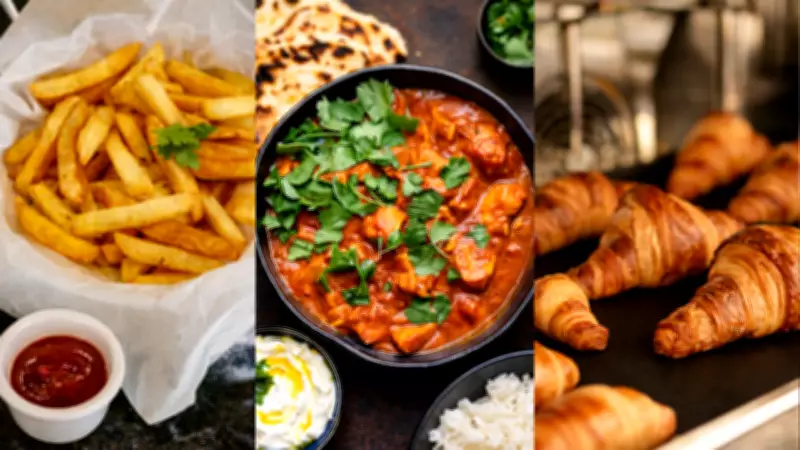
While it feels quintessentially Indian to many diners worldwide, chicken tikka masala is most commonly tied to Britain. Historical accounts note that one of the most accepted origin stories places its creation in Glasgow during the 1970s, where a Pakistani-Scottish chef reportedly added a creamy tomato-based sauce to traditional chicken tikka. The dish itself represents a beautiful blend of culinary influences: Indian-style grilled chicken paired with a rich, spiced tomato gravy that echoes the flavors of northern India's butter chicken. This makes it a classic example of how migration and cultural fusion actively reshape global cuisine.
Fortune Cookies
Fortune cookies are almost never what they appear to be at first glance. Research indicates they are not a Chinese invention at all, but rather "an American creation by way of Japan." Their roots trace back to Japanese confectionery traditions, which were later adapted in the United States and eventually incorporated into Chinese-American restaurant culture. The result stands as one of the most famous culinary misattributions in modern food history.

French Fries
Despite their name suggesting French origins, French fries are widely believed by historians to have originated in Belgium, not France. Experts often point to Belgian villagers who traditionally fried small fish and, when rivers froze during winter months, turned to frying sliced potatoes instead. Over time, these crispy potato strips spread across Europe and beyond, eventually acquiring the misleading "French" label while Belgium continues to claim them as a national culinary staple.
Croissants
The croissant may look and taste like Paris in pastry form, but its story actually begins in Austria. Culinary historians trace its origins to the kipferl, a crescent-shaped yeast roll known in Austria as early as the 13th century. French bakers later refined this pastry into the laminated, buttery version that eventually became a global breakfast icon, demonstrating how culinary techniques travel and evolve across borders.
Hamburgers
The hamburger stands as one of America's most recognizable and iconic foods, yet historical records suggest its roots probably arrived with 19th-century German immigrants. The name itself points back to the German city of Hamburg, and the sandwich-like patty eventually became so thoroughly American in the public imagination that its foreign beginnings largely disappeared behind diner counters and fast-food chains across the United States.
Caesar Salad
The Caesar salad has absolutely nothing to do with ancient Rome despite its imperial-sounding name. Historical accounts confirm it was invented in 1924 by Caesar Cardini, an Italian restaurateur working in Tijuana, Mexico. The creation story is deliciously accidental: a salad assembled from whatever ingredients were available at the time became a global classic, and the border town where it was born became an unexpected part of culinary history.

Doughnuts
Doughnuts may feel like an all-American comfort food, but their origins trace back to Dutch immigrants in 17th- and 18th-century New York. Their oily dough balls, known as olykoeks, served as the direct ancestor of the ring-shaped treat now found in bakeries from Boston to Bangkok, showing how immigrant communities shape national food identities.
Macarons
The delicate French macaron actually has an Italian backstory. Historical records indicate its ancestor was an almond cookie first made in Italy during the late 1400s and later brought to France in the early 16th century, likely through Catherine de' Medici's Italian cooks. While France perfected the form into the colorful, layered confection we know today, Italy helped start the entire story, highlighting how culinary traditions cross national boundaries.