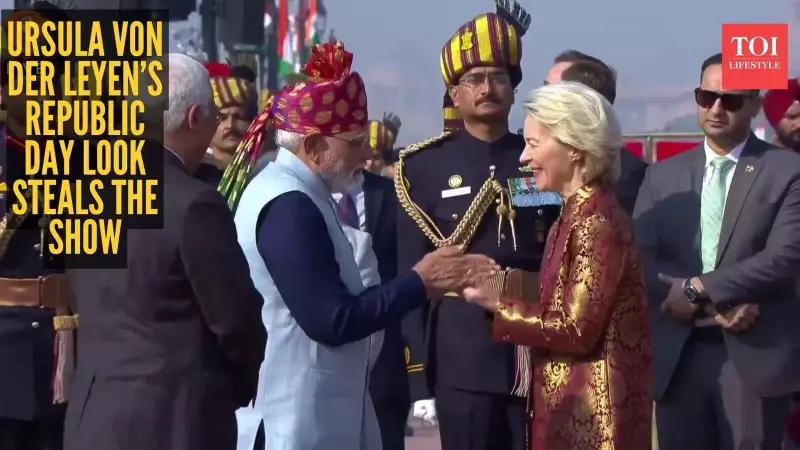
Republic Day 2026 unfolded with its characteristic grandeur, showcasing India's military might and cultural heritage on Kartavya Path. Amidst the precision of marching contingents and the roar of fighter jets, however, a subtle yet powerful fashion moment emerged, capturing attention and sparking conversations about diplomatic elegance.
A European Presence at India's Grand Parade
The 2026 Republic Day celebrations were marked by significant international participation, with India hosting two prominent European leaders as chief guests. Ursula von der Leyen, President of the European Commission, and António Luís Santos da Costa, President of the European Council, were on a state visit from January 25 to 27. Both dignitaries joined President Droupadi Murmu on the morning of January 26 to witness the spectacular parade, symbolizing strengthened India-EU relations.
Contrasting Styles on the Dais
While President Santos da Costa opted for a traditional, sharp dark suit appropriate for Delhi's winter morning, it was President von der Leyen who created a visual narrative through her attire. Her choice stood out not merely as a fashion statement but as a carefully considered gesture of cultural appreciation.

The Banarasi Silk Statement
Von der Leyen wore a striking high-collared jacket in a deep, rich maroon hue, adorned with intricate metallic gold detailing that caught the morning sunlight. Upon closer inspection, the garment revealed its true significance: it appeared to be crafted from authentic Banarasi silk, one of India's most celebrated and historically significant textiles.
The jacket featured elaborate zari work, with gold threads woven into dense, traditional floral patterns. This craftsmanship, characteristic of Banarasi weaving, gave the outfit an ornate yet refined quality. The ensemble was completed with crisp white trousers that provided a clean contrast, allowing the jacket to remain the focal point. Her accessories were minimal—small gold stud earrings that subtly echoed the gold elements of her jacket—creating an overall impression of sophisticated simplicity.
Fashion as Quiet Diplomacy
In an event steeped in national tradition and pride, von der Leyen's outfit served as a non-verbal communication of respect and connection. By choosing Banarasi silk, she acknowledged India's rich textile heritage, transforming her attire into a symbol of cross-cultural dialogue. This sartorial choice resonated as a gesture of thoughtfulness, demonstrating how fashion can bridge continents and convey mutual appreciation without words.
Military Collaboration and Symbolism
Beyond the fashion moment, the parade itself carried deeper geopolitical significance. For the first time, a contingent from the European Union marched alongside Indian armed forces, led by Colonel Frederik Simon Spruijt on a ceremonial Gypsy vehicle. This contingent represented the EU Military Staff, headed by Michiel van der Laan, highlighting growing defense and strategic cooperation between India and the European Union.
The Enduring Image
While the parade featured impressive military displays, cultural performances, and technological showcases, the most lingering visual for many observers was von der Leyen standing tall on Kartavya Path, wrapped in Indian silk. This image encapsulated how contemporary diplomacy often operates through nuanced gestures—where respect is woven into fabric, and connections are stitched across borders.
Fashion, in this context, did not need to be loud or flamboyant to make an impact. Instead, it told a quiet story of shared history, cultural exchange, and diplomatic warmth, proving that sometimes the most powerful statements are made without uttering a single word.