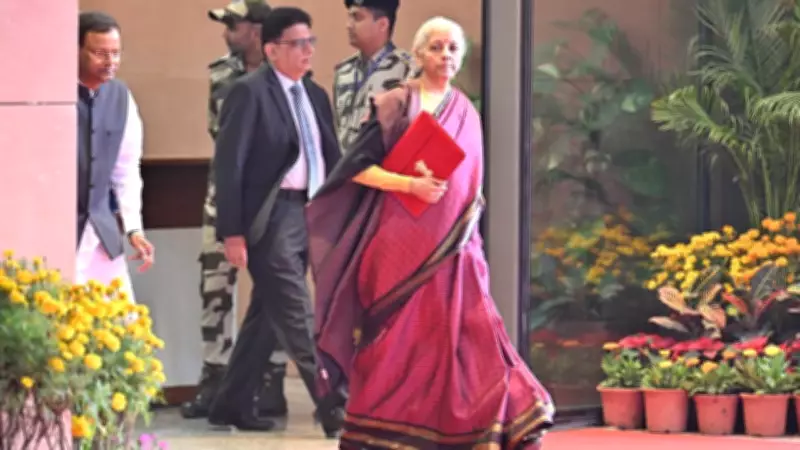
Budget 2026: Nirmala Sitharaman's Purple Saree Weaves History into Parliamentary Address
As Finance Minister Nirmala Sitharaman entered Parliament on February 1, 2026, to present the Union Budget, her attire captured national attention alongside fiscal announcements. The deep purple-magenta Kancheevaram silk saree, adorned with mustard-tinted checks and a coffee-brown border featuring fine thread embroidery, represented more than fashion—it embodied a 1,300-year-old weaving legacy from the Pallava dynasty. Paired with a bright yellow blouse and the traditional red-silk-wrapped Bahi-Khata, the ensemble projected dignified assurance, continuing Sitharaman's tradition of highlighting handloom heritage during budget presentations.
Centuries of Craftsmanship in Every Thread
Kancheevaram silk, originating from the temple town of Kanchipuram, is a textile tradition refined over generations through royal patronage and temple commissions. This weaving system, developed under the Pallava dynasty around 400 years ago as an artistic weave, emphasizes durability and sacred geometry inspired by South Indian architecture. Patterns often feature stepped temple gopurams as borders, lotus medallions in pallus, and repeating squares echoing stone carvings, preserved through family lineages and apprenticeship.
Key aspects of this legacy include:

- Oral instruction and mathematical precision in thread density, color proportion, and motif scale
- Use of natural dyes from roots, bark, and minerals for earthy, saturated tones
- Aesthetic principles of contrast, structure, and permanence over ornamentation
Sitharaman's 2026 saree, with its sober palette and architectural checks, functioned as a living artifact, carrying centuries of technique into modern governance.
Decoding the Design: Symbolism and Structure
The checked kattam pattern in Sitharaman's saree creates a rhythmic grid, reminiscent of a woven ledger, that tempers the intensity of purple with muted gold-brown checks. This design prevents darker shades from overwhelming the eye, lending architectural calm. The coffee-brown border, a hallmark of South Indian weaving where borders carry dense design work, grounded the garment with delicate thread motifs that catch subtle glints of light.
Purple, historically associated with dignity and authority in Indian textiles due to its expensive dyeing process, combined with mustard and brown to convey warmth and accessibility. This color choice aligns with Sitharaman's reputation for understated elegance, making a visual statement without overt political messaging.
Saree Diplomacy: A Visual Archive of India's Craft Heritage
Over successive budgets, Sitharaman has consistently spotlighted regional textile traditions, from Mangalgiri cotton to Bomkai silk, Ikat patterns, Kantha embroidery, and Madhubani-painted borders. This practice creates an annual visual archive of India's craft map, redirecting focus to weaver communities often overlooked. The approach is marked by restraint, emphasizing handmade heritage over mass-produced trends, and using texture and provenance as a softer language in political imagery.
- Continuity in showcasing local crafts on a global news cycle
- Elevation of artisanal labor in spaces dominated by economic discourse
- Subtle advocacy for sustainable and traditional practices
Art Before Arithmetic: Weaving Economy with Tradition
From an art-historical perspective, Sitharaman's Budget-day sarees serve as curated exhibitions, unveiling India's textile heritage under intense scrutiny. The 2026 Kancheevaram piece, with its geometry, weight, and disciplined border, represents labor measured in weeks, not minutes. It reminds viewers that economies are built not just from numbers but from skills and traditions passed through generations.
As cameras flashed during the budget presentation, the purple saree offered a visual argument for continuity and craft in an era of reform. In its folds lay a story older than the Budget itself—one spun on wooden looms, perfected over centuries, and shaping how India presents itself to the world through governance and heritage.