Raw Mango's London Fashion Week Debut Redefines Indian Design Philosophy
When Raw Mango unveiled its Fall/Winter 2026 collection, titled It's Not About The Flower, at London Fashion Week, the presentation transcended a mere international runway moment. The show felt profoundly personal, culturally resonant, and deeply anchored in the fabric of everyday South Asian life. For its inaugural appearance on such a prominent global fashion platform, the brand drew inspiration from an incredibly familiar yet often overlooked element: the garland.
The Garland as Emotional and Conceptual Foundation
In South Asia, garlands are ubiquitous, present in celebrations, rituals, mourning, devotion, and acts of welcome. Raw Mango transformed this everyday object into the emotional and conceptual starting point for the collection. The design philosophy shifted focus away from the singular beauty of an individual flower, redirecting attention toward the collective, arranged beauty of the garland itself. This exploration delved into the intricate space between ornamentation and identity.
Designer and founder Sanjay Garg elaborated on the collection's core idea. "Flowers remain an important part of South-East Asia and South Asia," Garg explained. "But we don’t really have a culture of giving one individual flower to someone, like, say, a rose on Valentine’s Day. As a culture, we are a country of garlands. Whether it’s a death, a birth, a wedding or a religious ritual, you see garlands, irrespective of the religion. It’s not about one individual flower; it’s about the plurality."

Challenging Stereotypes and Redefining Value
This central theme of plurality influenced every aspect of the collection, from garment silhouettes to narrative storytelling. The presentation moved beyond treating decoration as superficial embellishment, instead examining how adornment itself generates meaning. It provocatively questioned conventional values in fashion, asking whether the motif or the emotional resonance created by the arrangement of elements holds greater significance.
Showing at London Fashion Week also provided a strategic platform to confront enduring international perceptions of Indian fashion. Garg addressed the persistent stereotyping that boxes Indian design into categories of heavy embroidery and excessive embellishment. "There is still a strong association between Indian fashion and a certain kind of aesthetic - heavy gold embroidery, and maximalist ensembles that overwhelm the eye and the body with 'bling'," he noted. "Indian fashion is too often quantified – it's not seen for its innate aesthetic value, but the number of hours it took a weaver to create a garment. It’s a surface-level engagement that sometimes drowns out the beauty of the weave itself."
Garments as Sculptural Interpretations
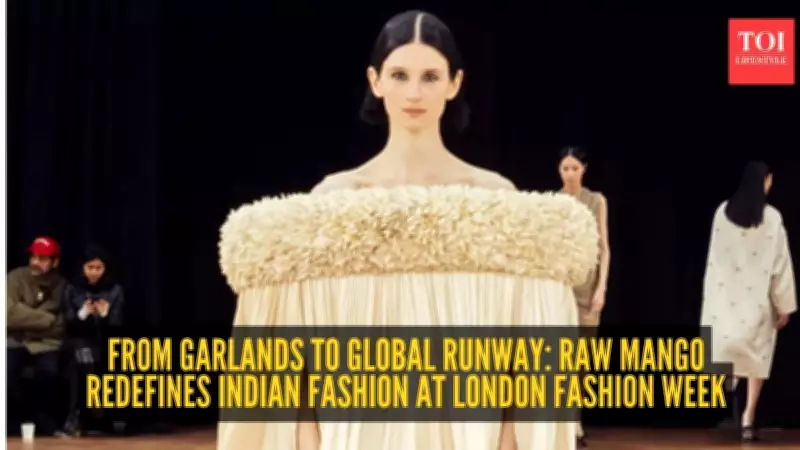
On the runway, the collection interpreted how a garland might naturally drape and rest on the human form. Florals were not presented as literal prints but as sculptural, three-dimensional elements. These were meticulously rolled, assembled, and hand-placed using innovative, silk-like fabrics. These artistic arrangements floated across a diverse textile landscape featuring:
- Lightly embroidered brocades
- Ribbed cotton knits
- Quilted rayon fabrics
- Wool felt materials
- Assorted soft textiles
The overall effect was a harmonious blend of nostalgic warmth and contemporary modernity.
A Diverse Audience and a Clear Design Vision
The show attracted a notably diverse audience from the worlds of art, culture, fashion, and business. Attendees included musician Anoushka Shankar, former UK First Lady Akshata Murty, filmmaker Gurinder Chadha, and artist Lubna Chowdhary. This eclectic mix was fitting for a collection that deliberately resisted easy categorization.

For Sanjay Garg, however, the geographical location of the show was secondary to the integrity of the work. Reflecting on the London presentation, he stated, "Presenting here is as good as presenting in Kanpur for me. At the end of the day, it is the work being presented that matters. And that doesn’t change according to who is viewing it, or where. I’m less interested in defining my audience and more interested in further exploring and articulating my design language that can cater to different audiences that transcends borders and seasons."
A Legacy of Craft and Contemporary Expression
This clarity of purpose has been the hallmark of Raw Mango for nearly two decades. The label has consistently built a vision of contemporary fashion upon a deep foundation of traditional textile knowledge. It approaches craft not as a relic of nostalgia but as a living, evolving language of expression.
The London presentation of It's Not About The Flower was supported by the De Beers Group, with Forevermark serving as the jewellery partner. In a powerful, understated manner, the collection served as a reminder that Indian fashion does not need to be loud or ostentatious to command attention. Sometimes, much like a garland, its true power and beauty lie in how individual, carefully considered elements come together—layered, collective, and profoundly human.