Queen Elizabeth II's Wardrobe: Seven Decades of Fashion as Soft Power
For seven remarkable decades, Queen Elizabeth II never chased fleeting trends. Instead, she cultivated a signature style that was instantly recognizable and uniquely her own. Through bright coats, show-stopping hats, sensible tweeds, and a rotating collection of Commonwealth-inspired emblems on silk, the Queen's wardrobe functioned as a meticulously managed instrument of soft power. A groundbreaking new exhibition at the King's Gallery in Buckingham Palace, commemorating the centenary of her birth on April 10, now places that iconic wardrobe under an unprecedented spotlight.
The Tweed and Tartan Skirt: A Symbol of Steadfast Leadership
Designed by the legendary Norman Hartnell and first worn in the 1950s, a Harris tweed jacket paired with a Balmoral Tartan skirt became the Queen's quintessential off-duty ensemble for decades. The practical fabrics were ideal for someone who spent significant time outdoors, but their selection was profoundly deliberate. Royal fashion commentator Marian Kwei describes this outfit as a powerful vehicle for promoting "British fashion, excellence, and production." The feminine cut and muted tones conveyed deep connotations of stability and dependability. As Kwei insightfully noted, the look communicated "I'm in charge" without the need for loud proclamations. Its enduring influence remains considerable, with Italian luxury label Miu Miu drawing direct inspiration from the Balmoral aesthetic for its 2024 collection.
The Coronation Dress: Embroidering a Reign
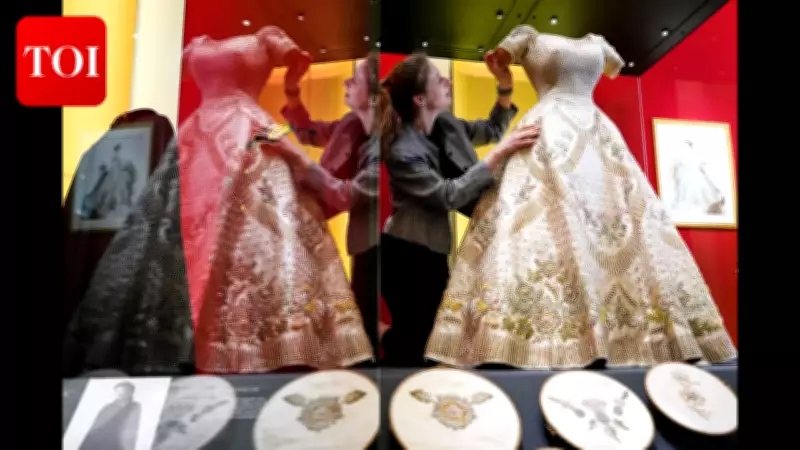
Also crafted by Norman Hartnell, the magnificent 1953 coronation gown was constructed from Kent-produced silk and adorned with gold bugle beads, diamantés, and pearls. However, its true significance resided in the intricate embroidery. The dress originally featured the floral emblems of all four United Kingdom nations. Upon reviewing Hartnell's eighth design, the Queen personally requested the addition of Commonwealth symbols. Consequently, England's Tudor rose, Scotland's thistle, the Welsh leek, and the Irish shamrock were joined by the Canadian maple leaf and India's lotus flower. Through this fabric, Marian Kwei asserts, the Queen was signaling precisely how she intended to reign—as a monarch for a global family of nations.

The Green Eisenhower Gown: A Diplomatic Gesture in Silk
In 1957, Queen Elizabeth II wore an elaborate, sleeveless apple-green gown by Hartnell to a pivotal state banquet honoring US President Dwight Eisenhower at the British Embassy in Washington. This visit aimed to fortify transatlantic relations during the tense Cold War era. While exhibition curator Caroline de Guitaut admits she cannot pinpoint a direct symbolic reference within the dress's design, Marian Kwei offers a compelling interpretation. She suggests the vibrant green hue itself was the message—a subtle echo of America's cultural associations with apples, from New York's "Big Apple" nickname to apple pie as a national symbol. The gown, Kwei explains, communicated to the room: "I'm Britain's sovereign, but I'm also nodding to you."
The Blue Bolero and Gown: Timeless Elegance on the Eve of Change
Worn at Princess Margaret's wedding in 1960, a stunning kingfisher-blue crinoline gown paired with a matching bolero jacket featuring exquisite guipure lace detailing possesses what curator Caroline de Guitaut describes as "an incredible timeless quality." The accompanying blue hat was adorned with three silk roses, believed to be a quiet tribute to "Margaret Rose," the bride's full name. This outfit also serves as a significant historical marker, representing the last instance a full-length dress was worn by a non-bride at a royal wedding. Britain stood on the precipice of the Swinging Sixties and the ensuing hemline revolution. As Marian Kwei observes, blue was evolving into a recurring choice for the Queen—a color perceived as calming, trustworthy, and diplomatically unobtrusive.

The Transparent Raincoat: Practical Communication and Evolving Style
A clear plastic raincoat from the 1960s, designed by Hardy Amies—who later costumed characters for Stanley Kubrick's 2001: A Space Odyssey—might appear unremarkable beside embroidered coronation gowns. Yet, it was a masterclass in practical communication. The Queen was renowned for her brightly colored coats, and this transparent raincoat ensured those vibrant hues remained visible in all weather conditions. As de Guitaut notes, even if you were standing ten people deep in a crowd, you could still see the Queen. This coat also exemplifies how Her Majesty tracked the spirit of the times without being defined by them.
- The 1940s saw the influence of Dior's cinched waist in her attire.
- The 1960s introduced shorter hemlines and bolder colors.
- The 1970s welcomed looser, more relaxed silhouettes.
Throughout all these stylistic shifts, the Queen's overall aesthetic remained, as de Guitaut eloquently summarizes, "very elegant, quintessentially British, and restrained." The exhibition Queen Elizabeth II: Her Life in Style runs at the King's Gallery, Buckingham Palace, from April 10, 2026, offering an unparalleled journey through a wardrobe that dressed a reign and defined an era.