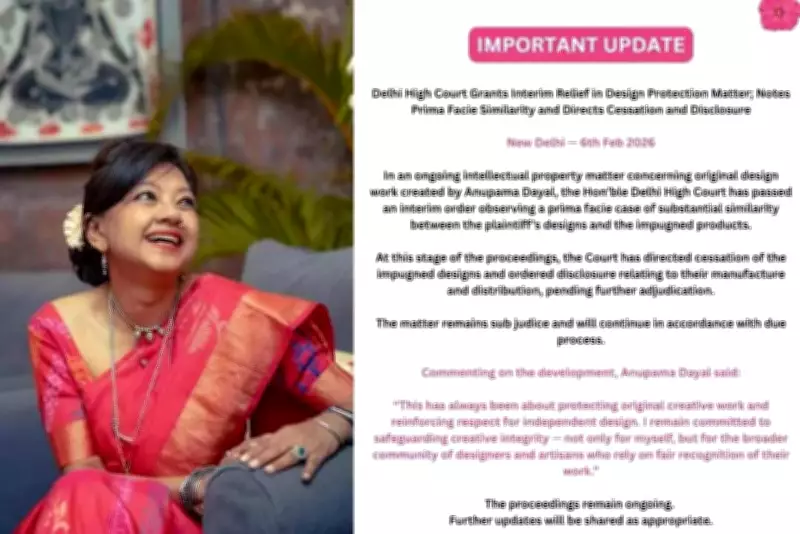
Delhi High Court Grants Interim Relief to Designer Anupama Dayal in Fashion Design Infringement Case
In a significant development with potential broader implications for the protection of original fashion design in India, the Delhi High Court has granted interim relief to renowned designer Anupama Dayal in a case concerning alleged infringement of her registered design work. The court's decision marks a pivotal moment in the ongoing battle for intellectual property rights within India's creative industries.
Court Orders Immediate Halt to Disputed Designs
Passing an interim order, the court observed that a prima facie case of substantial similarity appeared to exist between Dayal's original designs and the products manufactured and sold by the defendant. Based on this preliminary assessment, the court directed an immediate cessation of the sale, manufacture, and circulation of the disputed designs until further hearings can be conducted.
Beyond the restraining direction, the court issued a comprehensive disclosure order requiring the defendant to furnish complete details regarding the production chain of the contested items. This includes specific information about manufacturing units, suppliers, inventory levels, and distribution channels. Such disclosures are typically aimed at assessing the scale of alleged infringement and preventing further commercial exploitation while the case remains pending before the court.

Why This Ruling Matters for India's Creative Industries
Legal observers and fashion professionals are viewing this ruling as a significant moment for India's creative industries, particularly for independent designers who frequently struggle to enforce intellectual property rights in a market where copying and fast replication remain widespread concerns. Interim relief in intellectual property disputes is not granted lightly; courts generally require compelling evidence suggesting that the plaintiff's claim is credible and that irreparable harm could occur without immediate intervention.
By acknowledging the apparent similarity between the designs, the court has effectively recognized that this dispute raises serious legal questions deserving full trial consideration. The disclosure requirement represents another crucial aspect of this ruling. If the defendant's production and sales scale is found to be substantial, it could significantly influence future claims for damages, profits, or permanent injunctions.
Designer's Response: A Stand for Creative Integrity
Responding to the court order, Dayal framed the case as larger than a personal legal victory. "This has always been about protecting original creative work and reinforcing respect for independent design," she stated in an official statement. "I remain committed to safeguarding creative integrity, not only for myself, but for the broader community of designers and artisans who rely on fair recognition of their work."
Her remarks reflect a recurring concern among designers that intellectual property violations disproportionately harm smaller labels and artisan-linked production systems, where originality is closely tied to livelihood and economic survival. This case highlights the ongoing challenges faced by creative professionals in maintaining control over their original work.
Larger Industry Context and Implications
India's fashion sector has expanded rapidly over the past decade, driven by multiple factors including:
- E-commerce proliferation
- Social media visibility
- Growing domestic demand for fashion products
However, this remarkable growth has also intensified debates around copying, design ownership, and enforcement mechanisms. While copyright, trademark, and design laws exist in India, litigation in the fashion industry remains relatively limited due to several factors:

- High legal costs
- Extended litigation timelines
- Evidentiary complexity in design cases
As a result, interim injunctions like this one are often viewed as key tools in deterring imitation and protecting creative work. Industry insiders suggest this case could encourage more designers to formally register their work and pursue legal remedies when necessary. It may also push retailers and manufacturers to adopt stricter due diligence processes before producing design-led merchandise, potentially transforming industry practices.
What Happens Next in the Legal Proceedings
The matter will now proceed through subsequent hearings where both sides will present fuller arguments, evidence, and documentation. The interim order will remain in force unless modified by the court through further judicial review. Legal experts note that while interim relief does not determine final liability, it can strongly shape the trajectory of the case, particularly if disclosures reveal extensive commercial use of the disputed designs.
Further developments in the proceedings are expected in the coming months, and the ultimate outcome could serve as an important precedent in how India's courts approach design protection within the fashion industry and broader creative economy. This case represents a critical test of intellectual property enforcement mechanisms in India's rapidly evolving creative landscape.